How to Manage Security Across Multiple Payment Providers
See how payment orchestration creates a unified security layer across your stack.

Managing security across multiple payment providers requires a single control layer above all your PSPs, one set of fraud rules, one monitoring surface, and one reconciliation view. Without it, each new provider you integrate expands your attack surface independently, creating gaps that compound faster than any one team can close.
Most merchants add payment providers to gain flexibility. More PSPs, more acquirers, more local methods. Better coverage, better approval rates, fewer single points of failure.
The trade-off rarely shows up on a roadmap: each new provider you integrate expands your security surface. New endpoints. New webhooks. New fraud rules in a new dashboard. New reconciliation logic. New compliance scope.
By the time a merchant operates across four or five providers, security stops being a posture and starts being a patchwork. According to IBM's 2024 Cost of a Data Breach Report, the average breach in the financial sector now costs USD 6.08 million, 22% higher than the global average. And Verizon's 2024 Data Breach Investigations Report found that 15% of breaches involved a third party, including software supply chains and external providers, a figure that doubled to 30% in the 2025 edition. For merchants running fragmented payment stacks, the third party isn't theoretical. It is every PSP in the routing logic.
This article looks at why multi-provider environments create uneven security coverage, the three gaps that show up most often, and how a payment orchestration platform consolidates control before those gaps become vulnerabilities.

Why more providers create more risk
A single PSP is a single security model. One set of fraud rules. One reporting interface. One compliance certification to track. One incident response process to integrate with.
Add a second provider and you double the surface, not the protection. Each PSP applies its own fraud screening, exposes its own API endpoints, issues its own webhooks, and produces its own data format. Your team is now responsible for keeping rules aligned across two systems that were never designed to talk to each other.
By the fourth or fifth provider, the operational reality looks like this:
- Fraud thresholds set independently in each provider dashboard, with drift over time.
- Webhook endpoints that no one has audited in months.
- Reconciliation gaps where one provider's reporting cycle doesn't match another's.
- PCI DSS scope expanding silently with each new integration.
- Incident response slowed by the need to log into multiple systems before anyone has a complete picture.
The pace is the problem. The Verizon 2024 DBIR found that organisations take roughly 55 days to patch half of their known vulnerabilities, while attackers begin large-scale scanning for those same vulnerabilities within five days of disclosure. Multiply that gap across multiple PSP integrations and the exposure window compounds.

The three gaps that show up most often
1. Inconsistent fraud rules across providers
When fraud logic lives inside each PSP, rules drift. A velocity threshold tuned in Provider A six months ago doesn't match the one in Provider B that was tuned last week. Smart routing then sends a transaction through whichever provider is fastest, with no guarantee the fraud screening at that provider matches what your risk team approved. The same customer can be approved on one route and blocked on another, for reasons no one centrally controls.
2. Unmonitored provider endpoints
Every PSP integration adds API endpoints, webhook listeners, and authentication flows. Each becomes part of your attack surface. Teams typically harden their own platform, then trust the PSP to harden theirs, without a clear monitoring layer in between. Stale credentials, deprecated endpoints, and silent webhook failures sit in production for months.
3. Reconciliation blind spots
Security is partly an accounting discipline. If you can't reconcile transactions cleanly across providers, you can't tell whether a discrepancy is a settlement timing issue, a refund processed twice, or a fraud event slipping through unflagged. The Nilson Report's January 2026 update projects global card fraud losses to total USD 407.60 billion over the next ten years. Reconciliation gaps are where some of that loss hides, particularly in high-risk verticals where chargeback velocity is high and chargeback resolution windows are short.
How orchestration consolidates the security layer
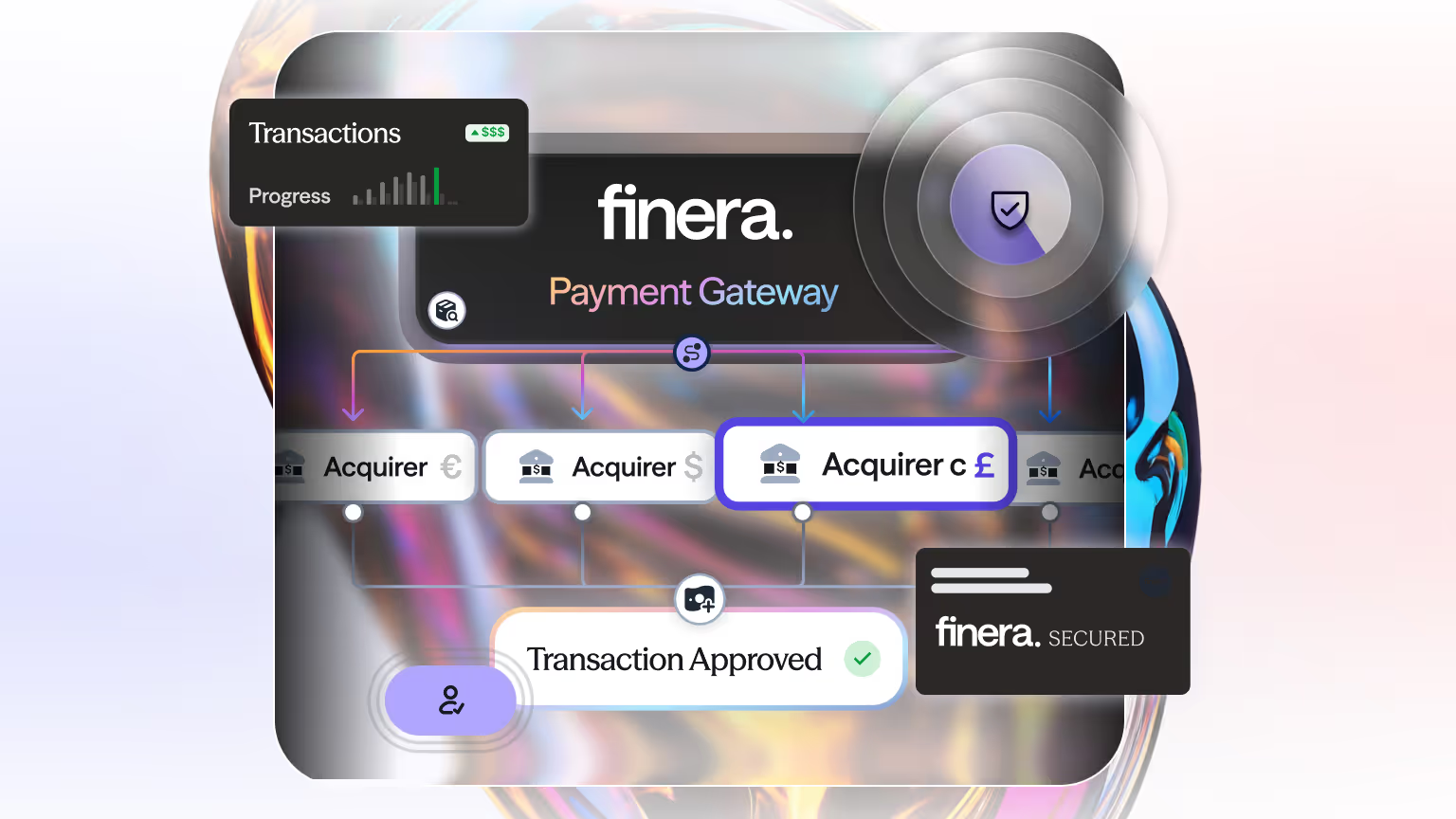
Payment orchestration sits above the PSPs. It's the layer that takes the transaction, applies rules, routes to the appropriate provider, and unifies the reporting back into one view.
For security, this matters in three ways.
One set of fraud rules, applied uniformly. Rules live in the orchestration layer, not in each PSP. With centralised fraud detection and risk management, approve and block decisions are consistent regardless of which provider ends up processing the transaction.
One control surface, not five. Webhook monitoring, endpoint auditing, credential rotation, and access logging are managed in one place. Security teams have a single dashboard to audit instead of one per provider, across cards, multi-currency payments, and the full global acquirer network.
One reconciliation view. Transactions, refunds, chargebacks, and settlements consolidate into a single ledger. Discrepancies surface faster, and fraud signals correlate across providers instead of sitting siloed in each.
This is what merchants mean when they describe orchestration as the unifying control layer. The PSPs continue to do their job. The orchestrator gives the merchant a coherent security posture across all of them.
Practical steps to take
If you're running more than two payment providers, the operational changes worth making this quarter:
- Audit your fraud rule inventory. Document every rule active in every PSP. Identify drift and overlap. Decide which should live at the orchestration layer instead.
- Map your endpoint surface. List every PSP API, webhook, and authentication flow your platform depends on. Confirm each is monitored and credentials rotate on a defined schedule.
- Centralise reconciliation reporting. If your finance team is opening multiple PSP dashboards each morning, that's a security signal as much as a finance one.
- Define a single incident response runbook that covers all providers, not one per PSP. The clock that matters during an incident is the clock from event to containment, not from event to logging into the right dashboard.
- Review PCI DSS scope with each new provider added. Scope expansion is often invisible until an audit forces the conversation.
The control layer is the security layer
Multi-provider strategies are correct. Coverage, redundancy, and approval rate optimisation all depend on running more than one PSP. The mistake is treating each provider as an isolated security domain.
Orchestration doesn't patch the gaps after they appear. It removes the conditions that create them.
At finera., we help merchants centralise payment operations through orchestration, giving them a single control layer across providers, fraud prevention, and reporting.
This article on payment security is for informational and educational purposes only.
- Not Professional Advice: The content provided does not constitute financial, legal, tax, or professional advice. Always consult with a qualified professional before making financial decisions.
- No Liability: The authors, contributors, and the publisher assume no liability for any loss, damage, or consequence whatsoever, whether direct or indirect, resulting from your reliance on or use of the information contained herein.
- Third-Party Risk: The discussion of specific payment services, platforms, or institutions is for illustration only. We do not endorse or guarantee the performance, security, or policies of any third-party service mentioned. Use all third-party services at your own risk.
- No Warranty: We make no warranty regarding the accuracy, completeness, or suitability of the information, which may become outdated over time.
.avif)
Frequently Asked Questions

Still Have Questions?
Let’s Find the Right Solution for You
Stay Connected with Us!
Follow us on social media to stay up to date with the latest news, updates, and exclusive insights!



.avif)