Security Layers in Modern Payment Stacks
A guide to layered payment security and why multiple protection layers are essential for merchants.
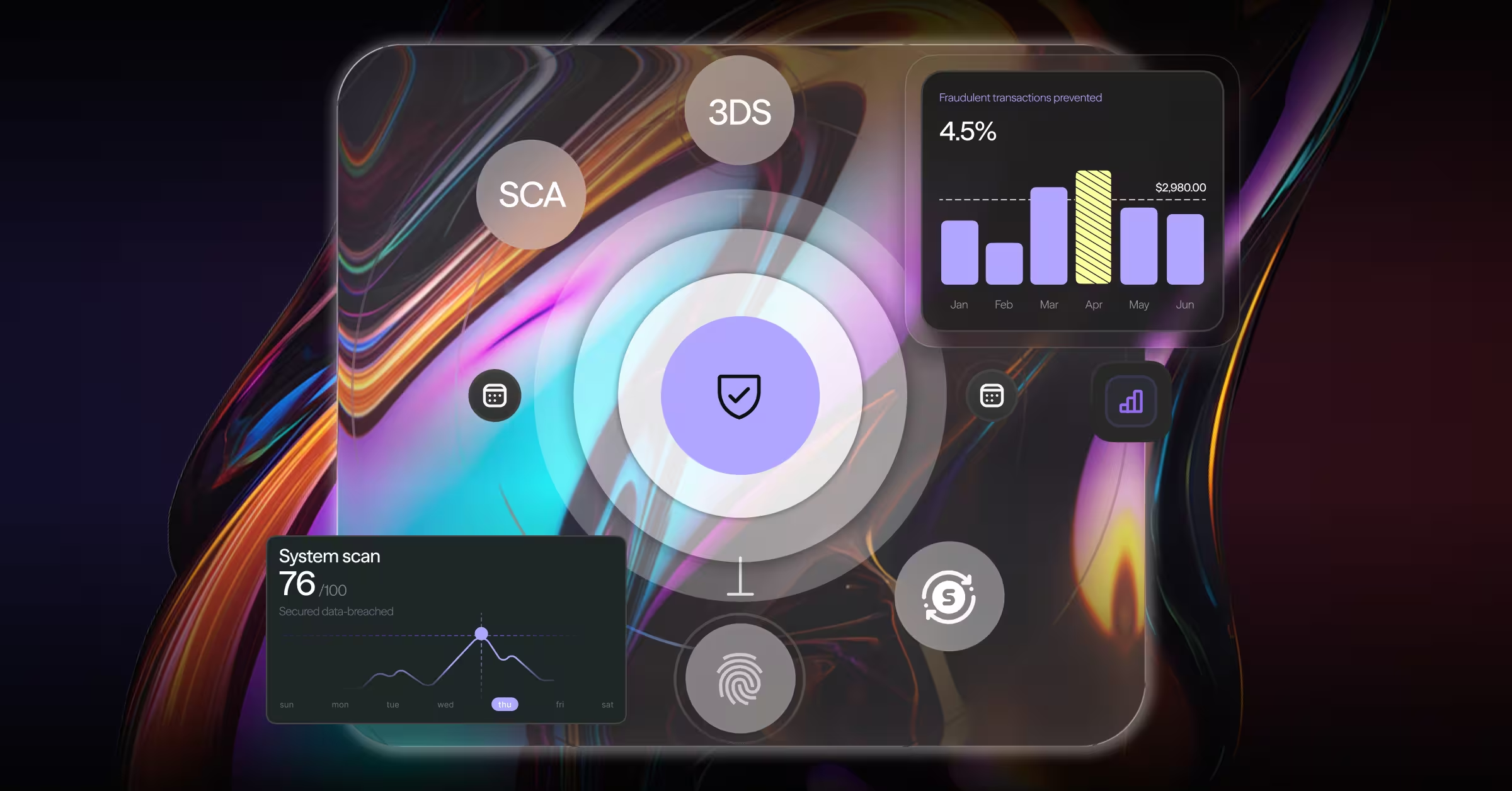
Payments sit at the centre of every digital business. They carry sensitive data, move funds across borders and directly impact customer trust.
Expanding payment ecosystems face growing risks from sophisticated fraud and evolving regulations, while customers demand both security and seamless experiences.
Modern payment systems have moved beyond single-measure protection, adopting instead a multi-faceted approach known as layered security.
Layered security means combining multiple protective mechanisms that work together across the entire payment journey. Each layer addresses a different type of risk, and together they create a stronger, more resilient system.
This strategy is increasingly important for merchants who are scaling their operations.
Key Takeaways
- Payment security is most effective when built as multiple layers, not a single solution.
- Each layer protects a different part of the transaction journey.
- Tokenisation and encryption secure sensitive data.
- Authentication and 3DS reduce fraud risk during checkout.
- Fraud monitoring adds real-time decision-making and control.
- More resilient systems tend to combine multiple layers into one cohesive strategy.
What Is Layered Security in Payments?
Layered security in payments refers to the use of multiple security mechanisms working together to protect transactions, data and users.
Instead of relying on one tool to stop fraud or protect data, businesses implement several safeguards at different stages of the payment process.
These layers typically include:
- Data protection (encryption and tokenisation).
- Customer authentication (such as 3D Secure).
- Fraud detection and monitoring.
- Transaction controls and routing logic.
Each layer addresses a different vulnerability. Together, they create a system where if one layer is bypassed, others still provide protection.

The Risks of Single-Layer Security
Relying on a single security measure may create risk.
For example, encryption alone protects data in transit, but it does not prevent fraudulent transactions. Authentication can verify a user, but it does not detect suspicious patterns across transactions.
Fraud today is multi-dimensional. Attackers may use stolen credentials, social engineering, or automated systems to bypass individual controls.
That is why security needs to be designed as a system.
Layered protection reduces dependency on any one control and increases the chances of detecting and preventing threats before they impact the business.
The Core Security Layers in a Modern Payment Stack
1. Encryption: Protecting Data in Transit
Encryption is one of the most fundamental security layers.
It ensures that sensitive data, such as card details or personal information, is securely transmitted between systems. Even if data is intercepted, it cannot be read without the correct decryption keys.
Encryption protects the movement of data, but it does not eliminate the need to store data securely.
2. Tokenisation: Protecting Sensitive Data at Rest
Tokenisation replaces sensitive data, such as card numbers, with a unique token.
This token has no meaningful value outside the payment system, reducing the risk of data exposure. Even if a database is compromised, tokens cannot be used to initiate fraudulent transactions.
For merchants, tokenisation reduces the scope of sensitive data handling and supports compliance requirements.
3. Authentication: Verifying the Customer
Authentication ensures that the person initiating the transaction is legitimate.
This can include:
- Passwords or PINs
- Biometric verification
- One-time passcodes
- Bank authentication through open banking
Authentication plays a critical role in preventing unauthorised access, especially in digital environments where physical verification is not possible.
4. 3D Secure (3DS): Adding an Extra Layer of Protection
3D Secure is a widely used authentication protocol in card payments.
It adds an additional verification step during checkout, often requiring the customer to confirm the transaction through their bank.
While 3DS can introduce friction in some cases, modern versions (such as 3DS2) are designed to balance security with user experience by applying risk-based authentication.
For merchants, 3DS can help improve transaction security and fraud prevention.
5. Fraud Monitoring: Detecting Risk in Real Time
Fraud monitoring systems analyse transaction behaviour to identify suspicious activity.
They look at factors such as:
- Transaction patterns.
- Device information.
- Geographic location.
- Velocity of transactions.
These systems operate in real time, allowing businesses to block, flag, or review transactions before they are processed.
Fraud monitoring adds intelligence to the payment process, enabling proactive risk management rather than reactive responses.
How Security Layers Work Together
The real strength of a payment security system comes from how these layers interact.
For example:
- Encryption protects data while it is transmitted.
- Tokenisation ensures data is safe when stored.
- Authentication confirms the identity of the user.
- 3DS adds an additional checkpoint for high-risk transactions.
- Fraud monitoring continuously evaluates behaviour.
Each layer supports the others.
If one control is bypassed, another may still detect or prevent the issue. This overlap is what makes layered security effective.
It also allows merchants to balance security and user experience. Not every transaction requires the same level of friction. With the right infrastructure, security measures can adapt based on risk.
The Role of Payment Infrastructure in Security
Managing increasingly complex payment systems makes governing these various security layers more difficult.
Fragmented security occurs when merchants lack a unified strategy for managing multiple providers, payment methods and regional needs.
Modern payment infrastructure is essential here.
Payment orchestration can help unify these security layers within one system, enabling merchants to apply rules more consistently across markets while monitoring risk and performance.
This makes security both scalable and effective.
Security and Customer Experience Work Together
One of the biggest challenges in payments is balancing security with user experience.
Too much friction can reduce conversion rates. Too little protection increases risk.
Layered security helps solve this by applying the right level of protection at the right time.
For example:
- Low-risk transactions can proceed with minimal friction.
- High-risk transactions trigger additional authentication.
- Suspicious behaviour is flagged without disrupting legitimate users.
This adaptive approach allows merchants to protect transactions without compromising the customer experience.
Strengthen your Payment Security with finera.
As payments continue to evolve, so do the risks.
Merchants that rely on isolated security tools may find themselves constantly reacting to new threats. Those that build layered security systems are better prepared to adapt.
The key takeaway is simple:
Security is not one solution. It is a system of interconnected layers working together.
At finera., we support merchants with payment orchestration technology and a full suite of payment solutions designed to integrate security, performance and scalability. By bringing together multiple payment methods, providers and security layers into one unified infrastructure, we help businesses operate with greater confidence.
If you are building or scaling your payment stack, contact the finera. team to explore how layered security can strengthen your payment infrastructure.
This article on payment security is for informational and educational purposes only.
- Not Professional Advice: The content provided does not constitute financial, legal, tax, or professional advice. Always consult with a qualified professional before making financial decisions.
- No Liability: The authors, contributors, and the publisher assume no liability for any loss, damage, or consequence whatsoever, whether direct or indirect, resulting from your reliance on or use of the information contained herein.
- Third-Party Risk: The discussion of specific payment services, platforms, or institutions is for illustration only. We do not endorse or guarantee the performance, security, or policies of any third-party service mentioned. Use all third-party services at your own risk.
- No Warranty: We make no warranty regarding the accuracy, completeness, or suitability of the information, which may become outdated over time.

Frequently Asked Questions

Still Have Questions?
Let’s Find the Right Solution for You
Stay Connected with Us!
Follow us on social media to stay up to date with the latest news, updates, and exclusive insights!


.avif)
.avif)