Insights with finera.'s Chief Product Officer: Designing Payment Infrastructure for Global Merchants
finera.'s CPO on why infrastructure-first thinking and orchestration are the new edge for growth.

For many merchants, payments begin as a technical requirement. Connect to a provider, process transactions and move on.
That approach may work when operating in a single market with a straightforward payment setup. However, global expansion introduces greater payment complexity, since entering new markets brings a variety of local currencies, payment methods, acquirers, regulatory landscapes and consumer expectations.
Today, payment infrastructure has become a strategic asset. It influences customer experience, approval rates, operational resilience and a merchant's ability to scale into new markets without rebuilding its payment stack.
To explore what modern payment infrastructure looks like, we spoke with Artur Savle, Chief Product Officer at finera.. With years of experience designing payment systems for global merchants, Artur shares why infrastructure-first thinking is becoming a competitive advantage and how payment orchestration is changing the way businesses approach payments.
Key Takeaways
Designing payment infrastructure for global merchants is no longer simply about connecting to multiple providers. It requires building flexibility into the foundation of the payment stack, enabling businesses to adapt as markets, technologies and customer expectations continue to change.
As Artur explains throughout the conversation, successful payment strategies increasingly focus on outcomes rather than integrations.
Merchants are no longer asking which provider they should connect to. They are asking how they can improve payment performance, support international growth and build infrastructure that remains resilient as their business evolves.
Payment orchestration makes that possible by bringing providers, payment methods and routing intelligence together within a single infrastructure layer. (New to the concept? Start with our primer on what payment orchestration is and why businesses need it.)
Meet Artur
As Chief Product Officer at finera., Artur leads the development of the company's payment orchestration platform, helping merchants simplify increasingly complex payment ecosystems through flexible infrastructure and intelligent payment technology.
His experience spans payment architecture, product strategy and global payment infrastructure, with a focus on building scalable systems that enable merchants to adapt as markets, customer expectations and payment technologies continue to evolve.
For Artur, successful payment products are not measured by the number of features they include, but by the business outcomes they enable.
"Designing for Global Merchants" Means Designing for Complexity
What does "designing for global merchants" actually mean?
"There is no single payment. Every market behaves differently, and payment infrastructure has to be designed with that variability in mind."
According to Artur, one of the biggest misconceptions about global payments is assuming that a payment is simply a payment.
"In reality, every transaction is influenced by geography, currency, card schemes, local payment methods, regulatory requirements and the characteristics of the provider processing that payment."
While domestic businesses can often operate successfully with a single payment provider, international merchants face a very different reality.
"As soon as you expand into multiple markets, you're managing different acquirers, regional payment preferences, licensing requirements and completely different payment behaviours. Infrastructure has to accommodate that complexity rather than expecting merchants to manage it manually."
Managing that variability well means supporting different acquirers across regions and the local payment methods customers actually expect at checkout. Rather than treating payment providers as fixed connections, Artur believes modern payment infrastructure should evaluate every transaction independently.
"The decision should not be 'Which provider did we integrate?' It should be 'Which provider is best suited for this transaction, under these specific conditions?'"
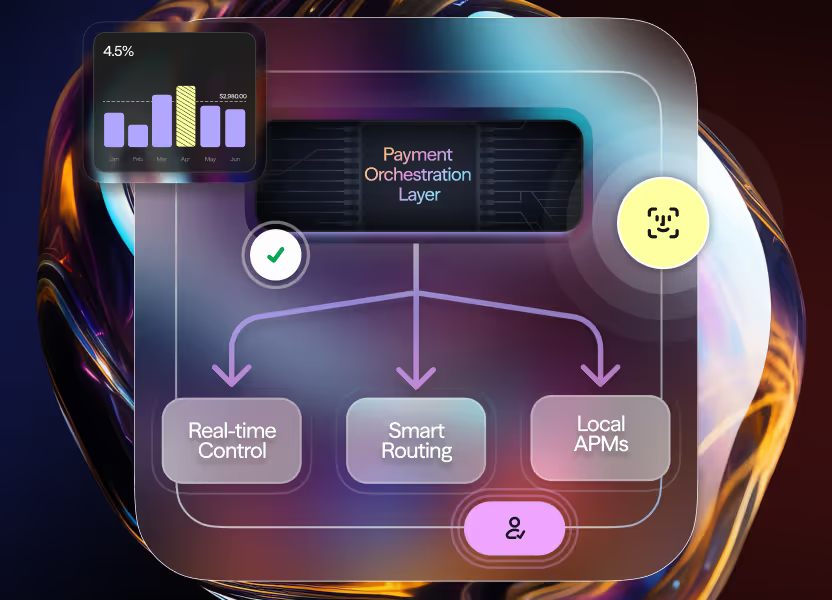
This philosophy sits at the heart of payment orchestration.
Through a single integration, merchants can connect to multiple providers while the orchestration layer manages the complexity behind the scenes, routing transactions intelligently and adapting to the requirements of each provider without adding operational overhead.
"Our goal is simple. Merchants integrate once, while the infrastructure manages the complexity underneath."
Why Merchants Often Underestimate Payment Infrastructure
What's the biggest mistake merchants make when building payment infrastructure?
Artur's answer is immediate.
"Treating payments as a feature rather than infrastructure."
He explains that many businesses naturally prioritise speed when launching.
"A merchant selects a provider, integrates directly and goes live. Initially, everything works exactly as expected."
The challenge appears later.
Businesses expand into new markets. Customer expectations change. Payment volumes increase. Providers introduce new requirements or shift their commercial priorities.
"What initially looked like a simple integration gradually becomes something much more deeply embedded throughout the organisation."
Changing providers no longer affects only the checkout experience.
It impacts settlement processes, reconciliation workflows, financial reporting and operational visibility across multiple teams.
"The real complexity isn't the integration itself. It's everything connected to it."
This is why Artur encourages businesses to think beyond today's requirements.
Infrastructure should not only support current operations. It should provide the flexibility to accommodate future providers, additional payment methods and new markets without requiring fundamental architectural changes. (For a breakdown of how these pieces fit together, see our guide to choosing the right payment stack: orchestrator vs gateway vs PSP.)
"Infrastructure should be designed for the second provider before the first one becomes a limitation."
That shift in thinking allows businesses to scale confidently instead of reacting to complexity after it has already emerged.
From Features to Outcomes: Why Payment Orchestration Changes the Conversation
How does payment orchestration change the conversation from features to outcomes?
Artur believes this is one of the biggest shifts taking place across the payments industry.
For years, merchants have approached payments by asking technical questions: ''Which payment provider should we integrate?"
"Which gateway should we use?"
"Which API gives us the features we need?"
While those questions remain important, Artur argues they focus on the wrong objective.
"The conversation shouldn't start with providers. It should start with outcomes."
Rather than evaluating payment infrastructure based on individual integrations, merchants should define the business results they want to achieve.
Do they want to improve approval rates? Expand into new markets more quickly? Increase operational resilience? Recover more soft declines? Reduce the effort required to manage multiple providers?
"Once those objectives become the priority, payment orchestration becomes the mechanism that helps achieve them."
Instead of treating each provider as a separate technical project, an orchestration layer continuously evaluates how payments are processed, selecting the most appropriate route for each transaction based on predefined business logic and real-time conditions.
This changes the role of payment providers within the payment stack.
"They're no longer individual integrations you become dependent on," Artur explains. "They become components within a broader infrastructure that's designed to deliver measurable business outcomes."
The result is greater flexibility. Merchants can introduce new providers, expand payment coverage or optimise routing strategies without redesigning their entire payment architecture.
"Merchants stop managing integrations and start managing payment performance."
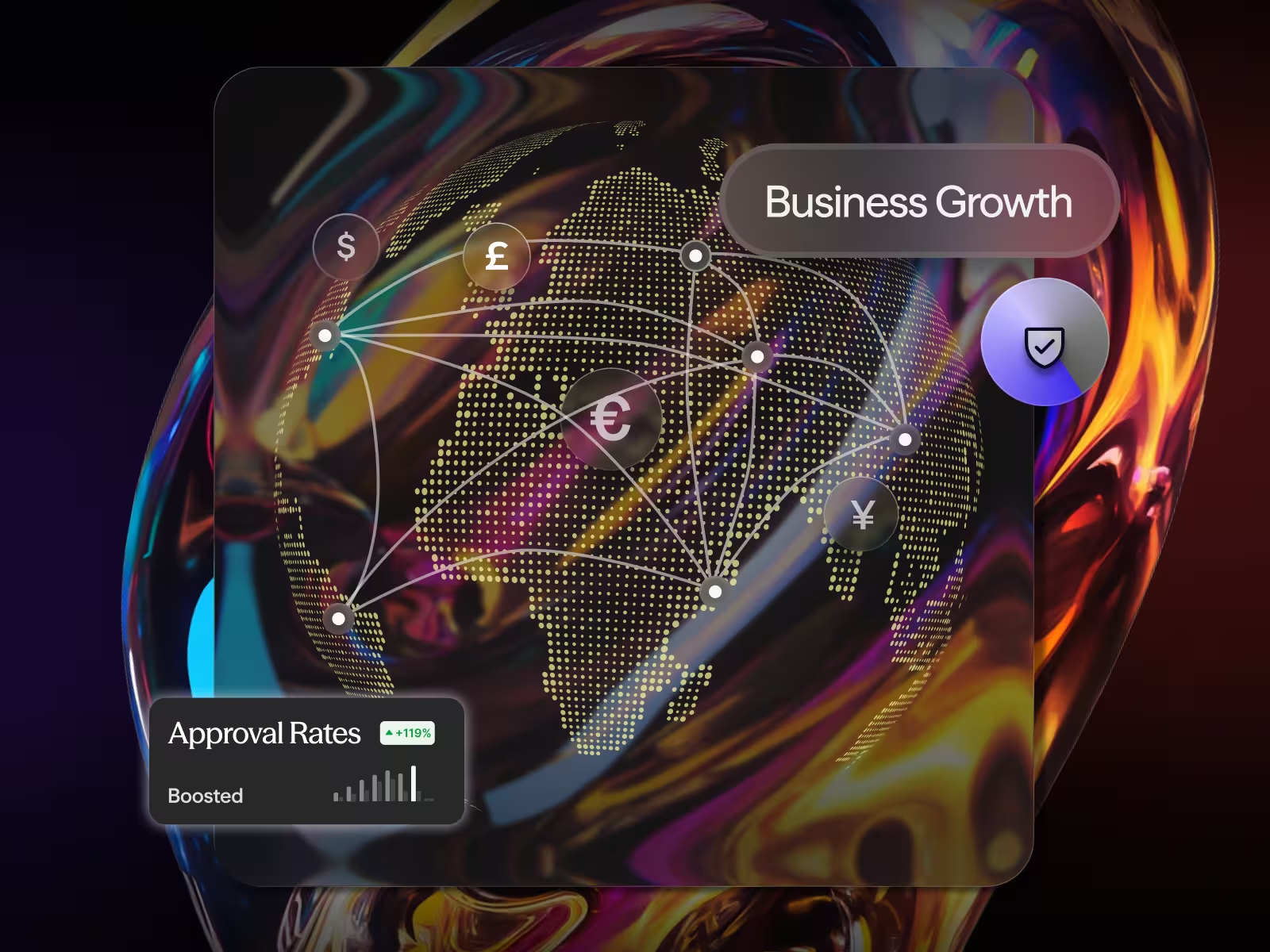
Why Payment Performance Has Become a Business Growth Strategy
How is payment performance transforming into a core strategy for business growth?
For Artur, the answer is surprisingly straightforward.
"Payment performance can directly affect revenue. For many businesses, it represents revenue they may not realise they're losing."
Every successful payment represents a customer who intended to complete a purchase.
When legitimate transactions fail unnecessarily, businesses are not simply processing fewer payments. They may also be losing customers who were ready to buy.
"Payment performance isn't just an operational metric anymore," Artur says. "It can directly influence customer experience, conversion and long-term growth."
Historically, payments were often viewed as back-office infrastructure, managed primarily by finance or operations teams.
Today, that perspective is changing. Leadership teams are increasingly recognising payment performance as a strategic business metric that deserves ongoing attention.
"Approval rates, resilience, provider performance and infrastructure flexibility can all influence commercial outcomes."
This is particularly true for businesses operating internationally, where payment behaviour varies significantly between markets and customer expectations continue to evolve. Serving customers in their local currency, for example, can be the difference between a completed checkout and an abandoned one.
"Customers don't separate your payment experience from your brand experience, they simply expect payments to work."
For that reason, payment performance has become something organisations actively optimise rather than simply monitor.
"It's becoming part of strategic planning rather than operational maintenance."

Where Payment Infrastructure Is Going Next
Where is payment infrastructure headed over the next 18 months?
Rather than predicting individual payment methods, Artur expects the industry's biggest changes to happen beneath the surface.
"The next phase isn't about adding more payment methods," he says. "It's about making payment infrastructure significantly more intelligent."
One of the clearest trends is the evolution of routing. Static routing rules are gradually giving way to systems capable of making increasingly dynamic decisions based on live payment performance.
"We're moving towards infrastructure that continuously evaluates provider health, approval performance and transaction outcomes, allowing routing decisions to become increasingly adaptive."
Another area receiving greater attention is payment data. Historically, much of the industry's innovation focused on authorisation while reconciliation and reporting were often treated as downstream processes.
Artur believes that approach is changing.
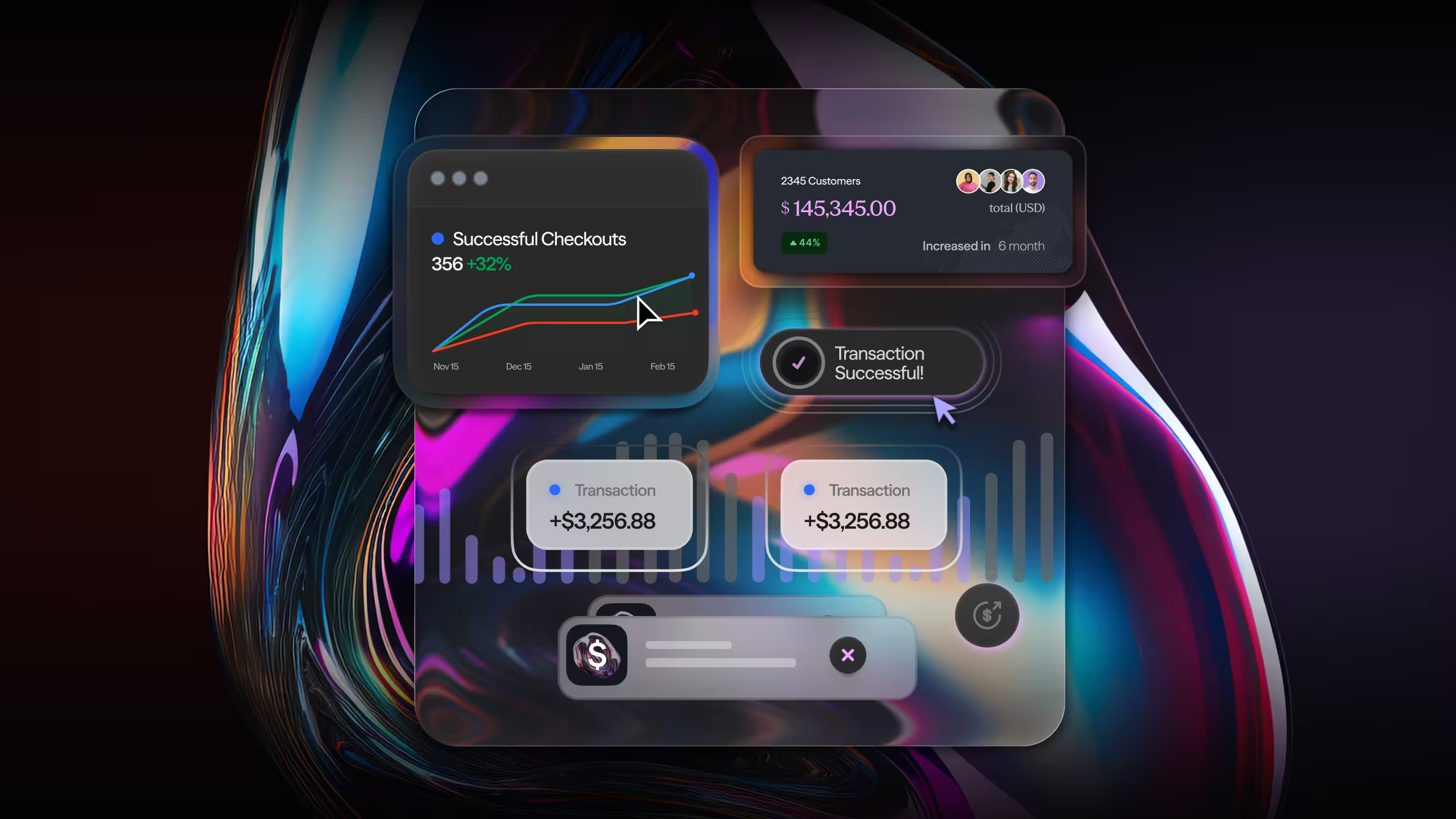
"Businesses need complete confidence in their transaction data from day one. Clean, reliable payment data isn't simply useful for reporting. It enables better operational decisions, stronger financial visibility and more effective payment optimisation."
That confidence depends on real-time analytics and reporting that give teams a single, trustworthy view of performance across every provider. Finally, he expects payment orchestration itself to become increasingly accessible. Capabilities that once required significant internal engineering investment are now being delivered through configurable, API-first platforms.
"The conversation is shifting from building payment infrastructure internally to adopting infrastructure that's already designed to scale."
For many organisations, this allows internal teams to focus on product innovation while relying on specialised payment infrastructure to manage increasing complexity. Despite the pace of technological change, Artur believes one principle remains constant.
"In our experience, businesses that treat payments as infrastructure rather than a feature tend to be better positioned to adapt as the industry evolves."
Building Payment Infrastructure for Long-Term Growth
As payment ecosystems become more connected and customer expectations continue to evolve, merchants need infrastructure that can adapt alongside their business.
At finera., we help businesses simplify payment complexity through a payment orchestration platform designed for flexibility, scalability and performance. By combining smart routing, multi-provider connectivity, local payment methods and real-time payment optimisation through a single integration, we aim to help merchants build payment infrastructure that can support growth across global markets.
Looking to strengthen your payment infrastructure? Talk to our team and discover how finera. can help you build payments that are ready for what's next.
This article on payments is for informational and educational purposes only.
- Not Professional Advice: The content provided does not constitute financial, legal, tax, or professional advice. Always consult with a qualified professional before making financial decisions.
- No Liability: The authors, contributors, and the publisher assume no liability for any loss, damage, or consequence whatsoever, whether direct or indirect, resulting from your reliance on or use of the information contained herein.
- Third-Party Risk: The discussion of specific payment services, platforms, or institutions is for illustration only. We do not endorse or guarantee the performance, security, or policies of any third party service mentioned. Use all third-party services at your own risk.
- No Warranty: We make no warranty regarding the accuracy, completeness, or suitability of the information, which may become outdated over time.

Frequently Asked Questions
Payment infrastructure refers to the technology, providers and systems that enable businesses to accept, process, route, reconcile and manage digital payments across different markets.
Global merchants operate across multiple payment ecosystems, each with different providers, payment methods and regulatory requirements. Flexible payment infrastructure helps manage this complexity while supporting international growth.
Payment orchestration is a modern strategy for routing transactions across providers, acquirers and methods using live data and intelligent logic. It’s a core service offered by the most scalable payment processing platforms today.
Payment performance can influence customer experience, successful transactions and revenue. As a result, many organisations now view payment optimisation as an important driver of long-term business growth rather than simply an operational function.

Still Have Questions?
Let’s Find the Right Solution for You
Stay Connected with Us!
Follow us on social media to stay up to date with the latest news, updates, and exclusive insights!