
The Payments Roadmap: A Conversation with Our Chief Product Officer
How payment orchestration and scalable infrastructure can shape the next phase of payments.
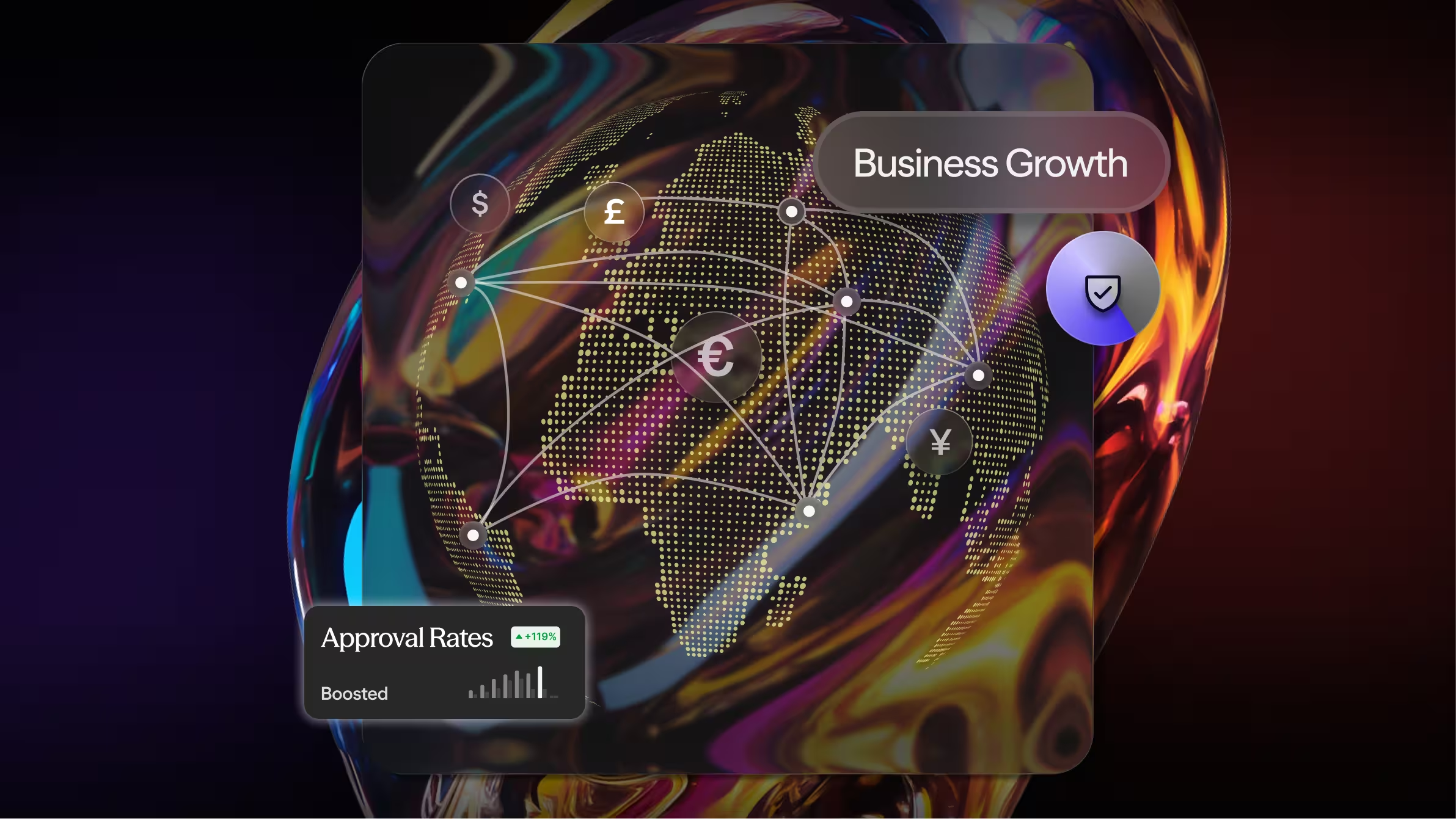
Payments are changing faster than ever. New regulations are being introduced across Europe, instant payments are expanding and merchants are under increasing pressure to offer faster, more flexible ways for customers to pay.
At the same time, payment infrastructure itself is becoming more complex. Companies are no longer integrating one or two payment methods. They are managing multiple processors, alternative payment methods, instant bank transfers and new technologies that are still emerging.
For product leaders, the big question is no longer how to add another payment method. It is how to design a payments system that can keep evolving without becoming harder to manage.
We spoke with finera.’s Chief Product Officer, Artur Savle, about why a clear payments roadmap matters today, what scalable payment infrastructure actually looks like in practice and what the next phase of payments might bring.

Why the Payments Roadmap Matters More Today
A few years ago, many companies treated payments as something they could simply add over time.
If a new payment method became popular, it could be integrated into the system. If a new market opened up, the same setup could often be reused.
That approach is becoming increasingly difficult.
“Three years ago you could get away with bolting on payment methods one by one,” our CPO explains. “Today that doesn’t really work anymore.”
New regulations, instant payment requirements and emerging schemes such as request-to-pay (SRTP) are changing the expectations placed on payment systems.
Merchants now expect a single integration that can handle multiple payment rails, markets and processors.
“If you don’t have a roadmap, you end up reacting to regulation instead of building ahead of it,” he says. “The companies that are doing well right now are the ones that planned their infrastructure well before the deadlines arrived.”
In other words, the difference between reacting and preparing often determines whether a payment system becomes an advantage or a bottleneck.
Defining a Scalable Payments Strategy
When people talk about scalable payment infrastructure, they often think about transaction volume. But according to our CPO, volume is only part of the story.
“The real challenge isn’t just processing more transactions,” Artur says. “It’s managing more complexity without your costs and development work growing at the same pace.”
A good payments product strategy starts with a simple question:
Can your platform support a new market, a new payment method, or a new processor without rewriting the core system?
If the answer is no, scaling becomes slow and expensive.
At finera., the goal is to avoid that situation by designing infrastructure that separates the core payment logic from market-specific configurations.
“We build once at the protocol level and configure it per client or partner,” he explains. “That allows the system to expand without constant redevelopment.”
This approach allows payment systems to grow in capability without becoming harder to maintain.

Why Expanding Into New Markets Is So Complex
Many companies assume that expanding payments into a new market will be relatively straightforward.
In practice, it rarely is.
“Every market looks simple from the outside,” our CPO says, “but the moment you start integrating, you realise how different things actually are.”
Each country may have different clearing systems, payment preferences, regulatory requirements and levels of instant payment adoption.
Even countries within the same payment scheme may be at very different stages of readiness.
“The biggest mistake companies make is treating expansion like a copy-and-paste exercise,” he explains.
Instead of replicating the same setup everywhere, companies should have an adaptable infrastructure that can adjust to local conditions.
“The right model is an adaptable core with market-specific adapters. That way you’re not rebuilding the system for every new country.”
What Payment Orchestration Technology Makes Possible
As payment ecosystems become more complex, many businesses are turning to payment orchestration technology.
Traditional payment infrastructure tends to rely on direct integrations. A merchant connects to a processor, then another one, then another payment method.
Over time this creates a web of integrations that becomes difficult to manage.
“Traditional setups are very point-to-point,” our CPO explains. “One integration for each processor, each method, each market.”
Payment orchestration changes this model.
“It introduces a control layer that allows intelligent routing, fallback logic and the ability to add new payment rails without changing the merchant-facing integration.”
In practical terms, this means merchants can integrate once while the orchestration layer decides how transactions should be routed.
“A merchant integrates once and we determine whether that transaction flows through cards, alternative payment methods, or other payment rails,” he says. “The system chooses the optimal path based on cost, speed and availability.”
This flexibility becomes especially valuable as payment ecosystems continue to evolve.
From Integrations to Platforms: Rethinking Payment Infrastructure
Despite the increasing importance of payment infrastructure, many organisations still build their systems based on current needs rather than future complexity.
“The biggest mistake I see is companies designing their payments stack for the three or four payment methods they support today,” our CPO says.
That approach works initially but may create problems later.
When new payment solutions appear or when the business expands into new regions, the system may require major changes.
“They hit a wall when they need to add instant payments, request-to-pay systems, or expand geographically,” he explains.
Another challenge is the way new payment networks grow.
Many emerging schemes depend on both merchants and financial institutions joining the network before they deliver real value.
“There’s a chicken-and-egg dynamic with new payment networks,” he says. “You need both sides to participate.”
That is why modern payment infrastructure increasingly should function as a platform rather than a collection of separate integrations.
What the Future of Payments Might Look Like
Looking ahead to 2026, several developments are likely to shape the next phase of payments.
The European Instant Payments Regulation will be fully implemented, making instant transfers more widely available across the region.
At the same time, request-to-pay systems are expected to expand, particularly in Central Europe.
“Request-to-pay introduces a new communication layer before the payment itself,” our CPO explains. “It changes how merchants and customers interact around payments.”
Another emerging concept is agentic payments.
These are AI-driven systems capable of initiating and managing transactions automatically on behalf of businesses or users.
“Agentic payments are beginning to appear,” he says. “AI systems that can initiate, approve and reconcile payments.”
This suggests a broader shift in how payments are understood.
“Payments aren’t just transactions anymore,” he explains. “They’re becoming conversations and increasingly those conversations happen between machines.”
Companies that treat the interaction around a payment as part of the product experience may define the next phase of digital commerce.
Preparing for the Next Era of Payments
Payments influence customer experience, operational efficiency and how easily businesses can expand into new markets.
With evolving technologies, companies should prioritise building adaptable payment infrastructure over adding individual methods.
At finera., we help businesses prepare for this future with flexible payment infrastructure, including payment orchestration technology, card processing, crypto processing and alternative payment methods.
Our goal is to give merchants the flexibility and freedom to expand across markets while maintaining visibility and control over their payments.
If you are planning the next stage of your payments roadmap, contact the finera. team to explore how scalable payment infrastructure can support your growth.
This article on payment methods is for informational and educational purposes only.
- Not Professional Advice: The content provided does not constitute financial, legal, tax, or professional advice. Always consult with a qualified professional before making financial decisions.
- No Liability: The authors, contributors, and the publisher assume no liability for any loss, damage, or consequence whatsoever, whether direct or indirect, resulting from your reliance on or use of the information contained herein.
- Third-Party Risk: The discussion of specific payment services, platforms, or institutions is for illustration only. We do not endorse or guarantee the performance, security, or policies of any third-party service mentioned. Use all third-party services at your own risk.
- No Warranty: We make no warranty regarding the accuracy, completeness, or suitability of the information, which may become outdated over time.

Frequently Asked Questions

Still Have Questions?
Let’s Find the Right Solution for You
Stay Connected with Us!
Follow us on social media to stay up to date with the latest news, updates, and exclusive insights!


-thumbnail.avif)
.avif)