Choosing the Right Payment Stack: Orchestrator vs Gateway vs PSP
Gateway vs PSP vs orchestrator: what each does, how they compare, and which payment stack fits your business.
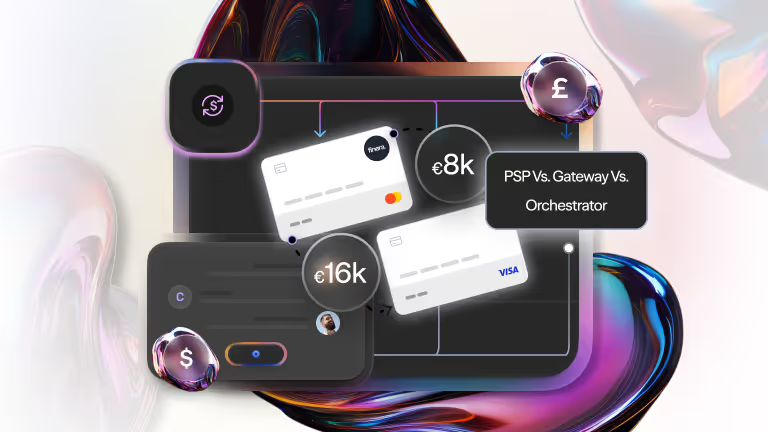
Choosing the right payment stack can make or break your growth strategy. If you are expanding into new markets or optimising performance across regions, your payments setup plays a critical role in how efficiently you operate and how many transactions you convert. With terms like payment gateway, PSP and payment orchestrator often used interchangeably, it's easy to overlook their differences. But understanding what each does (and doesn't do) is key to building infrastructure that supports your business today and scales with you tomorrow.
Without the right stack, the risks are higher declines, rigid routing and limited control over cost and performance, and each of those can erode revenue over time. The rest of this guide explains each layer, compares them side by side, and helps you decide which fits your stage of growth.
Payment Gateway vs PSP vs Payment Orchestrator: What's the Difference?
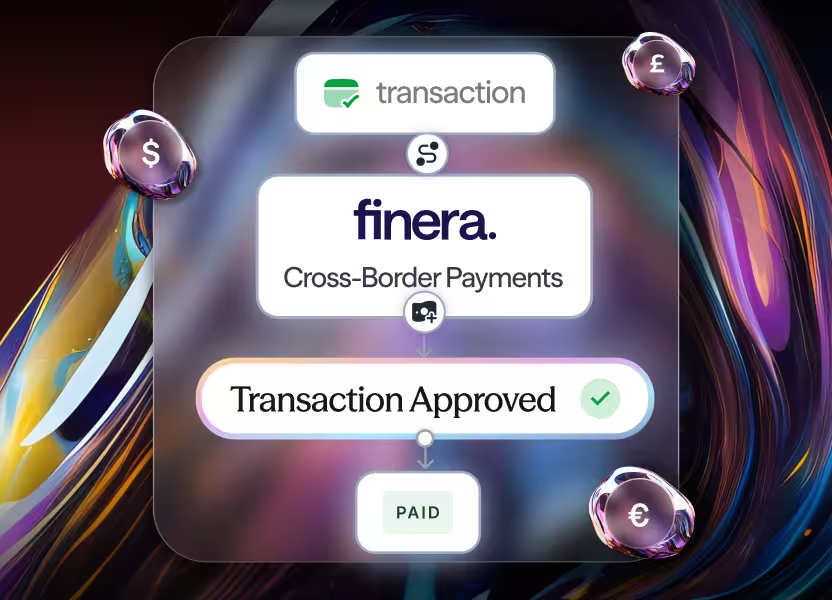
A PSP and a payment gateway are related but not the same: a gateway simply transmits transaction data to a processor, while a PSP bundles that gateway function together with acquiring, fraud tools and merchant account services. A payment orchestrator sits above both, coordinating multiple PSPs and gateways so a business is not tied to any single provider.
Payment Gateway
A payment gateway is the basic software layer that connects your platform to an acquirer. It handles the authorisation of card payments and supports some local methods. Gateways are straightforward to integrate and well suited to small, single-market merchants. The trade-off is that they are usually tied to a single processor and offer little flexibility in routing, optimisation or redundancy.
Payment Service Provider (PSP)
A payment service provider packages the gateway, acquiring, fraud tools and merchant account services into one platform. PSPs simplify setup and compliance, which makes them an attractive choice for SMBs and startups that want to launch quickly. The compliance side matters here, since card handling falls under the PCI DSS standard and authentication under schemes such as 3D Secure. The limitation is that PSPs often tie a merchant to a single provider's infrastructure, which can constrain customisation and performance optimisation as volumes grow.
Payment Orchestrator
A payment orchestrator sits on top of multiple PSPs, gateways and acquirers, acting as a central control layer. Also known as a payment orchestration platform, it provides access to many payment providers and methods through one unified API. With smart routing, failover, multi-currency settlement and configurable logic built in, orchestration offers a high degree of flexibility and scalability. It's also called a multi-PSP orchestration layer or payment orchestration middleware. For a deeper explanation, see finera.'s guide to what payment orchestration is and how it works.
Payment Gateway vs PSP vs Orchestrator: A Quick Comparison
Each layer offers a different balance of simplicity, flexibility and control. The table below sets out how they compare.
A gateway is the simplest to integrate but the least flexible. A PSP goes further by bundling functionality, which suits fast-moving businesses that want to launch without juggling multiple contracts, but it can lock merchants into one ecosystem and limit visibility into performance. An orchestrator is built for scale and complexity, connecting multiple providers and letting a business customise logic by geography, card type or transaction behaviour. For platforms operating across borders or at volume, orchestration tends to offer the depth today's commerce demands.
Why Are Businesses Running Multi-PSP Setups?
Relying on a single payment service provider works well until a business starts to scale. As transaction volumes grow, so do the reasons to bring a second or third PSP into the stack.
Regional acquiring is often the first driver. A PSP that performs well in one market may not have strong local acquiring relationships elsewhere, and routing transactions through a local provider can improve authorisation rates and reduce currency conversion costs. Negotiating leverage follows closely behind: with more than one PSP live, a business is in a stronger position to negotiate processing rates, since no single provider holds all of the volume.
Redundancy is another common reason. A PSP outage that stops payments from processing can be costly, and having a second provider ready to take over means a single provider's downtime doesn't have to mean lost revenue. This is closely tied to avoiding a single point of failure more broadly: any setup that depends entirely on one PSP, one acquirer or one integration carries a concentration risk that a multi-PSP strategy is designed to reduce.
The complication is that running multiple PSPs manually, each with its own dashboard, reporting format and routing logic, quickly becomes its own operational burden. That is the problem multi-PSP payment gateway software and orchestration platforms exist to solve, which is where the next section picks up.
Multi-PSP vs Payment Orchestrator: Are They Alternatives?
Framing multi-PSP and payment orchestration as competing choices is a common mix-up, but they answer different questions. A multi-PSP strategy describes what a business has, multiple providers connected to its checkout. Payment orchestration describes how those providers are coordinated. One is not a substitute for the other.
In practice, most businesses that compare multi-PSP and payment orchestration are really asking whether they need a coordination layer once they've already added a second or third PSP. Without one, someone still has to decide, manually or through custom code, which provider handles which transaction, what happens when one goes down, and how performance is reported across all of them. An orchestration layer is what takes on that coordination, applying routing logic, failover and consolidated reporting across the PSPs a business already has.
So the honest answer to "multi-PSP or payment orchestrator" is that the question doesn't quite hold together: running multiple PSPs is the condition, and orchestration is the layer built to manage that condition well. Businesses that skip it don't avoid the complexity of a multi-PSP setup, they just carry it internally instead of handing it to a platform designed for the job.
PSP Failover and Redundancy
If a primary acquirer experiences downtime or underperforms, smart routing enables instant fallback to another provider, often very quickly.This kind of real-time failover helps support checkout reliability, which can be particularly valuable SaaS subscriptions, marketplaces and high-volume platforms.
Failover is typically triggered by one of a few conditions: a provider returning an outage or timeout, a soft decline that suggests a temporary issue rather than a genuine refusal, or performance dropping below a set threshold for approval rates. Rather than waiting for a full outage before acting, well-configured routing can treat early signs of degraded performance as a reason to shift volume elsewhere.
Failover isn't limited to switching between different providers. Many platforms also support same-provider, multi-MID failover, cascading a transaction across several merchant IDs held with the same PSP. This can help where a single MID hits a risk threshold or processing limit, without needing a second provider relationship at all.
One detail that's easy to overlook is authentication continuity. When a transaction cascades to a fallback provider or MID, maintaining consistent 3D Secure state across that handoff matters, since a mismatched authentication step can undo the benefit of failover by introducing friction or a fresh decline risk of its own.
For a business running a single PSP, adding this kind of redundancy doesn't necessarily mean a full platform migration. It can start with a secondary provider or MID held in reserve, with routing logic introduced incrementally as confidence in the setup builds.
What Makes Orchestration a Game-Changer?
Unified Integration, Infinite Flexibility
Integrating with multiple PSPs and acquirers would typically require multiple APIs, contracts and technical teams. Orchestration simplifies this by providing a single endpoint for managing payment providers, currencies and compliance, dramatically reducing time to market and operational complexity.
Smarter Routing with Real-Time Decisions
Smart routing automates transaction routing based on issuer location, card scheme, fee structure, success rates and more. A PaymentsJournal case study noted that orchestrated businesses typically see higher authorisation and lower decline rates due to smarter routing logic.
Cost and Margin Optimisation
Routing transactions based on cost and performance can help merchants minimise processing fees without sacrificing conversion. Merchants using payment orchestration may be able to reduce costs, particularly in multi-acquirer, cross-border setups, though results depend on individual circumstances.
Build vs Buy: Negotiate Directly With PSPs, or Use an Orchestration Layer?
As a payment stack grows, businesses generally face this decision at two different points, and it's worth separating them.
The first is whether to negotiate directly with PSPs and acquirers or route that relationship management through an orchestration layer. Negotiating directly can suit a business with the internal expertise and volume to secure strong terms on its own. An orchestration layer doesn't replace those provider relationships, but it can strengthen a business's negotiating position by making it easier to shift volume between providers, which reduces reliance on any single one.
The second, larger decision is whether to build payment infrastructure in-house at all rather than buying a platform. Building means developing and maintaining a routing engine, a vault, reconciliation logic and provider connectors, then keeping all of it current as APIs and compliance requirements change. That's a genuine engineering commitment, and for some large businesses with dedicated payments teams, it's the right one. For most others, the ongoing maintenance cost tends to outweigh the control gained, which is why buying an orchestration platform, and negotiating provider terms on top of it, is usually the more practical route.
How to Choose the Right Payment Stack for Your Business
When should you choose which stack?
- Startup selling in one region? A gateway or PSP may suffice.
- Scaling across borders or adding acquirers? A PSP quickly hits its limit.
- Serving multiple markets, currencies and channels? You likely need orchestration and smart routing to optimise performance and flexibility.
Imagine a travel platform expanding into Europe, Asia-Pacific and Latin America: orchestrated smart routing can help each transaction use a route well suited to the card issuer's region, currency and scheme, which may help improve approvals while controlling cost.
Smart Routing vs Payment Routing
All smart routing incorporates payment routing but not all payment routing is smart. Static routing rules often lack real-time intelligence or fallback logic. Smart routing, however, transforms routing from a rule-based path into a performance engine that can adapt, learn and scale.
Why Platform Owners Choose finera.
At finera., we provide modern payment orchestration infrastructure that helps businesses simplify operational complexity, optimise performance and scale across markets with confidence. Our ecosystem lets businesses connect to multiple acquirers and gateways through a single integration, giving them greater control and agility in how they route payments. With built-in smart routing, businesses can optimise for approval rates, cost or geography, adapting to market conditions in real time.
We also support multi-currency flows, making it easier to serve customers in their local currency while managing global operations efficiently. To help protect revenue, finera. offers fraud prevention tools and 24/7 human support, so payment teams can focus on growth and customer experience rather than infrastructure limits.
If you are deciding between a gateway, a PSP and an orchestrator, or planning your next stage of growth, talk to our payments team.
This article on payment methods is for informational and educational purposes only.
- Not Professional Advice: The content provided does not constitute financial, legal, tax, or professional advice. Always consult with a qualified professional before making financial decisions.
- No Liability: The authors, contributors, and the publisher assume no liability for any loss, damage, or consequence whatsoever, whether direct or indirect, resulting from your reliance on or use of the information contained herein.
- Third-Party Risk: The discussion of specific payment services, platforms, or institutions is for illustration only. We do not endorse or guarantee the performance, security, or policies of any third-party service mentioned. Use all third-party services at your own risk.
- No Warranty: We make no warranty regarding the accuracy, completeness, or suitability of the information, which may become outdated over time.

Frequently Asked Questions
A PSP processes payments through its own infrastructure. Payment orchestration is a control layer above multiple PSPs, gateways and acquirers, routing transactions across them with failover, multi-currency support and unified analytics.
A gateway connects one checkout to one processor and handles authorisation. A PSP bundles a gateway with acquiring, fraud tools and merchant services in a single provider, usually within one ecosystem.
It depends on scale. Single-market, single-provider merchants may not. Businesses running multiple providers, currencies or markets, or seeing declines above benchmark, tend to benefit most.
It depends on scale. Building in-house means an ongoing commitment to maintain routing logic, connectors and reconciliation, which suits only the largest teams. For most businesses, an orchestration layer is more practical.
A multi-PSP strategy means connecting more than one payment service provider to a checkout instead of depending on a single one. Businesses typically adopt this for regional acquiring, negotiating leverage, and redundancy against provider outages.
Yes. If a provider experiences downtime or a soft decline, the platform can cascade the transaction to an alternative provider or merchant ID, often within milliseconds, so checkout isn't interrupted.
When a transaction cascades to a fallback provider or merchant ID, the platform maintains consistent 3D Secure state across that handoff, avoiding a mismatched authentication step that could add friction or a fresh decline risk.
It can, depending on the integration model. When card data is tokenised and vaulted at the orchestration layer rather than by each provider separately, this can lower PCI DSS scope, though obligations don't disappear entirely.
Orchestration platforms consolidate data like approval rates, decline reasons, transaction costs and settlement timelines into a single view, rather than checking each provider's dashboard separately.

Still Have Questions?
Let’s Find the Right Solution for You
Stay Connected with Us!
Follow us on social media to stay up to date with the latest news, updates, and exclusive insights!


.avif)