How Payment Orchestration Solves Merchant Payment Complexity
How payment orchestration reduces complexity, improves approvals, and optimises payment performance.
Payments used to be simple.
A single gateway, one acquiring partner, and a handful of supported payment methods were enough to get most businesses up and running.
That is no longer the case.
Today, merchants operate across multiple markets, payment methods, and providers. Cards, digital wallets, instant bank payments, local APMs, and alternative rails all need to work together seamlessly. Add to that varying regulations, fraud requirements, and performance expectations, and payments quickly become one of the most complex parts of the business.
This is what defines merchant payment complexity.
The question is no longer how to accept payments, but how to manage them efficiently.
This is where payment orchestration can play a critical role.
What Is Payment Orchestration?
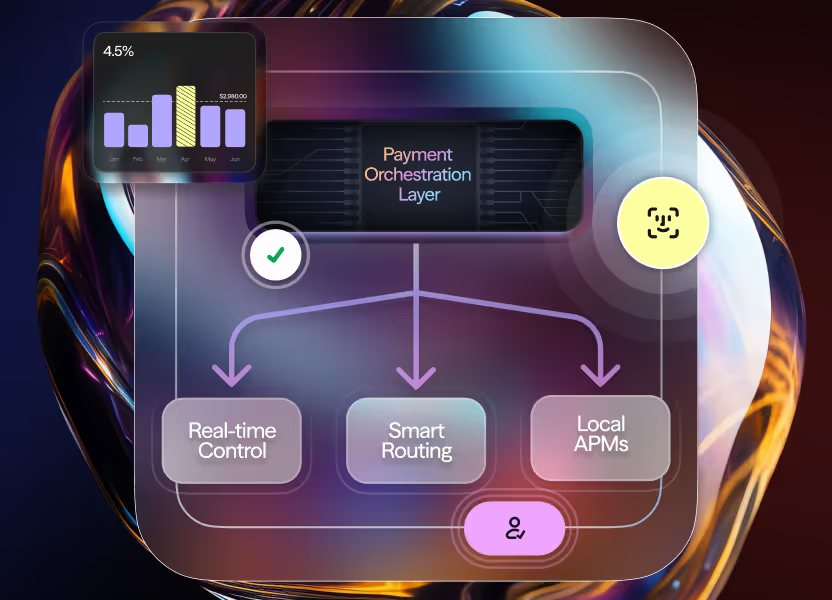
At its core, payment orchestration is the process of managing and optimising multiple payment providers, methods, and flows through a single integration.
Instead of connecting to each provider individually, merchants integrate once with a payment orchestration platform (POP) that sits between their system and the wider payment ecosystem.
This layer allows businesses to:
- Connect multiple acquirers, gateways, and payment methods.
- Control routing logic centrally.
- Monitor performance across all providers.
- Optimise transactions in real time.
Driven by a rising need for automated, intelligent routing and centralised payment management across digital commerce ecosystems, the market for payment orchestration platforms is projected to experience robust expansion. According to Global Insight Services, this sector is expected to grow from $2.4 billion in 2025 to $17.2 billion by 2035, representing a compound annual growth rate (CAGR) of 20.4%.
More recently, the concept has expanded into payment channel orchestration, a term gaining traction in 2026. This reflects a broader approach, where orchestration does not just manage providers, but entire payment channels across regions, methods, and user journeys.
How Does a Payment Orchestration Platform Work?
A payment orchestration platform acts as a control layer across the payment stack.
When a transaction is initiated, the platform determines the best path for that payment based on predefined logic and real-time conditions.
This includes:
- Selecting the most suitable acquirer.
- Routing transactions based on geography or performance.
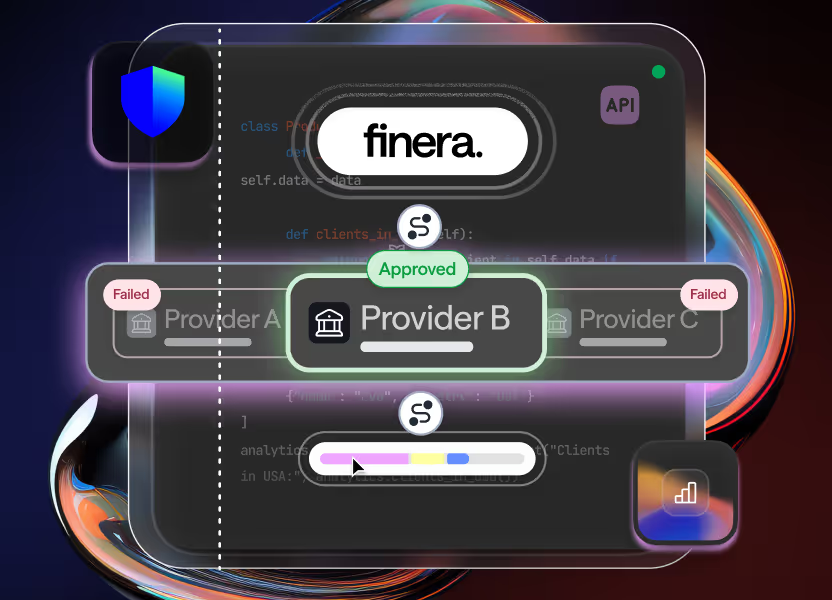
- Triggering fallback options if a payment fails.
- Applying fraud and risk rules dynamically.
This process is powered by smart transaction routing.
Instead of sending every transaction through the same provider, the system evaluates where it is most likely to succeed and cost less.
This can have two immediate benefits:
- Saving processing fees by routing through more cost-effective providers.
- Recovering lost sales by reducing failed transactions.
Over time, these incremental improvements can have a significant impact on overall revenue.
Payment Orchestration vs Payment Gateway
A common misconception is that payment orchestration replaces a payment gateway.
In reality, they serve different purposes.
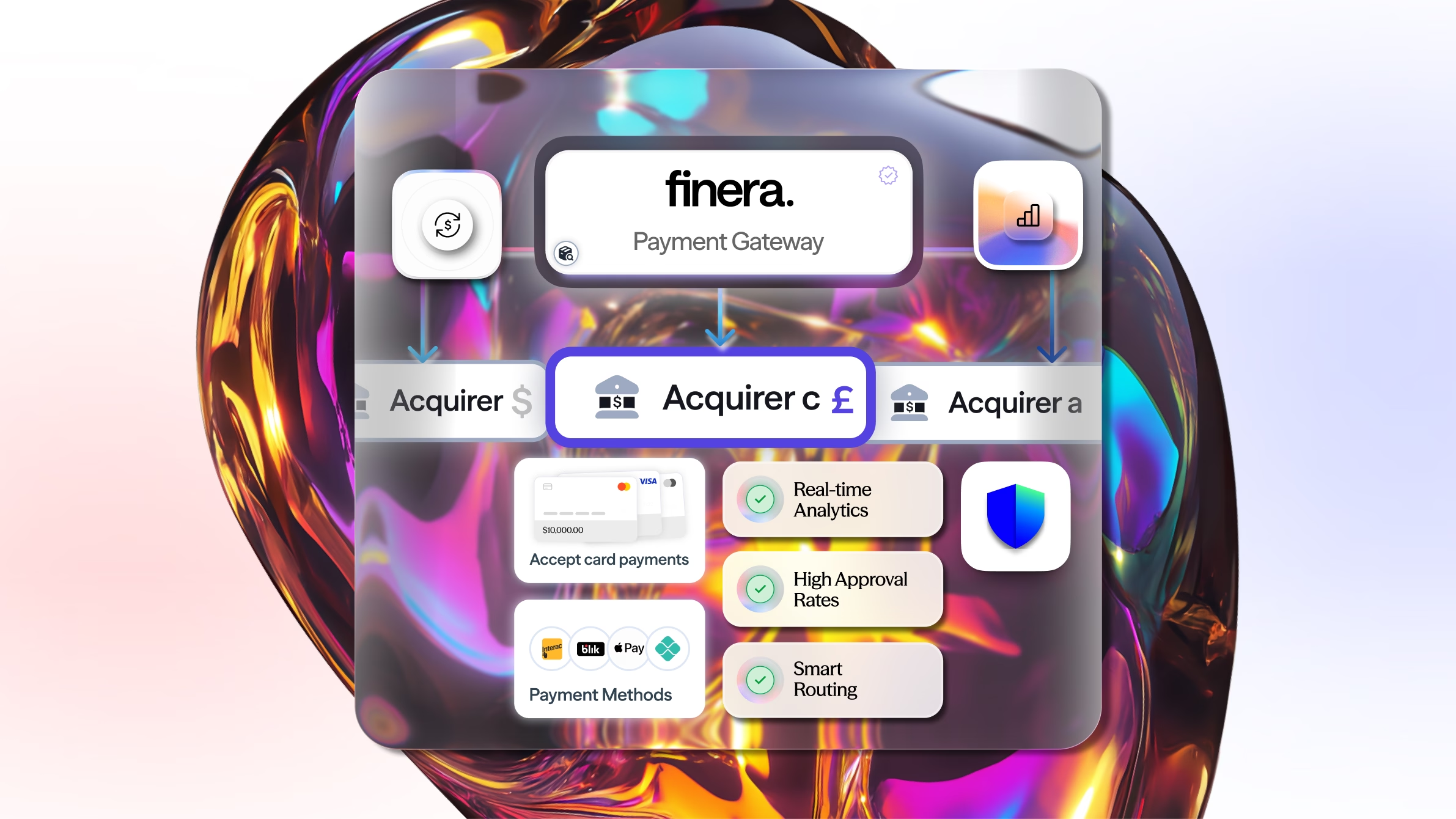
A payment gateway connects a merchant to a payment processor. It is responsible for transmitting transaction data securely.
Payment orchestration, on the other hand, sits above this layer.
It manages multiple gateways, acquirers, and payment methods, deciding how transactions should flow across them.
In simple terms:
- A gateway processes payments.
- Orchestration optimises how those payments are processed.
For merchants operating across multiple markets, this distinction is critical.
Why Merchant Payment Complexity Is Increasing
The need for orchestration is driven by how quickly payment ecosystems are evolving.
Several factors contribute to this complexity:
1. Multi-Market Expansion
Each market has different payment preferences, regulations, and providers. What works in one country or industry may not work in another.
2. Growth of Alternative Payment Methods
APMs; Digital wallets, instant payments, and local methods are now essential for conversion in many regions.
3. Multiple Provider Relationships
Merchants often rely on more than one acquirer or gateway to improve resilience and performance.
4. Performance Expectations
Approval rates, speed and reliability directly impact customer experience and revenue.
Managing all of this through separate integrations quickly becomes inefficient.
Benefits of Payment Orchestration
1. A Single Point of Integration
One of the most immediate benefits is reducing integration overhead.
Instead of building and maintaining multiple connections, merchants integrate once with the orchestration layer.
This simplifies development and allows faster deployment of new payment methods and providers.
2. Smart Transaction Routing
Smart transaction routing is one of the most valuable capabilities within a payment orchestration platform.
Transactions are dynamically routed based on:
- Performance data.
- Cost efficiency.
- Geographic relevance.
This means payments are not only more likely to succeed but can also be processed at a lower cost.
For merchants, this directly supports two goals:
- Increasing payment authorisation rates.
- Reducing unnecessary processing fees.
3. Improved Approval Rates
Declines are one of the most significant sources of lost revenue.
Different acquirers perform differently depending on region, issuer relationships, and transaction type.
Payment orchestration allows merchants to route transactions through the provider most likely to approve them.
In some cases, failed transactions can be retried through alternative routes automatically.
This approach helps recover revenue that would otherwise be lost.
4. Better Visibility and Control
With multiple providers, visibility often becomes fragmented.
A payment orchestration platform brings performance data into a single view.
This allows merchants to:
- Monitor approval rates across providers.
- Identify underperforming routes.
- Analyse transaction trends in real time.
This level of visibility is critical for continuous optimisation.
5. Flexibility for Growth
Businesses continue to expand and payment requirements change.
New markets require new methods. New regulations require adjustments. New providers may offer better performance.
Without orchestration, each change requires additional development work.
With orchestration, these changes can often be implemented through configuration rather than code.
This flexibility is essential for scaling efficiently.
How to Reduce Payment Complexity for Global Merchants
For global businesses, reducing payment complexity is not about removing options. It is about managing them effectively.
A strong payment strategy supported by orchestration allows merchants to:
- Balance performance across providers.
- Avoid reliance on a single acquirer.
- Adapt quickly to market-specific needs.
The goal is not simplification through reduction, but simplification through control.
Choosing the Right Approach
When evaluating best payment orchestration platforms in 2026, merchants should look beyond basic connectivity.
Key considerations include:
- Flexibility in routing logic.
- Support for multiple payment methods and regions.
- Real-time performance monitoring.
- Integration simplicity.
- Scalability for future growth.
A strong orchestration layer should not just connect systems. It should actively improve payment performance.
Securing and Optimising the Payment Stack
While orchestration focuses on optimisation, it also plays a role in security and resilience.
By distributing transactions across multiple providers, merchants reduce the risk of single points of failure.
Combined with strong fraud and risk management, orchestration helps maintain both performance and stability.
Managing Payment Complexity with finera.
Payment ecosystems will continue to grow in complexity.
New payment methods, evolving regulations, and rising customer expectations will only increase the demands placed on merchants.
The difference lies in how that complexity is managed.
Payment orchestration can help transform complexity into a competitive advantage.
By centralising control, enabling smart transaction routing, and improving visibility, it allows businesses to:
- Increase authorisation rates.
- Reduce processing costs.
- Improve customer experience.
- Expand across markets with confidence.
At finera., we support merchants in managing their payment infrastructure through payment orchestration, global acquiring connectivity, and performance optimisation tools.
If you are looking to reduce payment complexity and improve performance, talk to our team to explore how payment orchestration can support your growth.
This article on payment methods is for informational and educational purposes only.
- Not Professional Advice: The content provided does not constitute financial, legal, tax, or professional advice. Always consult with a qualified professional before making financial decisions.
- No Liability: The authors, contributors, and the publisher assume no liability for any loss, damage, or consequence whatsoever, whether direct or indirect, resulting from your reliance on or use of the information contained herein.
- Third-Party Risk: The discussion of specific payment services, platforms, or institutions is for illustration only. We do not endorse or guarantee the performance, security, or policies of any third-party service mentioned. Use all third-party services at your own risk.
- No Warranty: We make no warranty regarding the accuracy, completeness, or suitability of the information, which may become outdated over time.

Frequently Asked Questions

Still Have Questions?
Let’s Find the Right Solution for You
Stay Connected with Us!
Follow us on social media to stay up to date with the latest news, updates, and exclusive insights!