Intelligent Payment Routing for Smarter Payments
Intelligent payment routing boosts approval rates, lowers costs, and optimizes global payments scale.

Behind every successful online transaction lies a series of fast, invisible and often underestimated decisions. For years, merchants relied on a single acquirer, a single payment route and a predictable (but often inefficient) payment flow. But as commerce expanded internationally, a single pathway stopped being enough. Approval rates dropped, processing fees climbed and payment failures became a threat to revenue.
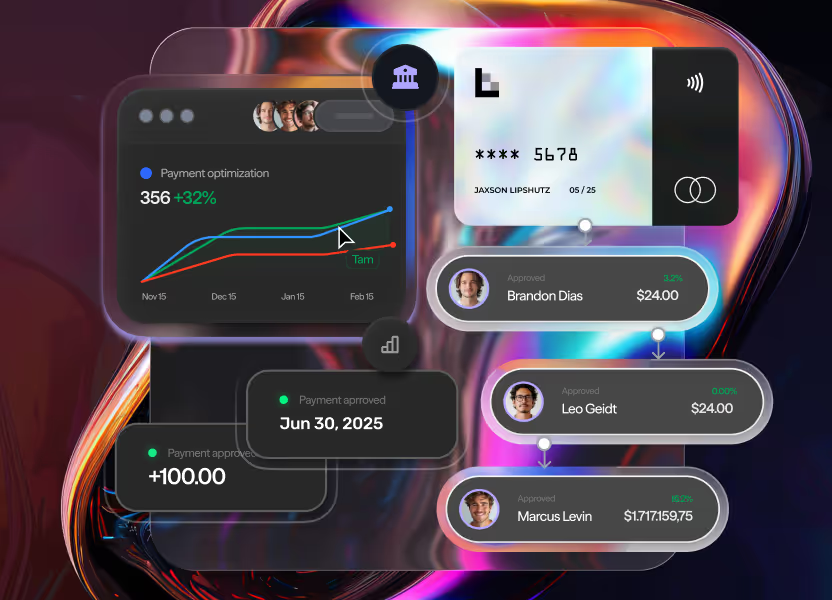
This is where intelligent payment routing comes in. Rather than sending every transaction through one fixed route, intelligent routing evaluates each payment in real time and selects the optimal path based on cost, performance, issuer conditions, geography and historical success rates. The result is a higher percentage of approved transactions, fewer declines and a smoother experience for customers around the world.
Today, intelligent routing is no longer a luxury but a competitive advantage. And with global commerce moving faster than ever, platforms like finera. are transforming payment performance by giving merchants the routing intelligence they need to oprtimize revenue with less friction.
Key Takeaways
- Intelligent payment routing uses real-time data to choose the optimal path for each transaction.
- It can increase approval rates, reduce costs and improve customer experience.
- It’s critical for merchants expanding into multiple regions or handling high payment volumes.
- Intelligent retries and dynamic routing reduce declines significantly.
- Platforms like finera. combine routing with full payment orchestration for global performance.

What Is Intelligent Payment Routing?
Intelligent payment routing is the process of dynamically selecting the best acquirer, PSP or payment rail for every transaction. Instead of relying on static rules or a single processor, the system evaluates multiple data points like issuer behaviour, card type, region, currency, historical success rates and routes each transaction to the path most likely to be approved.
In other words, it’s a decision engine.
Each payment is analysed in real time and directed to the route that offers:
- Better authorisation probability
- Lower processing cost
- Better overall performance for that customer’s profile
For merchants processing payments globally, this automation removes the guesswork and can bring clarity, predictability and intelligence to a previously rigid system.
Why Intelligent Payment Routing Became Essential
As digital commerce expanded, payment complexity followed. Customers use different cards, issuers follow different rules and acquirers vary widely in their performance. What works for a customer in France might fail for one in Brazil. What works for Visa may not work for a domestic debit card. What works at 2 a.m. may not work at 2 p.m.
A single routing path isn’t enough anymore.
Modern merchants began facing issues like:
- Lower approval rates in new regions
- Higher cross-border fees
- Increased payment declines due to issuer quirks
- Rising operational costs
- Dependence on a single acquirer
- Lost revenue due to insufficient payment performance
Intelligent payment routing solves this by removing the “one-size-fits-all” approach and replacing it with a responsive, data-driven engine that may adjust automatically to each transaction’s conditions.
How Intelligent Payment Routing Actually Works
At the moment a customer submits a payment, intelligent routing engines evaluate key variables within milliseconds:
1. Customer location & card origin
Local acquirers can often perform better than international ones.
2. Card type & issuer behaviour
Some issuers prefer specific acquirers or payment rails.
3. Currency mix & FX exposure
Routing choices impact FX fees and cross-border costs.
4. Current acquirer performance
Latency, downtime and approval patterns change throughout the day.
5. Historical merchant data
Past trends help predict the best route for similar transactions.
Once the system calculates the best option, it routes the payment in real-time. If the chosen route fails, intelligent retries may automatically send the transaction through a secondary or fallback route, increasing the chance of approval without disrupting the customer experience.
This level of intelligence is what separates modern payment infrastructures from traditional ones.
Who Benefits Most from Intelligent Payment Routing?
Many business operating internationally may see an immediate impact but some industries rely on it more heavily due to their volume and geographic diversity.
Marketplaces & e-Commerce brands
High-volume transactions with varying customer origins require optimised routing to keep approval rates high.
Subscription & SaaS companies
Automatic rebills benefit from intelligent retries and issuer-aware routing.
iGaming & online betting
Approval rates can significantly impact deposits, player engagement and revenue retention.
Travel & booking businesses
Cross-border payments with high ticket values can benefit optimised routing to avoid costly declines.
Fintech platforms & payment facilitators
They must ensure stability and performance for their own merchants.
In each case, intelligent routing isn’t just a technical feature, it becomes a strategic lever for revenue and user trust.
The Core Benefits of Intelligent Payment Routing
Higher Approval Rates
Optimising each payment route significantly reduces the chance of issuer declines. The system is designed to choose the highest-performing path based on real data, not guesswork.
Lower Costs
By selecting local acquirers or lower-fee corridors, merchants can reduce interchange costs, FX fees and processing expenses.
Less Dependency on One Acquirer
Relying on a single route creates risk. Intelligent routing spreads activity across multiple partners and eliminates single points of failure.
Better Customer Experience
More approved transactions may lead to fewer checkout frustrations and fewer abandoned carts.
Resilience & Redundancy
When an acquirer is down or experiencing delays, routing may instantly shift to a different provider.
More Reliable Global Expansion
As merchants move into new regions, intelligent routing can handle the nuances of local rails, issuers and compliance rules.
Platforms like finera. combine these benefits inside a unified orchestration layer that gives businesses consistent payout and payment performance worldwide.
How Intelligent Payment Routing Supports Global Scale
The real strength of intelligent routing appears when a business begins to expand across multiple markets. Every new region introduces variables: new banks, new issuers and new local payment methods. Intelligent routing absorbs this complexity by learning which routes work best in each local environment.
This means:
- Markets can be launched without building new infrastructure
- Authorisation rates can be optimised with localised routing
- FX exposure can be managed intelligently
- Payment experiences remain consistent across borders
- Merchants can gain a deeper understanding of how payments behave globally
Without intelligent routing, global expansion may become complex, expensive and unpredictable.
With intelligent routing, it becomes repeatable and controlled.
Choosing the Right Intelligent Routing Solution
When evaluating a routing engine, merchants should look beyond the headline feature and examine the depth of the system:
- Does it operate in real time?
- Does it adapt based on issuer behaviour and region?
- Does it support multiple acquirers and payment rails?
- Does it incorporate intelligent retries?
- Does it provide clear reporting and visibility?
- Does it improve both cost and approval KPIs?
- Is it built into a broader orchestration platform?
Solutions like finera. stand out because routing isn’t a standalone tool but is part of an orchestration environment that also manages payouts, FX, global partners, settlement tracking and end-to-end transaction logic.
This article on payment methods is for informational and educational purposes only.
- Not Professional Advice: The content provided does not constitute financial, legal, tax, or professional advice. Always consult with a qualified professional before making financial decisions.
- No Liability: The authors, contributors, and the publisher assume no liability for any loss, damage, or consequence whatsoever, whether direct or indirect, resulting from your reliance on or use of the information contained herein.
- Third-Party Risk: The discussion of specific payment services, platforms, or institutions is for illustration only. We do not endorse or guarantee the performance, security, or policies of any third-party service mentioned. Use all third-party services at your own risk.
- No Warranty: We make no warranty regarding the accuracy, completeness, or suitability of the information, which may become outdated over time.

Frequently Asked Questions
It’s a technology that automatically chooses the best acquirer or payment rail for each transaction to maximise approval rates and minimise costs.
Traditional routing follows fixed rules. Intelligent routing is dynamic, adapting based on real-time performance and historical data.
Yes. By selecting the most issuer-friendly and geographically optimised route, merchants can see significant gains in successful authorisations.
Different regions behave differently. Intelligent routing understands these patterns and adapts automatically, removing complexity for the merchant.
finera. integrates intelligent routing into its orchestration layer, combining acquirer optimisation, smart retries and real-time decisioning across global corridors.

Still Have Questions?
Let’s Find the Right Solution for You
Stay Connected with Us!
Follow us on social media to stay up to date with the latest news, updates, and exclusive insights!