
5 Emerging Payment Technologies Every Merchant Should Watch
Discover five emerging payment technologies shaping the future of payments.
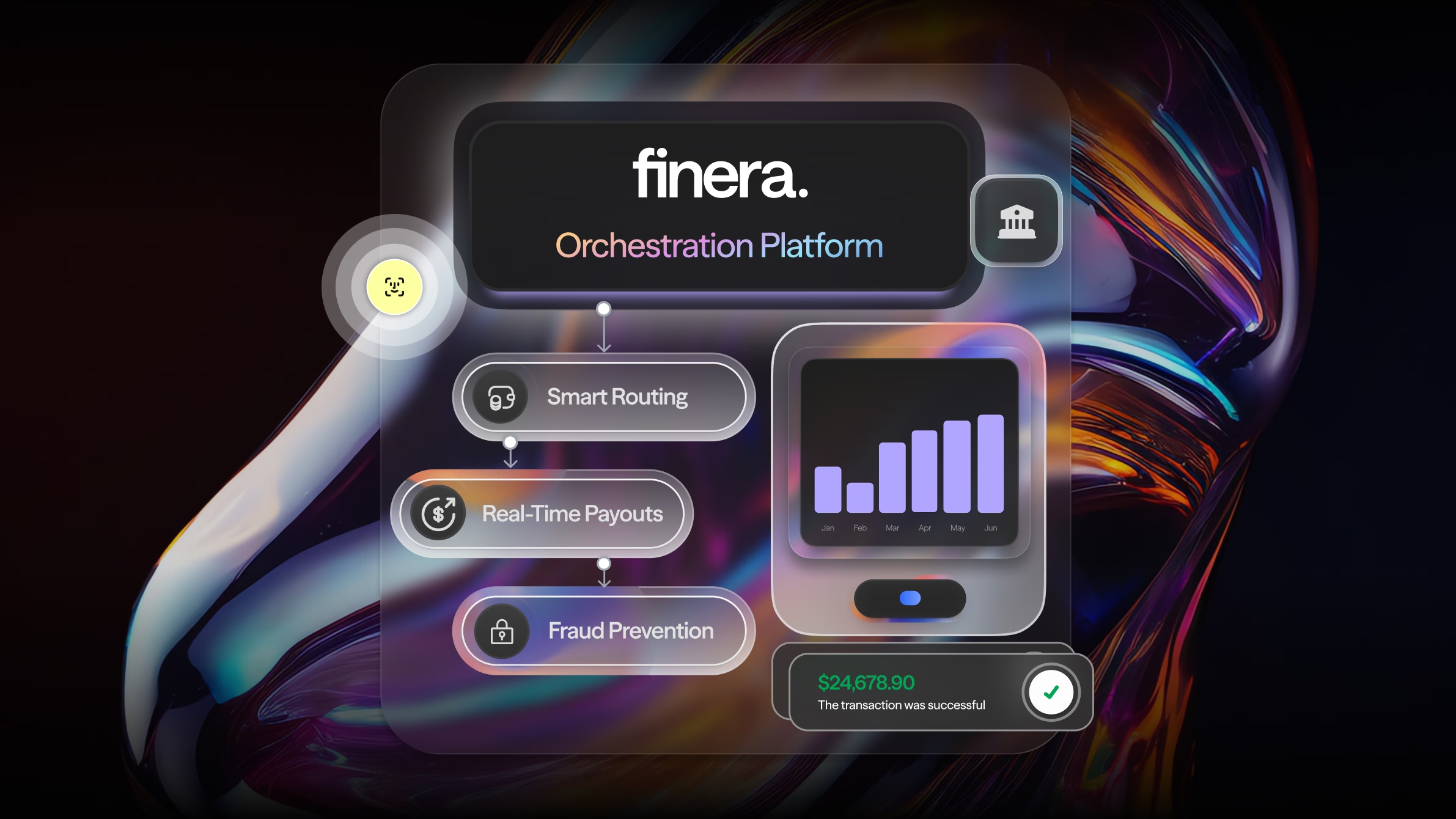
The way customers pay continues to evolve. Digital wallets are becoming mainstream. Instant bank payments are replacing traditional transfers in many markets. Artificial intelligence is changing how payments are routed and protected. At the same time, merchants are expanding into new markets where local payment methods often outperform international cards.
For businesses, keeping up with these changes is no longer just about offering more payment methods. It is about understanding which payment technologies can improve approval rates, reduce costs, strengthen security, and create a better customer experience.
So, which technologies are shaping the future of payments?
Here are five emerging payment technologies every merchant should keep on their radar.
1. Payment Orchestration
One of the biggest developments in modern payments is the rise of payment orchestration.
Instead of relying on a single payment provider, payment orchestration allows businesses to connect multiple payment service providers, acquirers, and alternative payment methods through one integration.
This creates a more flexible payment infrastructure that can adapt to changing business needs.
With the right orchestration platform, businesses can:
- Route transactions based on predefined rules, helping direct them toward a path that may be more likely to be approved.
- Add new payment providers without rebuilding their integration.
- Expand into new markets more efficiently.
- Improve resilience if one provider experiences downtime.
Payment orchestration is becoming the foundation for scalable global payments rather than a feature reserved for enterprise businesses.

2. Account-to-Account (A2A) Payments and Pay by Bank
Account-to-account payments move money directly between bank accounts over real-time rails, bypassing card networks entirely. Powered by open banking, "Pay by Bank" is moving from peer-to-peer transfers into mainstream retail checkout, where it can offer lower fees and reduced chargeback exposure compared with cards. Juniper Research forecasts that the global value of consumer A2A transactions will rise from 1.7 trillion USD in 2024 to 5.7 trillion USD by 2029, an increase of 230%.
Because they can settle quickly and may cost less than card acceptance, A2A payments can help support profit margins on high-value baskets and improve cash flow.
Open banking is designed to enable fast bank-to-bank payments with built-in security, so merchants can offer Pay by Bank alongside cards.
3. Crypto Payment Processing
Crypto payments are becoming part of the payment mix for businesses operating internationally. While adoption varies by market and industry, more merchants are offering cryptocurrency as an additional payment option alongside traditional payment methods.
Rather than building their own crypto infrastructure, businesses typically use a crypto payment processing provider to accept and manage cryptocurrency payments through a single integration.
Crypto payment processing can help businesses:
- Accept payments in multiple cryptocurrencies.
- Offer customers an additional payment option.
- Simplify cross-border payment acceptance.
- Connect to multiple blockchain networks through one platform.
The digital asset ecosystem continues to develop and crypto payment processing is becoming a relevant consideration for businesses that want to support a wider range of customer payment preferences.
finera.'s crypto processing accepts crypto payments globally with a non-custodial model.

4. Real-Time Payments and Payouts
Real-time payment schemes such as India's UPI, move funds and confirmation more quickly than traditional payment methods. The same rails power instant payouts, letting merchants pay disbursements the moment they are due.
Instant payouts are becoming an expectation. In competitive markets, the speed a customer receives money increasingly decides where they play, shop, or sell.
For businesses, real-time payments can support:
- Faster customer deposits.
- Improved cash flow.
- Immediate payment confirmation.
- Better customer experiences.
- Reduced settlement delays.
ACI Worldwide recorded 266.2 billion real-time payment transactions globally in 2023, a 42.2% year-on-year rise, with volume forecast to reach roughly 575 billion by 2028.
Payout solutions are designed to deliver instant, multi-currency disbursements at scale.
For the wider view, see Payouts in 2026: What Businesses Need to Know.
5. Fraud Prevention
Fraud prevention has moved from static rules to machine learning models that score risk in real time, reading behavioural signals and adapting as attack patterns change. For the first time, that shift is showing up in the headline numbers.
Smarter fraud models aim to reduce losses while limiting checkout friction and the false declines that can quietly cost merchants more than fraud itself.
finera.'s fraud & risk management combines fraud detection, 3D Secure authentication, and compliance features, while smart routing is designed to help improve payment approval rates by routing eligible transactions.
The Business Benefits of Emerging Payment Technologies
These technologies are shaping payments in different ways, but they all point towards the same goal: giving businesses more flexibility, better payment performance, and the ability to adapt as customer expectations evolve.
Rather than viewing these technologies as standalone innovations, businesses should consider how they work together as part of a modern payment strategy. A flexible payment infrastructure makes it easier to adopt new payment methods, enter new markets, and respond to changing customer preferences without rebuilding existing systems.
How Businesses Can Prepare
Emerging payment technologies are developing at different speeds across different markets. Not every business needs to adopt every new payment method immediately, but every business should be building an infrastructure that can accommodate change.
When reviewing your payment stack, ask yourself:
- Can you add new payment providers without significant development work?
- Can you support local payment preferences as you expand internationally?
- Does your infrastructure support both incoming payments and payouts?
- Can you introduce new payment methods without disrupting existing operations?
- Is your payment infrastructure flexible enough to adapt as new technologies emerge?
The answers to these questions often determine how quickly a business can respond to new opportunities.
Future-Proof Your Business with Modern Payment Technologies
The payments industry will continue to evolve as new technologies mature, regulations develop, and customer expectations change.
While trends come and go, one principle remains consistent: businesses with flexible payment infrastructure are better positioned to adapt.
Whether that means introducing Pay by Bank, accepting cryptocurrency payments, supporting instant payouts, or connecting new payment providers through orchestration, success increasingly depends on having technology that can evolve alongside the business.
At finera., we help businesses build payment infrastructure designed for long-term growth. Through a single integration, our payment orchestration platform enables businesses to connect multiple payment providers, support local and alternative payment methods, accept crypto payments, manage payouts, strengthen fraud prevention, and help improve payment performance through smart routing.
Looking to future-proof your payment strategy? Contact the finera. team to learn how our payment infrastructure can support your next stage of growth.

This article on payment methods is for informational and educational purposes only.
- Not Professional Advice: The content provided does not constitute financial, legal, tax, or professional advice. Always consult with a qualified professional before making financial decisions.
- No Liability: The authors, contributors, and the publisher assume no liability for any loss, damage, or consequence whatsoever, whether direct or indirect, resulting from your reliance on or use of the information contained herein.
- Third-Party Risk: The discussion of specific payment services, platforms, or institutions is for illustration only. We do not endorse or guarantee the performance, security, or policies of any third-party service mentioned. Use all third-party services at your own risk.
- No Warranty: We make no warranty regarding the accuracy, completeness, or suitability of the information, which may become outdated over time.

Frequently Asked Questions

Still Have Questions?
Let’s Find the Right Solution for You
Stay Connected with Us!
Follow us on social media to stay up to date with the latest news, updates, and exclusive insights!




.avif)