The Role of Payment Technology in Reducing Cart Abandonment
Explore how modern payment technology can help decrease cart abandonment.

Cart abandonment remains one of the most persistent challenges in digital commerce. Customers browse, compare and add items to their cart, only to leave before completing the transaction.
While pricing, delivery options and product clarity all play a role, the checkout experience itself is often where intent breaks down.
Modern payment technology has quietly become one of the most effective levers for reducing abandonment. Not by pushing users harder, but by removing friction, uncertainty, and unnecessary steps from the final moments of the purchase journey.
This article explores how contemporary payment infrastructure, routing logic, local payment methods, authentication flows and real-time intelligence, helps merchants improve conversion while maintaining trust and usability.
Why Cart Abandonment Still Happens at Checkout
Cart abandonment is rarely caused by a single factor. Instead, it is often the cumulative result of small moments of friction that compound at checkout.
Common contributors include poor UI, unfamiliar payment methods, unexpected redirects, repeated data entry, authentication friction, declines that lack clarity, or checkout flows that feel inconsistent across devices. In cross-border commerce, these issues are amplified by local payment expectations and varying banking behaviours.
In many cases, the customer wants to complete the purchase but the payment experience introduces hesitation at the worst possible moment.

Payment Technology as a Conversion Enabler
Modern payment systems are no longer limited to processing transactions.
They actively shape the checkout experience by determining how payments are presented, authenticated, routed and confirmed.
When designed effectively, payment technology can reduce cognitive load. It helps customers recognise familiar methods, authenticate in ways they trust and complete transactions without unnecessary steps.
According to finera.’s Chief Product Officer, Artur Savle: “Checkout success is less about speed alone and more about simplicity . When the payment experience aligns with what users expect locally, completion rates improve naturally.”
This shift, from payments as a backend utility to payments as a user-experience layer, can be central to reducing abandonment.
Local Payment Methods Reduce Uncertainty
A strong signal of trust at checkout is familiarity.
Customers may be more likely to complete a payment when they see methods they already use in their daily lives.
Local payment methods such as local bank transfers, domestic wallets and region-specific payment schemes reduce hesitation because they remove the feeling of “entering the unknown.” For many users, paying through their bank or preferred wallet feels safer than entering card details into an unfamiliar interface.
This is particularly relevant in markets where cards are not the dominant method or where bank-based payments carry higher trust. By aligning payment options with local expectations, merchants may reduce one of the common causes of checkout drop-off.
“Modern payment architecture must optimise decisions in milliseconds. The goal is resilience and adaptability, not complexity.” Ilya Badaev, Chief Technology Officer at finera.
Smart Routing Improves Payment Outcomes Invisibly
Even with the right payment methods available, not every transaction can succeed.
Declines can occur due to issuer behaviour, network rules, or temporary availability issues. When these failures happen without context or recovery, customers often abandon the purchase entirely.
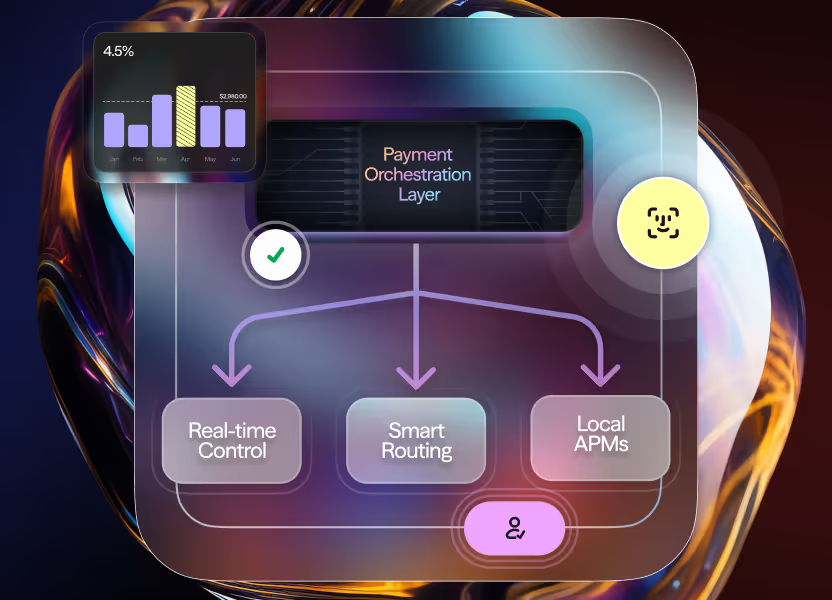
Smart routing addresses this problem by directing transactions through the most appropriate payment path based on factors such as geography, currency, device type, or historical performance.
When a transaction encounters friction, routing logic can help retry or redirect through an alternative path where appropriate.
Stefania Radu, Head of Product at finera. notes: “The best routing decisions are the ones customers never notice. When payments succeed on the first attempt, abandonment rates can decrease significantly.”
By improving first-attempt success rates, routing may reduce the need for users to intervene or repeat actions, which can be triggers for abandonment.
Authentication Without Excessive Friction
Security remains essential at checkout, but excessive or poorly timed authentication may disrupt the customer journey. Modern payment technology supports more adaptive approaches, applying additional verification only when risk indicators warrant it.
Risk-based authentication can help balance protection and usability. Customers with low-risk profiles experience smoother checkouts, while higher-risk transactions receive appropriate safeguards.
This approach can reduce unnecessary friction while maintaining compliance and trust, an important factor in keeping users engaged through to completion.
Mobile Optimisation Is No Longer Optional
With a growing share of ecommerce transactions taking place on smartphones, payment technology must adapt to smaller screens and shorter attention spans.
Mobile-optimised checkout flows can reduce data entry, support native authentication, and prioritise speed without sacrificing clarity.
Payment methods that integrate with mobile banking apps or wallets may perform better than those designed primarily for desktop environments.
Reducing friction on mobile is not about simplification alone, but about designing payment flows that fit the context in which users are paying.
From Payments Infrastructure to Checkout Strategy
Reducing cart abandonment is not about adding more payment methods indiscriminately. It is about offering the right methods, presented in the right way, supported by technology that adapts to users rather than forcing users to adapt to it.
Payment technology now plays a strategic role in conversion optimisation especially for igaming payments. It influences trust, usability, and success rates, often without being visible to the customer.
Payment Technology as a Competitive Advantage
The checkout experience can be a key differentiator between merchants who experience conversion friction and those who do not.
Modern payment technology, when implemented thoughtfully, can help reduce abandonment through alignment with customer expectations. It aims to remove friction, improve reliability, and build trust at the moment it matters most.
For merchants, investing in payment infrastructure is no longer just an operational decision. It can be a direct contributor to conversion, customer satisfaction and long-term growth.
Ready to explore payment orchestration solutions? Contact our team to learn how finera.’s payment technology and services can support your operations globally.
DISCLAIMER
This article on payment methods is for informational and educational purposes only.
- Not Professional Advice: The content provided does not constitute financial, legal, tax, or professional advice. Always consult with a qualified professional before making financial decisions.
- No Liability: The authors, contributors, and the publisher assume no liability for any loss, damage, or consequence whatsoever, whether direct or indirect, resulting from your reliance on or use of the information contained herein.
- Third-Party Risk: The discussion of specific payment services, platforms, or institutions is for illustration only. We do not endorse or guarantee the performance, security, or policies of any third-party service mentioned. Use all third-party services at your own risk.
- No Warranty: We make no warranty regarding the accuracy, completeness, or suitability of the information, which may become outdated over time.

Frequently Asked Questions

Still Have Questions?
Let’s Find the Right Solution for You
Stay Connected with Us!
Follow us on social media to stay up to date with the latest news, updates, and exclusive insights!