The Gap Between Payment Data and Business Decisions
Payment data without context limits decisions. Orchestration helps turn metrics into insights.
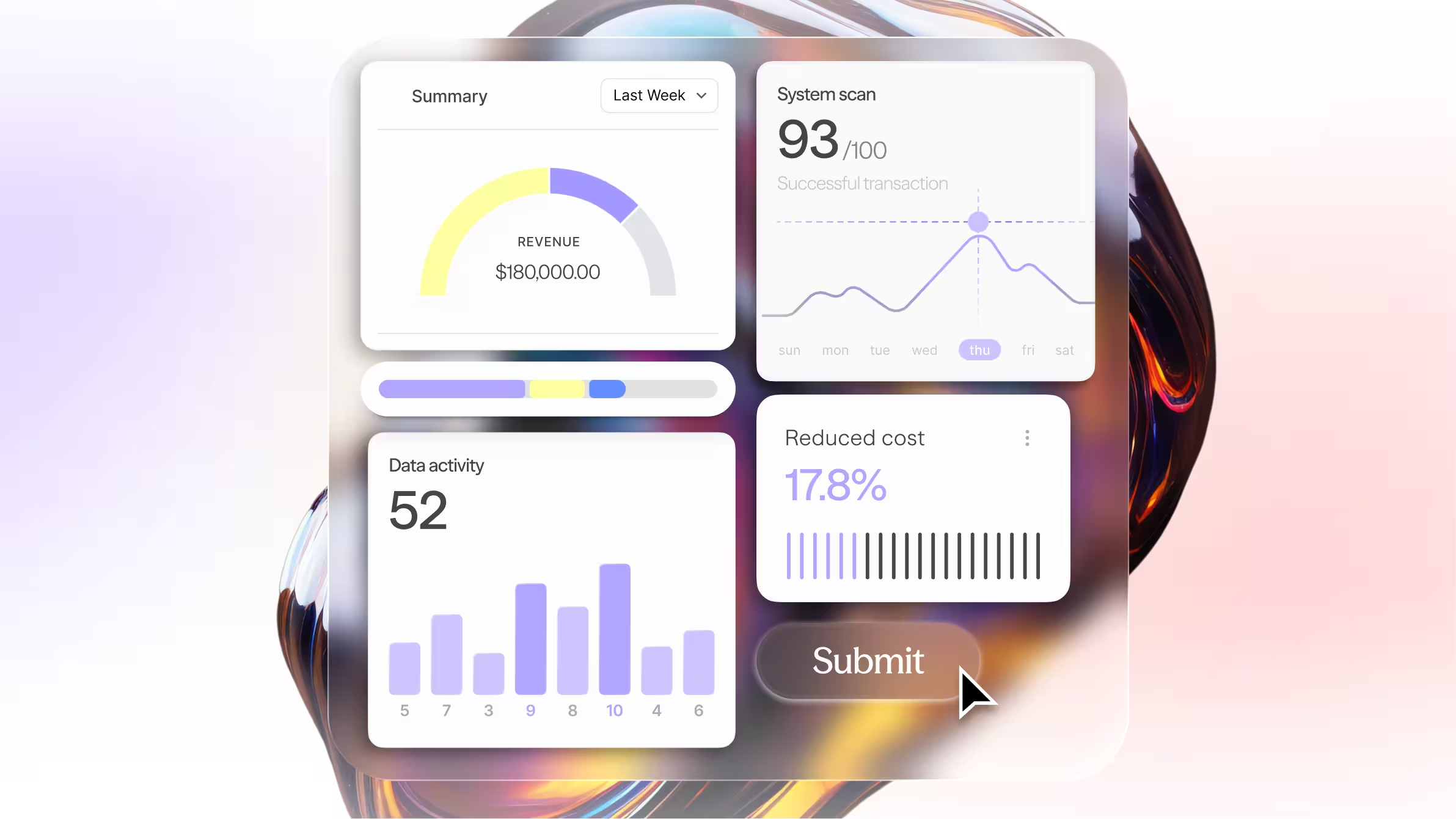
In most modern businesses, payments generate an enormous amount of data. Approval rates, decline codes, processing costs, regional performance, payment method usage and fraud indicators. The numbers are everywhere. Dashboards are full.
Yet many companies still struggle to answer a simple question: What should we do differently based on this data?
This is the gap between payment data and business decisions.
For many organisations, payment data exists but does not actively guide strategy. Reports are generated, metrics are monitored and teams review dashboards but turning those insights into concrete operational or strategic improvements often proves difficult.
The issue is rarely a lack of information. Instead, the challenge lies in visibility, interpretation and control. Data may be fragmented across multiple providers, payment methods or markets. Teams may lack a unified view of performance. And most importantly, the infrastructure may not allow companies to act quickly on the insights they discover.
Closing this gap is becoming increasingly important as payment ecosystems grow more complex. Businesses now operate across regions, integrate multiple providers and support an expanding mix of payment methods. Without the ability to translate data into decisions, payments, especially in iGaming, become reactive rather than strategic.
Key Takeaways
- Many companies collect detailed payment data but struggle to translate it into strategic decisions.
- Fragmented reporting across multiple providers often prevents a clear view of payment performance.
- Metrics such as approval rates or decline codes only become useful when analysed in context.
- Payment orchestration technology helps centralise visibility and enable faster optimisation.
- When payment data becomes actionable, it improves approval rates, reduces costs and supports smarter growth decisions.
Why Payment Data Alone Is Not Enough
Without context, payment data can create confusion instead of clarity.
A possible challenge is that data frequently lives in separate environments. A company may receive reports from multiple payment service providers, acquirers and alternative payment method partners. Each report may use different formats, definitions and timeframes.
The result is fragmentation. Teams spend time reconciling data instead of analysing it.
When data is fragmented, strategic decision-making slows down.
The Cost of Fragmented Payment Insights
The consequences of fragmented payment data often appear gradually rather than through dramatic failures.
Decline rates may remain slightly higher than necessary. Cross-border processing fees may go unnoticed. Underperforming acquirers may continue to handle transactions long after better alternatives are available.
These inefficiencies accumulate quietly.
For instance, a merchant operating in multiple regions may discover that one acquirer performs significantly better in certain countries or for specific card networks. Without unified visibility, these performance differences may remain hidden.
Similarly, companies may fail to recognise when customers abandon checkout because their preferred payment method is unavailable.
In both cases, payment data exists. But it does not lead to action.
Over time, this gap between data and decisions can affect revenue, margins and customer experience.
Why Visibility Changes Everything
To close the gap between payment data and business decisions, businesses need more than raw metrics. They need visibility.
Visibility means having a single, unified view of payment performance across all providers, markets, and payment methods.
With unified visibility, companies can identify patterns that would otherwise remain hidden. For example:
- Which providers deliver the highest approval rates in specific regions.
- How different payment methods perform across customer segments.
- Where costs are increasing due to cross-border processing.
- When performance changes occur in real time.
When these insights become visible, payment performance becomes measurable and actionable.
Instead of asking broad questions like “Why are approvals declining?” teams can pinpoint the exact source of the issue.
Visibility turns payment data from a static report into a diagnostic tool.
Turning Data Into Decisions Through Payment Orchestration
Visibility alone is not enough. Once insights are discovered, businesses must be able to act on them quickly. And this is where payment orchestration technology becomes critical.
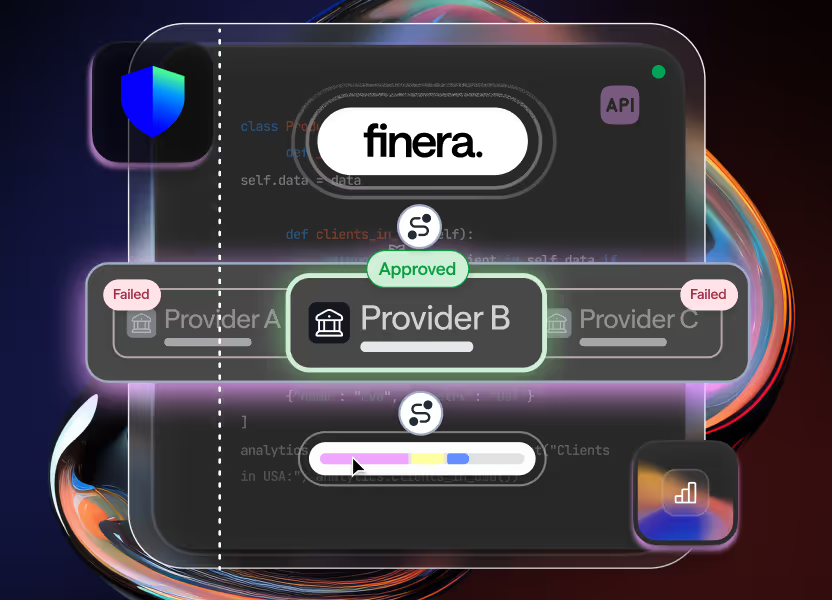
Payment orchestration connects multiple providers, payment methods, and acquiring partners through a unified infrastructure. More importantly, it provides the control layer needed to optimise performance.
With orchestration, businesses can:
- Route transactions dynamically based on performance or cost.
- Retry declined transactions through alternative providers.
- Review approval rates across payment methods and regions.
- Monitor performance across the entire payment ecosystem.
Payment orchestration enables companies, from iGaming to e-commerce, to route payments and get a clear view of payment flows almost in real-time. This significantly reduces the need for manual report analysis, allowing for almost immediate implementation of changes instead of waiting weeks.
This capability transforms payment data from passive information into an active optimisation engine.
Aligning Payment Insights With Business Strategy
When payment data becomes actionable, its value extends far beyond payment operations.
It begins to influence broader business decisions.
For example, companies planning international expansion can use payment performance data to determine which payment methods are essential in each market.
Product teams can improve checkout flows by identifying where customers encounter friction.
Even pricing strategies can be influenced by payment cost data.
In other words, payment data becomes a strategic asset rather than just a technical metric.
The Cultural Shift: Treating Payments as a Strategic Function
Closing the gap between payment data and business decisions also requires a shift in mindset.
Historically, payments have often been treated as a back-end utility. As long as transactions were processed successfully, they received little strategic attention.
However, today, payments, especially in online gaming and e-commerce, can possibly influence revenue, conversion and customer experience.
Companies that treat payments strategically tend to adopt a different approach, where they use payment metrics regularly rather than occasionally.
This cultural shift allows payment data to become part of the company’s broader growth strategy.
From Payment Data to Payment Intelligence
The gap between payment data and business decisions will likely persist for organisations that rely solely on fragmented reporting systems.
But businesses that invest in unified visibility and payment orchestration technology can transform raw metrics into meaningful insights.
When payment data becomes accessible, contextual and actionable, it evolves into something far more valuable: payment intelligence.
Approval rates improve. Costs become transparent. Expansion decisions become informed rather than speculative.
And perhaps most importantly, payment infrastructure becomes a driver of growth rather than a hidden constraint.
At finera., we help businesses bridge this gap through payment orchestration technology, smart routing, card and alternative payment methods and real-time performance monitoring. By bringing clarity and control to complex payment ecosystems, we enable companies to transform data to support confident business decisions.
This article on payment methods is for informational and educational purposes only.
- Not Professional Advice: The content provided does not constitute financial, legal, tax, or professional advice. Always consult with a qualified professional before making financial decisions.
- No Liability: The authors, contributors, and the publisher assume no liability for any loss, damage, or consequence whatsoever, whether direct or indirect, resulting from your reliance on or use of the information contained herein.
- Third-Party Risk: The discussion of specific payment services, platforms, or institutions is for illustration only. We do not endorse or guarantee the performance, security, or policies of any third-party service mentioned. Use all third-party services at your own risk.
No Warranty: We make no warranty regarding the accuracy, completeness, or suitability of the information, which may become outdated over time.

Frequently Asked Questions

Still Have Questions?
Let’s Find the Right Solution for You
Stay Connected with Us!
Follow us on social media to stay up to date with the latest news, updates, and exclusive insights!



.avif)