Payment Orchestration vs PSP: What Is the Difference?
Payment orchestration vs PSP: what each is, how they differ and when merchants need orchestration.
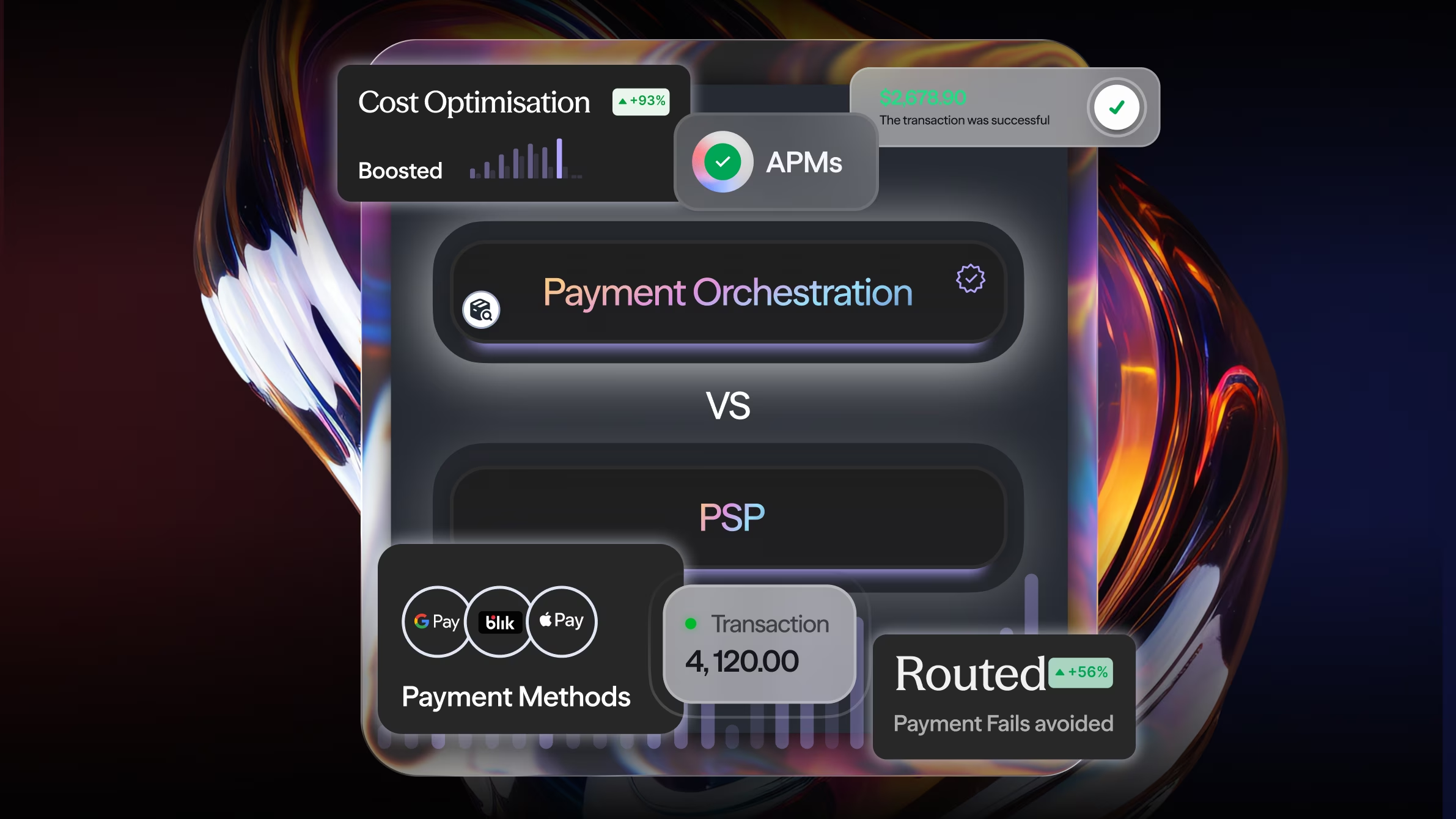
"Payment orchestration" and "payment service provider" are often mentioned in the same breath, and sometimes treated as alternatives to each other. They are not quite the same kind of thing, and understanding the difference matters, because it shapes how flexible, resilient and cost-effective your payment setup can be as you grow.
Here is the short version: a payment service provider (PSP) typically processes payments through its own platform and partner network, while payment orchestration is a layer that sits above multiple PSPs, gateways and acquirers and can route transactions across them through one integration. A PSP is generally one provider that handles your payments. Orchestration is a control layer that helps coordinate multiple providers, including PSPs. This guide explains each in plain terms, sets out the key differences, and offers some considerations to help you assess which may suit your business.
What Is a Payment Service Provider (PSP)?
A payment service provider is a company that lets a business accept payments. A PSP typically bundles several things into one package: a gateway to transmit transactions, acquiring to connect to the card networks, fraud tools, and merchant account services. That bundling is its main appeal. It gives a business a single, relatively quick way to start taking payments without arranging each component separately.
Because a PSP handles card data, it is generally required to comply with the PCI DSS standard, and it commonly supports authentication such as 3D Secure. PSPs suit many businesses well, particularly SMBs and startups that value simplicity and speed to launch. The trade-off tends to appear later: because a business using a single PSP relies on that provider’s platform, it may be largely dependent on that provider's performance, coverage and pricing. As volumes grow and markets multiply, that single dependency can, in some cases, limit approval rates, reach and control.
What Is Payment Orchestration?
Payment orchestration is a control layer that sits above multiple payment providers, connecting a business to several PSPs, gateways and acquirers through one integration. Rather than replacing those providers, it coordinates them. A single API connects to the orchestration layer, and the layer connects to everything behind it.
That coordination is where the potential value lies. Depending on configuration and the providers connected, an orchestration platform can help route transactions to providers based on performance, retry or fail over to another provider when one declines or is unavailable, support multiple currencies and local methods, and consolidate reporting across connected providers. The aim is a payment setup that operates more like a single, coordinated system rather than a set of separate relationships.
For a full explanation, see finera.'s guide to choosing the right payment stack.
Payment Orchestration vs PSP: The Key Differences
The clearest way to see the distinction is side by side.
The last row is the one most often misunderstood, and it leads to the next point.
Do You Have to Choose Between a PSP and Orchestration?
Not usually. This is an important point about the comparison: orchestration is not a replacement for a PSP. It sits above PSPs and works with them. A business can generally keep the PSP it already uses, connect one or more additional providers, and use the orchestration layer to route transactions across them.
So the real question is rarely "PSP or orchestration?". It is "do I need a layer above my providers to coordinate them?". For a single-provider business that is performing well, the answer may be no. For a business running, or planning to run, more than one provider, orchestration can help make that setup easier to manage.
When Do Merchants Need Payment Orchestration?
Orchestration tends to earn its place once a business outgrows a single-provider setup. Common signals include:
- Multiple providers already in use, or a plan to add them
- Cross-border volume, with customers and issuers across several regions
- Multiple currencies or local payment methods to support
- Decline rates above benchmark that a single provider cannot resolve
- Provider outages that have interrupted revenue
- Long lead times to launch a new payment method or market
- Fragmented reporting across separate provider dashboards
If several of these apply, it may be worth evaluating whether orchestration could support your payment setup.
The Benefits of Managing Multiple Providers Through One Integration
The core value of orchestration is bringing multiple providers together behind a single integration. That delivers several related gains.
Performance may improve when transactions can be routed to providers based performance and retried elsewhere on a decline, rather than being tied to one route. Smart routing is designed to help support approval rates and help recover payments a single provider might lose, although the results may vary by merchants, market and configuration. Reach may expand, because connecting local acquirers through a global acquirer network, alternative payment methods and multi-currency flows can be simpler through one integration than through many. Resilience may also improve, since failover can help reduce the impact of an outage at a single provider.
Visibility can also improve, as consolidated analytics across connected providers may make reconciliation and performance monitoring more manageable.
Industry research points in this direction. According to 451 Research, part of S&P Global, around 64% of US-headquartered merchants with at least half of their sales online prefer to work with multiple payment processors. Once a business runs more than one provider, coordinating them well is exactly what orchestration is for.
Learn More About finera.'s Orchestration Platform
At finera., we help merchants simplify payment complexity through orchestration, smart routing, local payment method coverage and multi-provider infrastructure designed for global growth. We can connect providers, acquirers and payment methods your business needs through one integration, route intelligently across them, with 24/7 human support behind it.
If you are weighing up a PSP against orchestration, or wondering whether you need a layer above your current providers, talk to our payments team or explore finera.'s payment orchestration platform.
This article on payment orchestration and payment service providers is for informational and educational purposes only.
- Not Professional Advice: The content provided does not constitute financial, legal, tax, or professional advice. Always consult with a qualified professional before making financial decisions.
- No Liability: The authors, contributors, and the publisher assume no liability for any loss, damage, or consequence whatsoever, whether direct or indirect, resulting from your reliance on or use of the information contained herein.
- Third-Party Risk: The discussion of specific payment services, platforms, or institutions is for illustration only. We do not endorse or guarantee the performance, security, or policies of any third-party service mentioned. Use all third-party services at your own risk.
- No Warranty: We make no warranty regarding the accuracy, completeness, or suitability of the information, which may become outdated over time.

Frequently Asked Questions
No. A PSP typically processes payments through its own platform and payment network. Payment orchestration is a layer that sits above multiple PSPs, gateways and acquirers and can route transactions across them through one integration.
No. Orchestration works with PSPs rather than replacing them. You can keep your existing PSP, connect additional providers, and let the orchestration layer route across all of them.
Not necessarily. If a single PSP performs well for your market and volume, you may not need it yet. Orchestration becomes valuable once you run, or plan to run, more than one provider.
A gateway transmits transactions to a processor, a PSP typically bundles services such as gateway, acquiring and fraud tools in one provider, and orchestration is a control layer that coordinates multiple gateways, PSPs and acquirers.
By routing transactions based on provider performance and retrying on an alternative provider when one declines, where appropriate, orchestration is designed to help recover some payments that a single fixed route might lose. Results vary depending on factors such as transaction mix, markets, issuers and configuration.

Still Have Questions?
Let’s Find the Right Solution for You
Stay Connected with Us!
Follow us on social media to stay up to date with the latest news, updates, and exclusive insights!