How Payment Orchestration Reduces Time-to-Launch When Entering a New Region
How payment orchestration helps businesses launch faster and scale into new markets with confidence.

Expanding into a new market is exciting. It usually means new customers, new revenue and new growth opportunities. But for most businesses, there’s a less glamorous reality behind the scenes where payments can slow everything down.
New acquirers, new payment methods, new compliance rules and new technical integrations. Suddenly, what looked like a simple regional launch turns into months of engineering work, legal reviews and last-minute fixes.
And while product and marketing teams are ready to go, payments often become the bottleneck.
This is where payment orchestration changes the equation. Instead of rebuilding your payment stack for every new region, payment orchestration lets you move faster, adapt locally and launch with less technical friction.
Let’s take a look at why regional expansion usually takes so long, where the real delays come from and how payment orchestration helps businesses cut time-to-launch without cutting corners.
Why Entering a New Market So Often Takes Longer Than Planned
On paper, launching in a new country sounds straightforward. Translate the site, adjust pricing, line up logistics and start selling. In reality, payments introduce a whole new layer of complexity.
Each region has its own mix of preferred local payment methods, local acquiring requirements, compliance rules and fraud risks.
What works in one market rarely works out of the box in another. Cards might dominate in one country, while wallets, bank transfers or local schemes lead in another. Some regions require strong customer authentication, while others have different data or reporting requirements.
Learn how to master the mix of cards and APMs to boost European conversions.
Traditionally, supporting a new market means:
- Signing contracts with new PSPs or acquirers
- Building and testing new integrations
- Adapting checkout flows for local payment methods
- Handling new compliance and reporting requirements
- Updating fraud and risk rules
- Maintaining yet another set of connections over time
Each one of these steps takes time. Together, they can often turn “we’ll launch next quarter” into “we’re still working on payments.”
And the more markets you enter, the more fragmented your setup becomes.
The Hidden Cost of Fragmented Payment Integrations
Many growing businesses don’t start out with a global payment strategy. They add providers as they go. One PSP for Europe. Another for Asia. A local acquirer for one high-growth market. A separate integration for a popular wallet.
Over time, this creates a patchwork of systems that are hard to manage and even harder to scale.
Every new region means more custom work. Every new provider means more testing, more maintenance and more things that can break. If something goes wrong, teams have to jump between dashboards, reports and support teams just to understand what’s happening.
From a time-to-launch perspective, this fragmentation is deadly. Instead of reusing what you already have, you are forced to repeat the same integration work again and again.
Payment orchestration exists to break this cycle.
What Payment Orchestration Changes
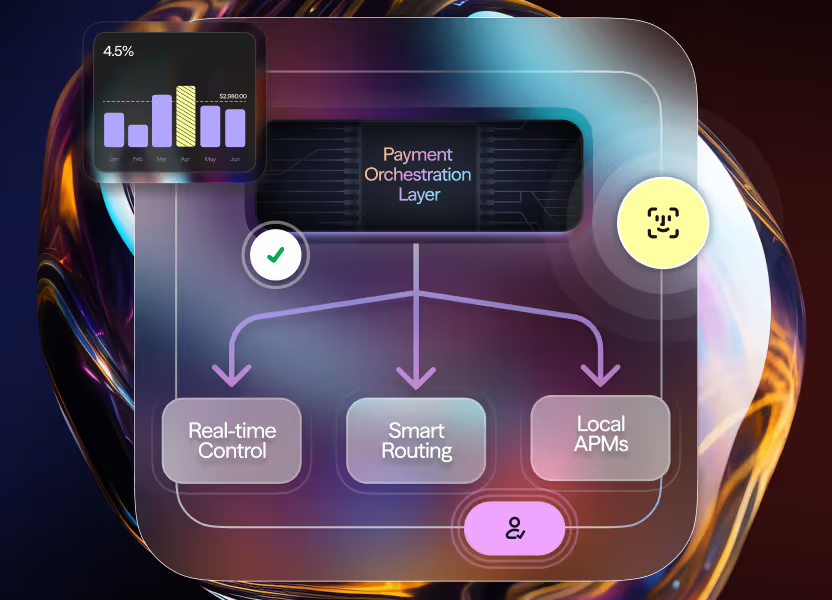
At its core, payment orchestration sits between your business and your payment providers. Instead of integrating directly with every PSP, acquirer or payment method, you integrate once with an orchestration layer.
From there, you can connect, manage and optimise multiple providers through a single setup.
This changes regional expansion in three important ways:
- First, you decouple your checkout from individual providers. Your product doesn’t need to change every time you add or switch a payment partner.
- Second, you standardise how payments are routed, monitored and managed across markets.
- Third, you can activate new regions and methods much faster because the heavy lifting has already been done.
In practical terms, this means you stop rebuilding your payments stack for every new country and start extending it instead.
Faster Access to Local Payment Methods
One of the biggest launch delays in new regions is local or alternative payment methods.
In many markets, cards alone are not enough. Customers expect to see the options they already trust, whether that’s wallets, bank transfers, real-time payments or local schemes. Without them, conversion suffers. But adding each new method usually means a new integration project.
With payment orchestration, local methods can be added through existing connections. Instead of building everything from scratch, you activate what’s already available in your orchestration setup and configure how it appears in checkout.
This dramatically shortens the time between “we need to support this market” and “customers can actually pay".
It also means you can test markets faster. You’re no longer committing months of development work just to see if demand is there.
Optimised Acquirer and PSP Onboarding
Acquiring banks and PSPs are essential for regional performance. Local acquiring can improve approval rates, reduce cross-border fees and increase trust with issuers. But integrating each new provider traditionally takes weeks or months.
Payment orchestration abstracts away complexity. The technical integration exists, leaving only configuration, routing and commercial setup.
This doesn’t remove the need for due diligence or contracts but it does remove a large part of the engineering bottleneck. Teams can onboard new providers in parallel with other launch work instead of waiting for payments to be “finished” first.
The result is a much shorter critical path to launch.
Smart Routing Without Rebuilding Your Checkout
When you enter a new region, performance is rarely predictable on day one. Some acquirers will perform better than others. Some routes will be faster, cheaper or more reliable. Without orchestration, improving this means code changes, new integrations and more testing.
With payment orchestration, routing logic is smart. You can direct transactions based on country, currency, payment method or performance data without touching your core product.
That means you can launch quickly with a baseline setup, then optimise in real time as data comes in. Instead of delaying launch to “get payments perfect", you launch sooner and improve continuously.
This alone can shave months off expansion timelines.
Built-In Resilience and Risk Management
Another common cause of delayed launches is risk management and reliability. Teams worry about single points of failure, downtime or poor performance in unfamiliar markets. So they delay, add more providers and build more complexity before going live.
Payment orchestration allows you to launch with resilience built in. Failover routing, provider redundancy and performance-based decision-making can be part of the setup from the start, not an afterthought.
That reduces the risk of painful early outages and removes another reason to postpone launch “just in case".

Less Operational Drag After Go-Live
Time-to-launch isn’t just about getting live. It’s also about how quickly you can stabilise and improve performance after launch.
Without orchestration, every change takes engineering time. New provider? Code change. New routing rule? Code change. New reporting needed? Another custom integration.
With orchestration, operations teams gain more control. They can monitor performance, adjust routing and manage providers without constantly pulling in developers. This speeds up iteration and keeps momentum high in the crucial first months of a new market launch.
How Payment Orchestration Technology Brings It All Together
Payment orchestration technology reduces time-to-launch by centralising integrations, simplifying provider management, enabling faster access to local payment methods and making routing and optimisation configurable rather than code-driven.
It lowers the need to rebuild your payment stack for every region, adds resilience from day one and gives teams the tools to improve performance continuously after launch instead of delaying go-live to chase perfection.
Launch Faster Without Cutting Corners
Entering a new region will always involve complexity. Regulations, customer expectations and local market dynamics don’t disappear just because you have better technology.
But payment orchestration changes how much of that complexity becomes a blocker.
Instead of treating payments as a series of one-off projects, you start treating them as a scalable capability. You launch sooner. You adapt faster. And you spend more time growing in new markets instead of rebuilding infrastructure.
Turning Expansion Into a Repeatable Process
One of the key advantages of payment orchestration isn’t just speed. It’s repeatability.
Once your orchestration layer is in place, every new market becomes easier than the last. You reuse the same foundation, the same monitoring, the same routing logic and the same operational workflows. Expansion stops being a special project and starts becoming part of normal business growth.
That’s what modern payment infrastructure should look like.
Entering New Regions Faster with Payment Orchestration
If your growth plans include new regions, new customers or new payment methods, your ability to launch quickly will increasingly depend on how flexible your payment setup is.
At finera., we help businesses expand faster with payment orchestration technology, card and crypto processing, and support for local and alternative payment methods. All designed to reduce complexity, improve performance, and turn regional launches into a repeatable, scalable process.
Ready to optimise your next market launch?
Talk to our team and see how finera. can help you move faster.
This article on payment methods is for informational and educational purposes only.
- Not Professional Advice: The content provided does not constitute financial, legal, tax, or professional advice. Always consult with a qualified professional before making financial decisions.
- No Liability: The authors, contributors, and the publisher assume no liability for any loss, damage, or consequence whatsoever, whether direct or indirect, resulting from your reliance on or use of the information contained herein.
- Third-Party Risk: The discussion of specific payment services, platforms, or institutions is for illustration only. We do not endorse or guarantee the performance, security, or policies of any third-party service mentioned. Use all third-party services at your own risk.
- No Warranty: We make no warranty regarding the accuracy, completeness, or suitability of the information, which may become outdated over time.
.avif)
Frequently Asked Questions

Still Have Questions?
Let’s Find the Right Solution for You
Stay Connected with Us!
Follow us on social media to stay up to date with the latest news, updates, and exclusive insights!