Managing Multiple Payment Providers Through One Integration
Why merchants run multiple payment providers, and how one integration simplifies managing them.
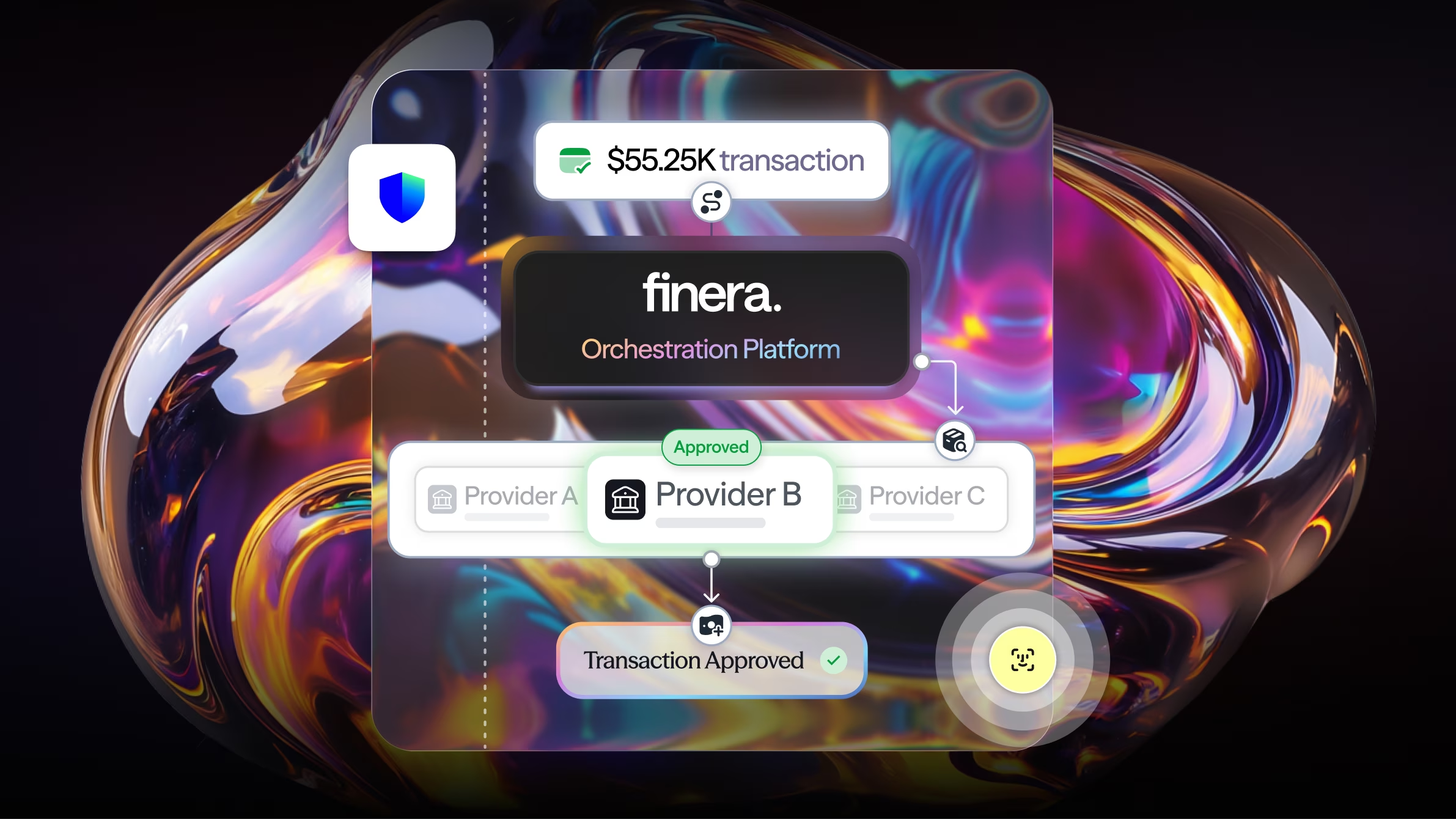
Most growing businesses do not set out to run several payment providers. It happens gradually. One provider is added to reach a new market, another to support a local payment method, a third for redundancy after an outage, a fourth because a particular acquirer offers better economics on certain card types. Each decision is sensible on its own. Together, they leave a payment operation stitched from separate integrations, each with its own dashboard, its own reporting format and its own maintenance burden.
This is now a mainstream reality rather than an edge case. According to 451 Research, part of S&P Global, around 64% of US-headquartered merchants with at least half of their sales online say they prefer to work with multiple payment processors. The same firm reports that the share of merchants preferring a multiprocessor setup rose from 50% in 2023 to 62% in 2025. The question for most merchants is no longer whether to use more than one provider, but how to manage them without the complexity growing faster than the business.
Why Merchants End up with Multiple Providers
The reasons are practical, and they compound as a business expands. Approval rates vary by region and by provider, so routing a transaction to a better-performing provider in a given market can recover sales that a single provider might lose. Local payment methods matter too, since no single provider covers every wallet, bank payment option and card scheme a merchant might need across markets. The European Central Bank's 2024 SPACE study found that around 24% of euro area consumers could not always use their preferred payment method, a gap that broader provider coverage helps close.
Resilience is a further driver. Relying on one provider means every transaction shares a single point of failure, so an outage can halt revenue entirely. Add cost optimisation and the pattern is clear: multiple providers are often the right answer. The difficulty is the operational weight that comes with them.
The Hidden Cost of Managing Providers Separately
Each direct integration carries a long tail of work. Engineering time goes into building and maintaining every connection, and that time recurs with each API change or new provider. Finance teams reconcile across mismatched reporting formats. Operations teams monitor several dashboards to answer a single question about performance. And when something breaks, tracing it across disconnected systems takes longer than it should.
There is a commercial cost hiding inside this complexity. When routing and provider coverage are hard to adjust, sales can slip away quietly. False declines are one example of the scale involved. Payments press outlet PYMNTS reported that an estimated $157 billion in US ecommerce sales were considered at risk from false declines in 2023, with a portion projected to be lost. Missing or poorly routed payment options may contribute to lost conversion in a similar way, with the Baymard Institute putting average documented cart abandonment at roughly 70%. Managing providers separately can make it harder to act on exactly these problems.
What "One Integration" Actually Means
The alternative is to place a single layer between the business and all of its providers. Rather than integrating each provider directly, a merchant integrates once, and that layer connects to the providers, acquirers and payment methods behind it. This is the core idea of payment orchestration: a unified control layer that abstracts the complexity of a multi-provider setup behind one connection.
In practice, that means one API to build against, one place to configure routing rules, and one consolidated view of performance across every provider. Adding a new provider or method becomes a configuration change rather than a fresh engineering project. For a clear primer on how this differs from working with a single gateway or PSP, finera.'s explainer on choosing the right payment stack is a useful reference.
The Benefits of a Single Integration
Consolidating providers behind one integration tends to deliver several related gains.
The first is performance. With multiple providers connected, smart routing can direct each transaction along a well-performing path, which is designed to help improve approval rates and recover payments a single provider might otherwise decline. The second is resilience. If one provider experiences an outage, transactions may be able to fail over to an alternative, which can help protect revenue. The third is reach, since connecting more providers and local methods through one layer can make it easier to meet customers with the options they expect in each market. The fourth is visibility, because a single, consolidated view of performance across providers can turn reconciliation and analytics from a manual chore into something a team can act on. And the fifth is speed, as adding providers and methods through configuration rather than code can help a business adapt as markets and preferences shift.
Taken together, these are less about any single feature and more about flexibility: the ability to change a payment strategy as conditions change, without re-engineering the stack each time.
What to Look for in a Payments Partner
Not every approach to consolidation is equal. When evaluating how to manage multiple providers through one integration, it can help to look for a few things: a genuinely provider-agnostic layer that does not lock you into a single processor; configurable routing and failover rules that can be adjusted without heavy development; consolidated reporting across connected providers; support for the local payment methods your markets actually use; sound security practices such as tokenisation and PCI DSS alignment; and responsive human support when something needs attention.
The right combination depends on where a business operates and how it wants to grow.

One integration with finera.
At finera., we aim to help merchants simplify payment complexity through orchestration, smart routing, local payment method coverage and multi-provider infrastructure designed to support global growth. Managing multiple providers through one integration is a practical expression of that: connect the providers, acquirers and payment methods your business needs, route across them, and see everything in one place, with 24/7 human support behind it.
If you are looking to reduce integration overhead, improve payment performance or add providers and methods without added complexity, talk to our payments team.
This article on payment methods is for informational and educational purposes only.
- Not Professional Advice: The content provided does not constitute financial, legal, tax, or professional advice. Always consult with a qualified professional before making financial decisions.
- No Liability: The authors, contributors, and the publisher assume no liability for any loss, damage, or consequence whatsoever, whether direct or indirect, resulting from your reliance on or use of the information contained herein.
- Third-Party Risk: The discussion of specific payment services, platforms, or institutions is for illustration only. We do not endorse or guarantee the performance, security, or policies of any third-party service mentioned. Use all third-party services at your own risk.
- No Warranty: We make no warranty regarding the accuracy, completeness, or suitability of the information, which may become outdated over time.
.avif)
Frequently Asked Questions

Still Have Questions?
Let’s Find the Right Solution for You
Stay Connected with Us!
Follow us on social media to stay up to date with the latest news, updates, and exclusive insights!