How Local Payment Methods Shape Global Payment Strategy
Why local payment methods can drive conversion and trust, and how to localise a payment strategy.
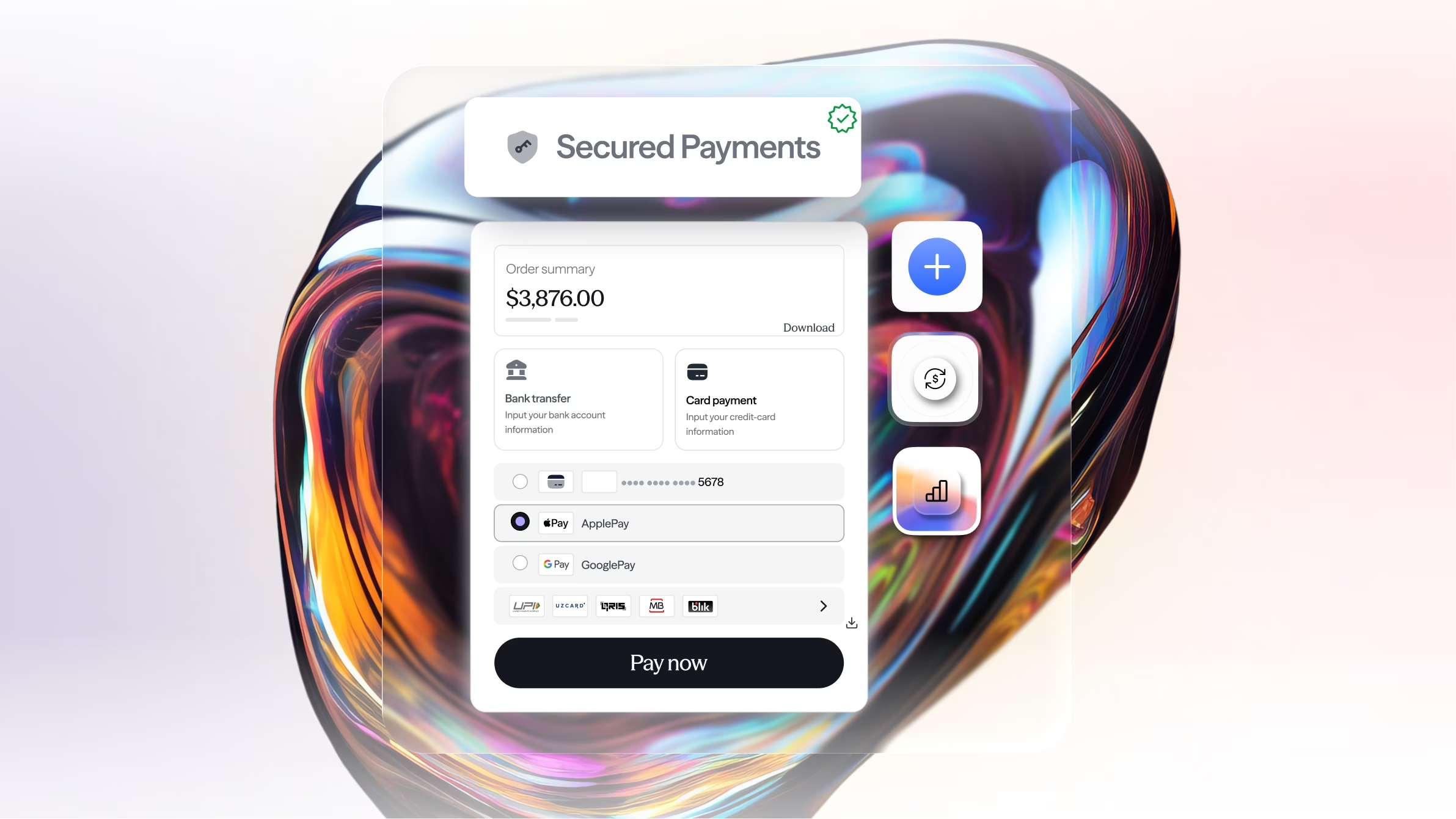
Expanding into a new market is rarely just a matter of translating a website and switching on shipping. The moment a customer reaches checkout, global ambition meets local reality. If the payment methods on offer are unfamiliar, or the ones a customer trusts are missing, the sale can stall at the final step, no matter how strong the product or the marketing that brought them there.
This is why local payment methods have moved from a technical afterthought to a strategic priority. Payment localisation, offering the methods people in each market actually prefer, increasingly shapes conversion, customer trust and the pace of international growth. This article looks at why preferences differ, why local methods matter more than ever, and how to build a global payment strategy that stays locally relevant without becoming unmanageable.
Why Do Payment Preferences Differ Across Markets?
How people pay is shaped by far more than convenience. Local banking infrastructure, cultural habits, regulation and the availability of particular schemes all influence what feels normal and trustworthy in a given market. The result is that the "default" payment method varies enormously from country to country.
The contrast is easy to see across Europe alone. The European Central Bank's 2024 SPACE study captures this variation neatly: mobile payments accounted for more than 10% of in-store transactions in some euro area countries and less than 5% in others. Same continent, same currency, very different habits. A payment rail that feels obvious in one market can be unknown in the next.
Why Local Payment Methods Matter More Than Ever
The broad direction of travel appears consistent. Card usage, while still important, is no longer the automatic default it once was in many fast-growing markets. Alternative payment options such as digital wallets and account-to-account systems are widely projected to expand rapidly. Across a number of studies, a common pattern emerges: many consumers appear to gravitate towards the alternative payment methods that feel local and familiar to them.
For businesses selling internationally, that shift changes the calculation. Supporting local methods is no longer a nice-to-have for a handful of markets. It is increasingly part of what it takes to compete credibly in each one.
How Payment Localisation Influences Conversion
The commercial link runs through the checkout. When a customer cannot pay the way they expect to, the risk is not just friction but abandonment. The Baymard Institute puts average cart abandonment at around 70%, with too few payment options and a lack of trust at the payment step among the contributing causes. The ECB study reinforces the point from the consumer side, finding that around 24% of euro area consumers reported that their preferred payment method was not always available.
There is a trust dimension too. A familiar local method signals that a business understands and belongs in the market, which can matter as much as price. Payment localisation, then, is not only about removing friction. It can also strengthen the confidence a customer needs to complete a purchase with a brand they may not yet know well.

How to Expand Internationally Without Adding Complexity
Here lies the tension. Every new market can bring new preferred methods, new local acquiring relationships and new currencies. Supported through separate, direct integrations, that expansion tends to multiply engineering work, reconciliation overhead and points of failure. The strategy that wins customers locally can, if handled the traditional way, quietly slow the business down.
The goal, therefore, is to add local relevance without adding proportionate complexity. That means being able to switch on the right methods for a market as a configuration rather than a fresh build, and to manage them all through one place rather than many. It is the difference between localisation being an enabler of growth and localisation becoming a tax on it.
Building a Global Payment Strategy with Local Relevance
A sound approach is to think global and act local. Rather than offering every possible method everywhere, which adds cost and clutter, the aim is to offer the right mix for each market: the dominant local methods, the relevant wallets and account-to-account rails, and cards where they still lead, supported by multi-currency pricing and, where useful, local acquiring through a global acquirer network to help lift approval rates.
This is a decision informed by data, not assumption. Understanding how customers in each target market actually prefer to pay, and reviewing performance market by market, is what turns a generic global checkout into a genuinely local one. finera.'s perspective on optimising payments for emerging markets explores this local-first mindset in more depth.
How Payment Orchestration Can Simplify Local Payment Method Expansion
This is where payment orchestration can become a practical enabler. By connecting cards, alternative payment methods, open banking and local rails through a single integration, orchestration can help a business add or adjust payment methods per market with less need to re-engineer its checkout each time. Combined with unified reporting and intelligent routing, it can help turn payment localisation from a series of one-off projects into a more repeatable capability.
At finera., we aim to help merchants manage payment complexity through orchestration, smart routing, local payment method coverage and multi-provider infrastructure designed to support global growth. The goal is a payment experience that can feel local across many markets, while remaining manageable from one place.
If you are expanding internationally and want your checkout to feel local wherever your customers are, talk to our payments team.

This article on payment methods is for informational and educational purposes only.
- Not Professional Advice: The content provided does not constitute financial, legal, tax, or professional advice. Always consult with a qualified professional before making financial decisions.
- No Liability: The authors, contributors, and the publisher assume no liability for any loss, damage, or consequence whatsoever, whether direct or indirect, resulting from your reliance on or use of the information contained herein.
- Third-Party Risk: The discussion of specific payment services, platforms, or institutions is for illustration only. We do not endorse or guarantee the performance, security, or policies of any third-party service mentioned. Use all third-party services at your own risk.
- No Warranty: We make no warranty regarding the accuracy, completeness, or suitability of the information, which may become outdated over time.

Frequently Asked Questions

Still Have Questions?
Let’s Find the Right Solution for You
Stay Connected with Us!
Follow us on social media to stay up to date with the latest news, updates, and exclusive insights!


.avif)