Optimising Payments for Emerging Markets: A "Local-First" Approach
Learn how a local-first payments strategy helps businesses optimise transactions and scale.

For years, global expansion followed a predictable formula: enable card payments, localise language and currency and launch. But across emerging markets, that approach is increasingly falling short.
Throughout high-growth regions, alternative payment methods (APMs), including domestic bank transfers, open banking payments, QR code systems and mobile wallets, are increasingly preferred over international card schemes. This shift is particularly critical for optimising payments for iGaming, where these local-first methods reduce friction at checkout and align more closely with how consumers manage money on a day-to-day basis.
As we head into 2026, merchants looking to scale sustainably in emerging markets may benefit from recognising a shift: payments are increasingly being viewed as local infrastructure, rather than a generic layer of commerce.
What “Local-First” Really Means in Payments
A local-first payment stack prioritises alternative payment methods that consumers already recognise and trust.
This includes:
- Bank-backed transfer systems.
- Account-to-account (A2A) payments.
- QR code standards.
- Domestic card networks.
- Mobile wallets tied to local banks or telecoms.
Importantly, local-first does not replace cards. Instead, it places cards alongside APMs in proportion to their actual relevance within each market.
Why Cards Struggle in Emerging Markets
In many emerging economies, bank account ownership significantly exceeds card ownership. Open banking infrastructure enables fast, direct payments without the need for card issuance, while domestic rails often provide better approval alignment than cross-border card transactions.
Common challenges with card-heavy strategies include:
- Higher decline rates due to cross-border risk scoring.
- Added friction from card entry and authentication.
- Lower consumer trust when entering card details.
- FX and card scheme fees impacting pricing.
By contrast, open banking payments and local APMs operate on domestic rails, reducing both technical friction and consumer hesitation.
The Rise of Local APM Dominance Across Regions
The rise of alternative payment methods (APMs) is already reshaping how commerce operates across emerging and growth markets. Rather than relying primarily on international card schemes, many regions are built around domestic payment rails, real-time transfers and mobile-first wallets.
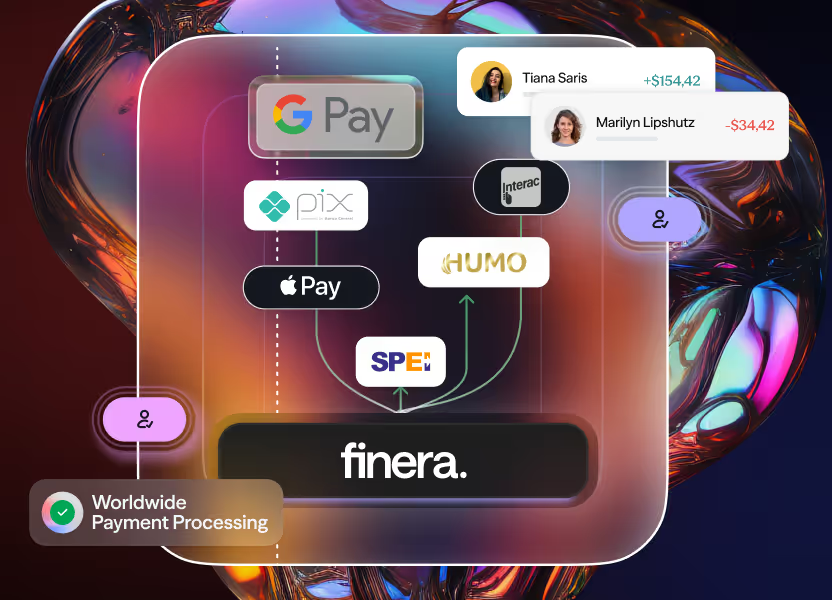
In Southeast Asia, mobile wallets and bank-linked payments are the preferred methods for everyday digital transactions. Solutions such as GCash in the Philippines and QRIS in Indonesia reflect markets where consumers prefer app-based and QR-enabled payments over cards, particularly for mobile and in-app purchases.
In Central Asia, domestic card networks and bank-backed payment systems remain central to local commerce. Methods like UZCARD and HUMO are deeply embedded into the financial ecosystem, enabling consumers to transact online using rails they recognise and trust.
Across Latin America, real-time account-to-account transfers have become the preferred option for many consumers. Systems like PIX in Brazil and SPEI in Mexico support instant payments directly from bank accounts, offering speed and familiarity that often outperform traditional card payments for everyday online use.
In Europe, several markets continue to rely heavily on local APMs rather than international cards. Examples include iDEAL in the Netherlands and BLIK in Poland.
Interac in Canada for merchants serving North American audiences. These methods are closely aligned with domestic banking habits and enjoy broad consumer adoption.
Across Africa and parts of the Middle East, alternative rails such as Instant EFT, open banking payments and bank transfer–based solutions are widely used, particularly in markets where card usage is lower or where trust in direct bank authentication is stronger. In parallel, payment types such as cash-style transfers and solutions like Havale continue to play a role in specific corridors.
Taken together, these examples highlight a consistent pattern, where APMs succeed when they reflect how consumers already move money locally.
As a result, trust follows familiarity and familiarity remains fundamentally local.

Local Payments Reduce Friction and Friction Kills Growth
Payments influence conversion more than almost any other part of checkout.
When customers see a method they recognise:
They hesitate less.
They complete authentication faster.
They are less likely to abandon.
Local payment methods reduce:
- Form fatigue (no card entry).
- Perceived fraud risk.
For merchants, this translates into cleaner payment flows, higher approval alignment and more predictable performance.
Why “Adding Local Methods” Isn’t Enough
Many merchants acknowledge the need for local payment methods but underestimate the operational complexity they introduce.
Without a structured approach, local expansion often leads to:
- Multiple PSP integrations.
- Different settlement timelines.
- Manual routing decisions.
This is where strategies break down. The issue isn’t local payments. It's managing them at scale.
The 2026 Imperative: Orchestrated, Local-First Payment Stacks
Competitive merchants are beginning to focus less on whether to support local payment methods and more on how to manage them intelligently across markets.
A local-first stack, when paired with payment orchestration, allows businesses, particularly those optimising payments for iGaming to:
- Select the most relevant method by market and device.
- Route transactions dynamically.
- Reduce reliance on a single rail.
- Add or remove methods without rebuilding infrastructure.
Orchestration does not replace local payments. It makes them sustainable.
Cards Remain Important
Cards remain important, especially for cross-border travel, high-value purchases and certain demographics.
But an effective approach in emerging markets is often hybrid. Cards where they perform well. Local methods where they dominate.
Merchants that prioritise card-centric checkouts into card-light markets may risk a mismatch between infrastructure and reality.
Preparing Your Payment Stack for Emerging Markets in 2026
To scale into emerging markets effectively, merchants should ask:
- Which payment methods are already dominant locally?
- Which rails are backed by domestic banks or regulators?
- How does authentication align with consumer behaviour?
- Can my infrastructure adapt without engineering bottlenecks?
The answers shape not just payment performance but brand perception.
In 2026, payments will no longer be a supporting function of global expansion. They will be a strategic lever. A local-first approach recognises that growth does not come from asking customers to adapt to your checkout, it comes from adapting your checkout to them.
Does your payment stack reflect local payment habits across the regions you serve?
Connect with finera. to discuss how a local-first payment approach can potentially support your expansion into new markets.

DISCLAIMER
This article on payment methods is for informational and educational purposes only.
- Not Professional Advice: The content provided does not constitute financial, legal, tax, or professional advice. Always consult with a qualified professional before making financial decisions.
- No Liability: The authors, contributors, and the publisher assume no liability for any loss, damage, or consequence whatsoever, whether direct or indirect, resulting from your reliance on or use of the information contained herein.
- Third-Party Risk: The discussion of specific payment services, platforms, or institutions is for illustration only. We do not endorse or guarantee the performance, security, or policies of any third-party service mentioned. Use all third-party services at your own risk.
- No Warranty: We make no warranty regarding the accuracy, completeness, or suitability of the information, which may become outdated over time.
.avif)
Frequently Asked Questions

Still Have Questions?
Let’s Find the Right Solution for You
Stay Connected with Us!
Follow us on social media to stay up to date with the latest news, updates, and exclusive insights!