Tokenisation vs Encryption: Securing Modern Payment Stacks
Tokenisation vs encryption explained and how both secure modern payment systems and reduce risk.
Payment security is no longer just a compliance requirement. It is a core part of how businesses build trust, protect revenue, and scale safely across markets.
As payment ecosystems become more complex, so does the challenge of protecting sensitive data. Card details, personal information, and transaction data move across multiple systems, providers, and geographies.
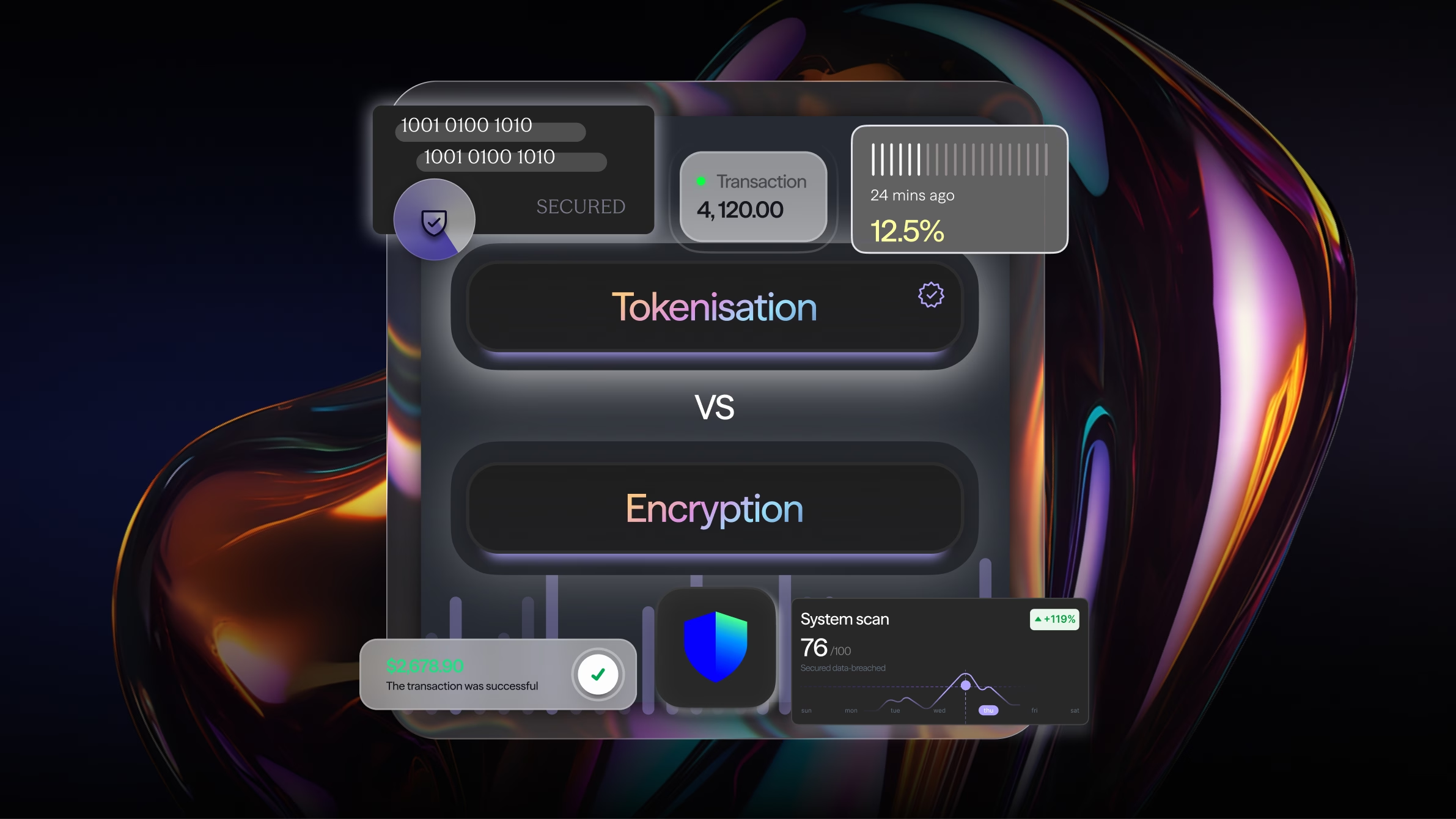
Two concepts often come up in this context: tokenisation vs encryption.
They are sometimes used interchangeably, but they solve different problems. Understanding the difference between tokenisation and encryption is essential for building a secure payment stack that supports both performance and compliance.
Why Securing Modern Payment Systems is Non-Negotiable
Every transaction carries sensitive data. If that data is exposed, the consequences go beyond financial loss. It affects customer trust, brand reputation, and regulatory standing.
According to IBM’s 2025 Cost of a Data Breach Report, the global average cost of a data breach is now $4.44 million. For U.S.-based organisations, that figure has reached $10.22 million. Costs in other markets vary.
This highlights a simple reality. Payment security is not just a technical requirement. It is a business-critical priority.
Modern payment systems must balance two priorities:
- Protecting sensitive information
- Maintaining seamless user experiences
This is where data tokenisation and data encryption play critical roles.
They are not competing approaches. They are complementary layers of a secure payment stack.
What Is Encryption?
Encryption is the process of converting sensitive data into an unreadable format using an algorithm and a key.
For example, when a customer enters card details at checkout, encryption is designed to make data significantly harder to read while it is being transmitted between systems.
One of the most common implementations in payments is point-to-point encryption (P2PE). This protects cardholder data from the moment it is captured until it reaches the payment processor.
Encryption is highly effective for:
- Protecting data in transit
- Securing communications between systems
- Preventing interception by unauthorised parties
However, encrypted data can still be decrypted if the correct key is available. This means it still exists in a reversible form.
What Is Tokenisation?
Tokenisation takes a different approach.
Instead of transforming sensitive data, it replaces it entirely with a non-sensitive equivalent, known as a token.
For example, a card number might be replaced with a randomly generated token that has no exploitable value outside the system.
The original data is stored securely in a separate environment, often referred to as a token vault.
This makes data tokenisation particularly effective for:
- Reducing exposure to sensitive data.
- Minimising risk in case of breaches.
- Simplifying compliance requirements.
Unlike encryption, tokens are not designed to be reversible without authorised access to the secure vault.
Tokenisation vs Encryption: What Is the Difference?
The key difference between tokenisation and encryption lies in how data is protected and used.
Encryption protects data by transforming it, but the original data still exists and can be restored.
Tokenisation removes sensitive data from the environment entirely and replaces it with a reference value.
In practical terms:
- Encryption protects data in motion.
- Tokenisation protects data at rest and in use.
This is why modern payment systems typically use both.
Which Is Better for Payment Security: Tokenisation or Encryption?
This is a common question, but it is not about choosing one over the other.
Encryption is essential for securing data as it moves between systems. Without it, data would be vulnerable during transmission.
Tokenisation, on the other hand, reduces the amount of sensitive data that businesses need to store or handle.
The real answer is that both are required for effective payment security.
A secure payment stack uses encryption to protect data in transit and tokenisation to minimise exposure within systems.
How Tokenisation Secures Modern Payment Stacks
Tokenisation has become a cornerstone of securing modern payment systems.
By replacing sensitive data with tokens, businesses can:
- Reduce the risk of data breaches.
- Limit the scope of sensitive data handling.
- Simplify internal systems.
This is especially important for merchants operating across multiple providers and markets.
In a tokenised environment, sensitive data does not need to move between systems repeatedly. Instead, tokens can be used for: Recurring payments, refunds and transaction tracking.
This reduces both operational complexity and risk.
Tokenisation vs Encryption for PCI Compliance
Compliance is another key factor in the tokenisation vs encryption discussion.
Standards such as PCI DSS compliance require businesses to protect cardholder data and limit its exposure.
Encryption helps meet these requirements by securing data during transmission.
Tokenisation can go further by reducing the amount of cardholder data that falls within the scope of compliance.
When sensitive data is replaced with tokens, systems that only handle tokens, depending on the specific implementation and assessor determination, fall outside certain PCI DSS scope requirements. Merchants should consult a qualified security assessor for guidance specific to their environment.
Examples of Tokenisation in Payments
Tokenisation is already widely used across payment systems.
Common examples include:
- Saving card details securely for repeat purchases.
- Enabling one-click checkouts.
- Supporting subscriptions and recurring billing.
- Powering digital wallets.
In each case, the actual card data is not stored or reused directly. Instead, tokens are used to represent that data securely, which makes tokenisation beneficial for modern busineesses.
This allows for a smoother user experience while maintaining strong security controls.
Securing a Modern Payment Stack
A secure payment stack is not built on a single technology. It is built on layers.
Encryption protects data as it moves.
Tokenisation protects data within systems.
Together, they reduce risk while maintaining flexibility.
As payment ecosystems evolve, this layered approach becomes increasingly important.
Merchants are no longer working with a single provider or system. They are managing multiple integrations, payment methods, and geographies.
Without the right security architecture, complexity can increase exposure.
Building for Security and Scale
Security is not just about protection. It is also about enabling growth.
A well-designed payment infrastructure allows businesses to expand into new markets, adopt new payment methods, and scale operations without increasing risk.
Tokenisation and encryption both play a role in this.
They allow businesses to maintain control over sensitive data while building systems that are flexible and adaptable.
Securing Modern Payment Stacks with Tokenisation, Encryption, and Payment Orchestration
The discussion around tokenisation vs encryption is not about choosing one over the other. It is about understanding how they work together to secure modern payment systems.
Encryption protects sensitive data in transit, making it significantly more difficult to intercept as it moves across systems. Tokenisation reduces exposure by replacing that data entirely, limiting where and how it can be used.
Together, they form the foundation of a secure payment stack, especially when combined with broader infrastructure capabilities such as payment orchestration, smart routing, and a global acquirer network.
Modern payment environments require more than basic protection. They demand layered security that supports:
- Multi-currency payments across regions
- Real-time fraud and risk management
- Continuous optimisation through real-time analytics
- Efficient chargeback resolution processes
- Continuous monitoring with 24/7 support.
Build a More Secure Payment Ecosystem Today
Security must evolve alongside payment performance. Businesses need systems that not only protect sensitive data but also enable flexibility, scalability and control.
This is where a well-designed payment infrastructure makes a difference. By combining data tokenisation, data encryption, and orchestration, merchants can build payment systems that are secure, compliant, and ready to scale across markets.
In the end, securing payments is not just about reducing risk. It is about enabling growth with confidence.
At finera., we help businesses build payment systems that balance security, performance, and scalability. By combining payment orchestration technology with advanced security layers, including tokenisation and encryption, merchants can operate with confidence in increasingly complex environments. Talk to our team to explore how we can support your payment infrastructure.
This article on payment security is for informational and educational purposes only.
- Not Professional Advice: The content provided does not constitute financial, legal, tax, or professional advice. Always consult with a qualified professional before making financial decisions.
- No Liability: The authors, contributors, and the publisher assume no liability for any loss, damage, or consequence whatsoever, whether direct or indirect, resulting from your reliance on or use of the information contained herein.
- Third-Party Risk: The discussion of specific payment services, platforms, or institutions is for illustration only. We do not endorse or guarantee the performance, security, or policies of any third-party service mentioned. Use all third-party services at your own risk.
- No Warranty: We make no warranty regarding the accuracy, completeness, or suitability of the information, which may become outdated over time.

Frequently Asked Questions

Still Have Questions?
Let’s Find the Right Solution for You
Stay Connected with Us!
Follow us on social media to stay up to date with the latest news, updates, and exclusive insights!