The Payment Coverage Checklist for Global Merchants
Read about the essential areas of payment coverage and identify gaps that may affect approval rates.
Most merchants believe they already accept payments everywhere. The checkout loads, the cards go through, money lands in the account. Coverage looks complete.
Then the data tells a different story. Digital payments now account for roughly two-thirds of global e-commerce value, yet 72% of merchants report higher payment failure rates on cross-border transactions. The gap between "we accept payments" and "we capture every payment we could" is where revenue quietly leaks away.
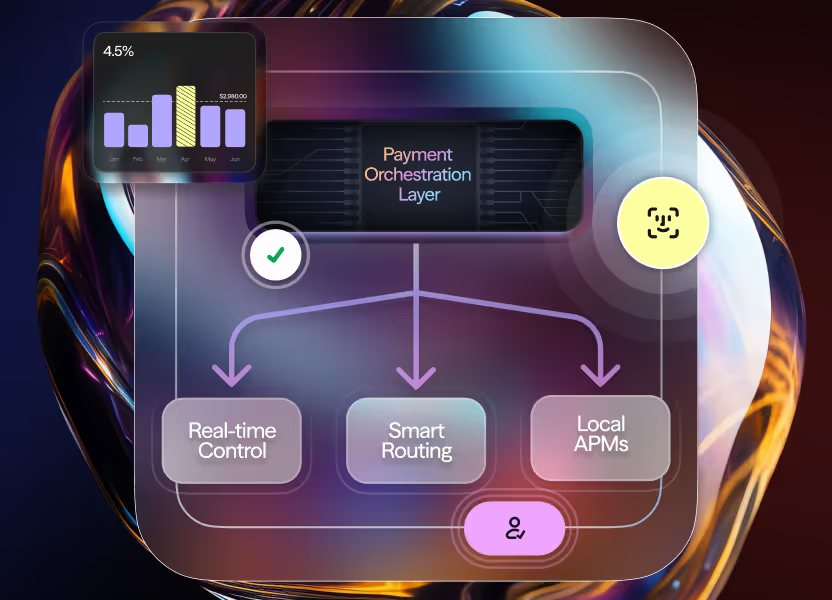
Real coverage is not simply a checkout that works. It is about having the right method, the right route, the right currency and the right rail available at the moment a customer tries to pay, across the markets you sell to. The layer that makes this possible is a payment orchestration platform: a single integration that connects your payment methods, acquirers and rails, then aims to route each transaction down a path likely to succeed.
Use the six checks below to see where your coverage falls short. Tick honestly.
The six checks at a glance:
- Local payment methods
- Multiple acquiring partners
- Smart routing enabled
- Local currencies supported
- Payment performance monitored
- Scalable infrastructure
Check 1: Local Payment Methods
Shoppers abandon what they cannot pay with. The average cart abandonment rate sits near 70%, and a lack of preferred payment options is one of the fixable reasons behind it. In many markets, a global card is not the preferred option at all, wallets dominate in much of Asia, account-to-account transfers are growing fast in Europe and Latin America, and local schemes such as PIX and BLIK own their home turf.
Complete coverage means offering the wallets, bank transfers and local cards each market expects, not only the global schemes. That is the job of a broad alternative payment methods catalogue, working alongside card acquiring and open banking rails so customers are more likely to see a familiar way to pay.
Not sure which methods belong in a new market? Start with our guide to account-to-account vs card vs wallet.
Tick it if: every market you sell in shows at least one payment method local shoppers already trust.
Check 2: Multiple Acquiring Partners
A single acquirer is a single point of failure. One outage, one regional restriction or one tightened risk appetite, and transactions that should have approved simply stop. Relying on one processing relationship also caps your negotiating power and your approval ceiling.
Coverage means spreading volume across several acquirers so no single gap is likely to halt a payment. A global acquirer network can provide regional redundancy and may help improve local approval rates, while a payment bridge lets you connect existing PSPs and acquirers into one flow instead of rebuilding for each.
Tick it if: losing any one acquirer would not take a market offline.
Check 3: Smart Routing Enabled
Having multiple acquirers only helps if something decides where each transaction should go. Static, first-available routing leaves approvals on the table because it ignores which issuer, region or price point performs best for a given payment.
Smart routing aims to direct each transaction down the path most likely to approve, evaluating issuer, geography and cost in real time, and retrying elsewhere when the first attempt fails. It is the engine that turns a network of acquirers into higher, more consistent approval rates, and it sits at the core of many payment orchestration platforms.
Tick it if: your routing adapts to performance data, not just availability.

Check 4: Local Currencies Supported
Pricing in an unfamiliar currency introduces doubt at the worst possible moment, the point of payment. Shoppers hesitate, second-guess the exchange rate, and abandon. Settlement complexity and foreign-exchange costs then eat into whatever does convert.
Coverage means displaying and settling in local currency which can help lift conversion and reduce friction. Multi-currency payments let customers check out in the currency they think in, while you keep control of how funds are settled on your side.
Tick it if: customers rarely, if ever, see a foreign currency at checkout.
Check 5: Payment Performance Monitored
What goes unmeasured goes unfixed. Approval rates drift, declines cluster around specific issuers or regions, latency creeps up — and without visibility, the first sign of trouble is a quiet drop in revenue.
Coverage means tracking approval rates, declines and latency as they happen, then acting before losses compound. Real-time payment analytics turn raw transaction data into decisions, and pairing them with fraud and risk management can help protect performance gains from being undone by chargebacks. Monitoring also supports compliance: handling card data responsibly means meeting the PCI DSS standards that govern merchants at scale.
Tick it if: you would notice a regional approval-rate drop within hours, not weeks.
Check 6: Scalable Infrastructure
Growth should not mean rebuilding. If adding a market means a new integration, and adding a method means a new contract, your payment stack is a brake on expansion rather than an engine for it.
Coverage means being able to add methods, markets and volume with less need to re-architect or renegotiate for each one. A true payment orchestration platform can abstract complexity behind a single integration, so scaling can be closer to a configuration change than an engineering project. Learn more in our guide to designing payment infrastructure for global merchants.
Tick it if: entering your next market is a decision, not a development cycle.
How a Payment Orchestration Platform Ties the Six Together
Read the checklist again and a pattern emerges: the six checks are not six separate purchases. Local methods need acquirers behind them. Acquirers need routing to choose between them. Routing needs analytics to learn from. Analytics need to feed back into currency, risk and method decisions. Each check depends on the others.
That is precisely what payment orchestration is for. Rather than stitching together separate providers and hoping they cooperate, a payment orchestration platform unifies methods, currencies, acquirers, routing and reporting into one layer you integrate once and grow into. Coverage stops being a collection of features and becomes a single, manageable system, which is why orchestration has become the practical route to genuinely global payments, whether you sell across travel, retail or high-risk verticals.
Score Yourself
Six ticks suggests strong coverage. Anything less may point to a gap - and gaps can mean revenue left on the table.
If you counted fewer than six, the fix is rarely six new vendors. It is one orchestration layer that helps close the gaps together. Our payments team can help map where your coverage may fall short and help you understand what closing it could be worth.
This article on payment coverage is for informational and educational purposes only.
- Not Professional Advice: The content provided does not constitute financial, legal, tax, or professional advice. Always consult with a qualified professional before making financial decisions.
- No Liability: The authors, contributors, and the publisher assume no liability for any loss, damage, or consequence whatsoever, whether direct or indirect, resulting from your reliance on or use of the information contained herein.
- Third-Party Risk: The discussion of specific payment services, platforms, or institutions is for illustration only. We do not endorse or guarantee the performance, security, or policies of any third-party service mentioned. Use all third-party services at your own risk.
- No Warranty: We make no warranty regarding the accuracy, completeness, or suitability of the information, which may become outdated over time.

Frequently Asked Questions

Still Have Questions?
Let’s Find the Right Solution for You
Stay Connected with Us!
Follow us on social media to stay up to date with the latest news, updates, and exclusive insights!