
Pay by Bank: How Open Banking and Instant Bank Payments Are Reshaping Merchant Strategy
Discover how open banking and instant bank payments expand payment choice.
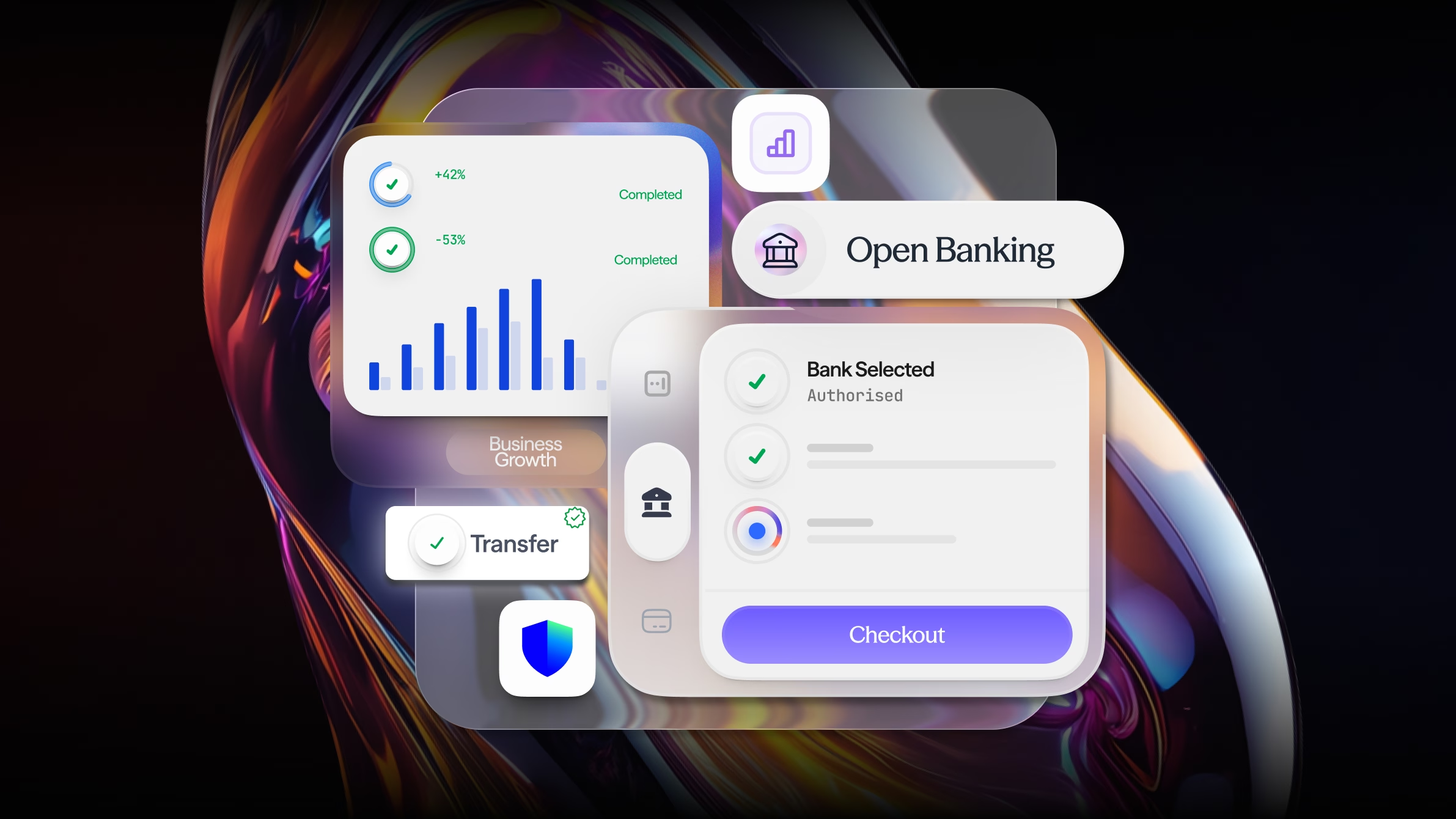
Cards still run the checkout in most markets. But quietly, a different rail is scaling fast and the merchants paying attention are already building it into their payment mix.
Customers now expect more ways to pay than ever, and they expect every one of them to work the first time, across devices and borders. Open Banking answers that expectation directly: it lets customers pay straight from their bank account, in real time, without card networks sitting in the middle. This guide explains what Open Banking is, how instant bank payments work, and why account-to-account payments are becoming a strategic option for merchants rather than a niche experiment.
What Is Open Banking?
Open Banking is a regulated framework that lets customers securely share their banking data, and authorise payments, through licensed third parties using bank APIs. Instead of typing card details, a customer approves a payment inside their own banking app. The money then moves directly from their account to the merchant's. That is an account-to-account (A2A) payment, and it is the engine behind pay-by-bank.
Adoption is no longer theoretical. In the UK alone, Open Banking reached 16.5 million user connections by December 2025, up 36% year on year, according to Open Banking Limited. One in five UK consumers and small businesses now use Open Banking, up from just one in seventeen in 2021. Globally, Juniper Research forecasts Open Banking users will climb from 183 million in 2025 to more than 645 million by 2029.
How Instant Bank Payments Usually Work
The flow is short and, for the customer, familiar. Four steps:
- Customer selects "Pay by Bank" at checkout and chooses their bank.
- Bank authentication: They approve the payment in their banking app using biometrics or their usual login.
- Payment authorisation: Strong customer authentication confirms the payment securely.
- Merchant confirmation: The merchant receives near-instant confirmation and, on real-time rails, the funds.
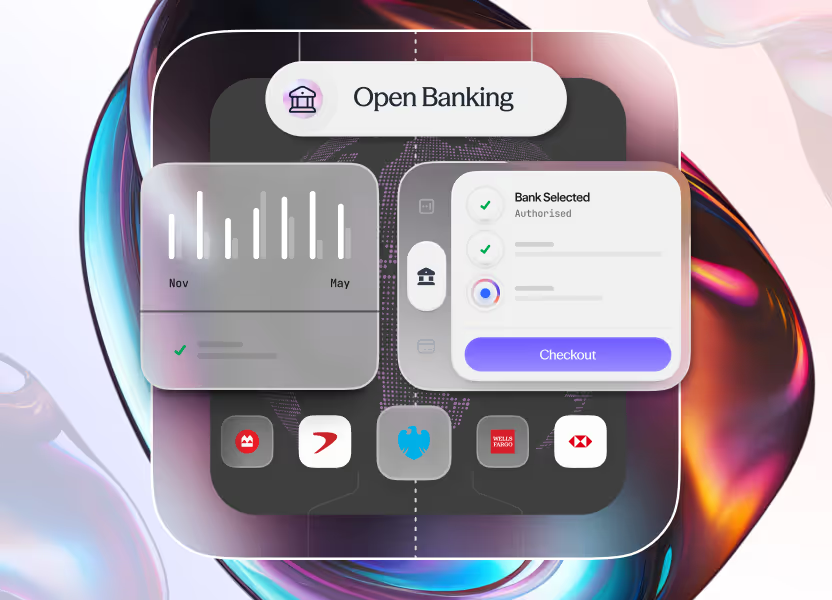
Because authentication happens inside the bank's own environment, there are no card numbers to enter, store or leak. That design choice can help reduce checkout friction and certain types of fraud exposure at the same time.
Behind the scenes, the payment travels over real-time bank rails, schemes such as Faster Payments in the UK or SEPA Instant across Europe, which is why confirmation, and increasingly the funds themselves, arrive in seconds. Unlike a card payment, there is no multi-day settlement window sitting between the sale and the money landing in the merchant's account. The transfer is a direct, push payment from the customer's account, initiated by the customer, rather than a request pulled through several intermediaries.
Built-In Security
Security is a core part of the Open Banking model. Every payment is confirmed inside the customer's own banking app, usually with biometrics or the login they already use, so approval is tied to the account holder rather than a card number that can be copied, skimmed or phished. No sensitive details are typed into the merchant's checkout.
Because no card details change hands, merchants also store less sensitive payment data, which shrinks the surface area an attacker can target. And since the customer approves each payment for a specific amount inside their bank, there is a clear record of exactly what was authorised, which helps reduce disputes and unauthorised-transaction claims. Bank-verified account data can further strengthen identity and anti-fraud checks, a real advantage in higher-risk verticals where knowing who is really behind a transaction matters.
Why Businesses Are Expanding Beyond Cards
Cards are not going anywhere. But relying on them alone leaves conversion, cost and resilience on the table and consumer behaviour has already moved. Instant rails are scaling just as fast. ACI Worldwide's Prime Time for Real-Time report forecasts 575.1 billion real-time transactions globally by 2028, around 27% of all electronic payments. In Europe, the EU Instant Payments Regulation is pushing instant transfers toward 13% of electronic payments by 2028, up from 8% in 2023. Offering cards alone increasingly means opting out of the fastest-growing part of the market.
The Business Benefits
Open Banking payments earn their place in the mix on four fronts:Q12
- Cost efficiency. A2A payments bypass card-scheme interchange and the fees layered on top, so cost per transaction is typically lower, a difference that compounds at volume.
- Reduced payment friction. No card entry, no manual data, fewer abandoned baskets. Authentication is one tap in an app the customer already trusts.
- Customer choice. Offering pay-by-bank alongside cards and alternative payment methods meets customers where they are and choice at checkout is directly tied to conversion.
How Payment Orchestration Supports Open Banking Adoption
Payment orchestration is the layer that makes Open Banking practical at scale. Instead of managing cards, wallets and bank rails as separate silos, orchestration unifies them behind one integration, then routes each transaction to the method and provider most likely to approve it at the lowest cost.
For Open Banking specifically, orchestration lets merchants add instant bank payments as one more route, with automatic failover to a backup acquirer or PSP if the bank connection fails, helping to keep the transaction alive while minimising disruption to the user experience. It turns a diversified payment mix from an integration burden into a configuration choice, and gives finance teams unified reporting across every rail.
The strategic case is straightforward. Payment choice is now a driver of conversion, cost and resilience, not a back-office detail. Open Banking can offer merchants a fast, secure and potentially lower-cost rail; orchestration can make it more straightforward to adopt without rebuilding the stack.
Ready to Expand Your Payment Options?
Diversifying beyond cards is no longer optional for merchants competing on experience and margin. Explore how finera. Open Banking payments help you accept secure, instant bank payments and route them intelligently, alongside every other method your customers want to use.

This article on payment methods is for informational and educational purposes only.
- Not Professional Advice: The content provided does not constitute financial, legal, tax, or professional advice. Always consult with a qualified professional before making financial decisions.
- No Liability: The authors, contributors, and the publisher assume no liability for any loss, damage, or consequence whatsoever, whether direct or indirect, resulting from your reliance on or use of the information contained herein.
- Third-Party Risk: The discussion of specific payment services, platforms, or institutions is for illustration only. We do not endorse or guarantee the performance, security, or policies of any third-party service mentioned. Use all third-party services at your own risk.
- No Warranty: We make no warranty regarding the accuracy, completeness, or suitability of the information, which may become outdated over time.

Frequently Asked Questions

Still Have Questions?
Let’s Find the Right Solution for You
Stay Connected with Us!
Follow us on social media to stay up to date with the latest news, updates, and exclusive insights!




.avif)