How Intelligent Routing Performs Under Issuer Pressure in Regulated Markets
Issuer pressure in payments and why orchestration and smart routing ensure resilience
Few industries demonstrate the challenges of payment infrastructure. Transactions are frequent and cross-border by nature and subject to frequent regulatory oversight. Issuers operate under heightened scrutiny, card networks monitor activity closely and approval behaviour can change without notice. In this environment, intelligent routing is essential for maintaining stable operations.
This article examines how intelligent routing performs under issuer pressure, using iGaming as a clear real-world example of a regulated market where traditional payment models face significant challenges. It explains why issuer behaviour becomes unpredictable, how routing decisions break down under regulatory constraints and why modern payment orchestration is required to maintain stability.
Key Takeaways
- iGaming is one of the most issuer-constrained payment environments
- Issuer pressure, not fraud, drives many declines in regulated markets
- Static routing models fail quickly in iGaming conditions
- Payment orchestration enables systems to adapt as issuer behaviour shifts
- Orchestrated payment flows are essential for operating under regulatory scrutiny
Why iGaming Is the Ultimate Test for Payment Infrastructure
iGaming sits at the intersection of regulation, risk and real-time payments. Unlike standard eCommerce, transactions are continuous, player behaviour is dynamic and regulatory exposure is high. Issuers evaluating iGaming transactions must balance fraud prevention, compliance obligations and network rules simultaneously.
As a result, issuer pressure is higher in iGaming than in most other industries. Authorisation decisions tend to be conservative and approval outcomes are often inconsistent. A transaction that succeeds through one acquirer may fail through another moments later.
This makes iGaming a valuable environment to study how intelligent routing behaves under stress, with lessons applicable to other regulated markets.
Understanding Issuer Pressure in iGaming Transactions
Issuer pressure refers to the restrictive authorisation behaviour applied by issuing banks when they perceive elevated regulatory or risk exposure. In iGaming, this pressure is structural rather than situational.
Issuers monitor factors such as merchant classification, jurisdiction, transaction velocity and historical dispute data. When these signals align with regulatory sensitivity, issuers tighten approval thresholds broadly rather than selectively. Legitimate transactions may be declined not because they are fraudulent but because they fall into risk-adjacent patterns.
In iGaming, issuer pressure fluctuates constantly. Regulatory updates, enforcement actions or changes in network guidance can alter approval behaviour rapidly. Payment systems must be designed to absorb this volatility rather than react to it after the fact.
Why Regulated Markets Amplify Declines
Regulated markets introduce additional layers of decision-making that do not exist in standard payment environments. Issuers are accountable not only for fraud outcomes but also for compliance failures and reporting accuracy.
In iGaming, this accountability is amplified. Issuers may decline transactions simply to reduce exposure, especially during periods of regulatory uncertainty. This leads to higher rates of soft declines, where transactions fail without actionable feedback.
Without payment orchestration, these declines may appear random. Teams are left troubleshooting symptoms instead of addressing the underlying structural issue: issuer-driven volatility.
The Failure of Static Routing in iGaming Environments
Static routing assumes predictability. Transactions are sent through predefined paths based on geography or historical performance. In iGaming, this assumption often does not hold.
Issuer behaviour can vary by country, bank, card network and even time of day. A route that performs well in the morning may degrade by evening due to issuer recalibration. Static systems continue sending traffic through failing paths until performance issues become obvious.
This delay is costly. Approval rates drop, players abandon transactions and recovery becomes reactive. Intelligent routing can function most effectively with an architecture that allows it to adapt in real time.
Intelligent Routing Requires an Orchestration Layer
Intelligent routing is often described as a decision engine but decisions alone may not fully address issuer pressure. Routing logic must be executed in real time, across providers, without friction.
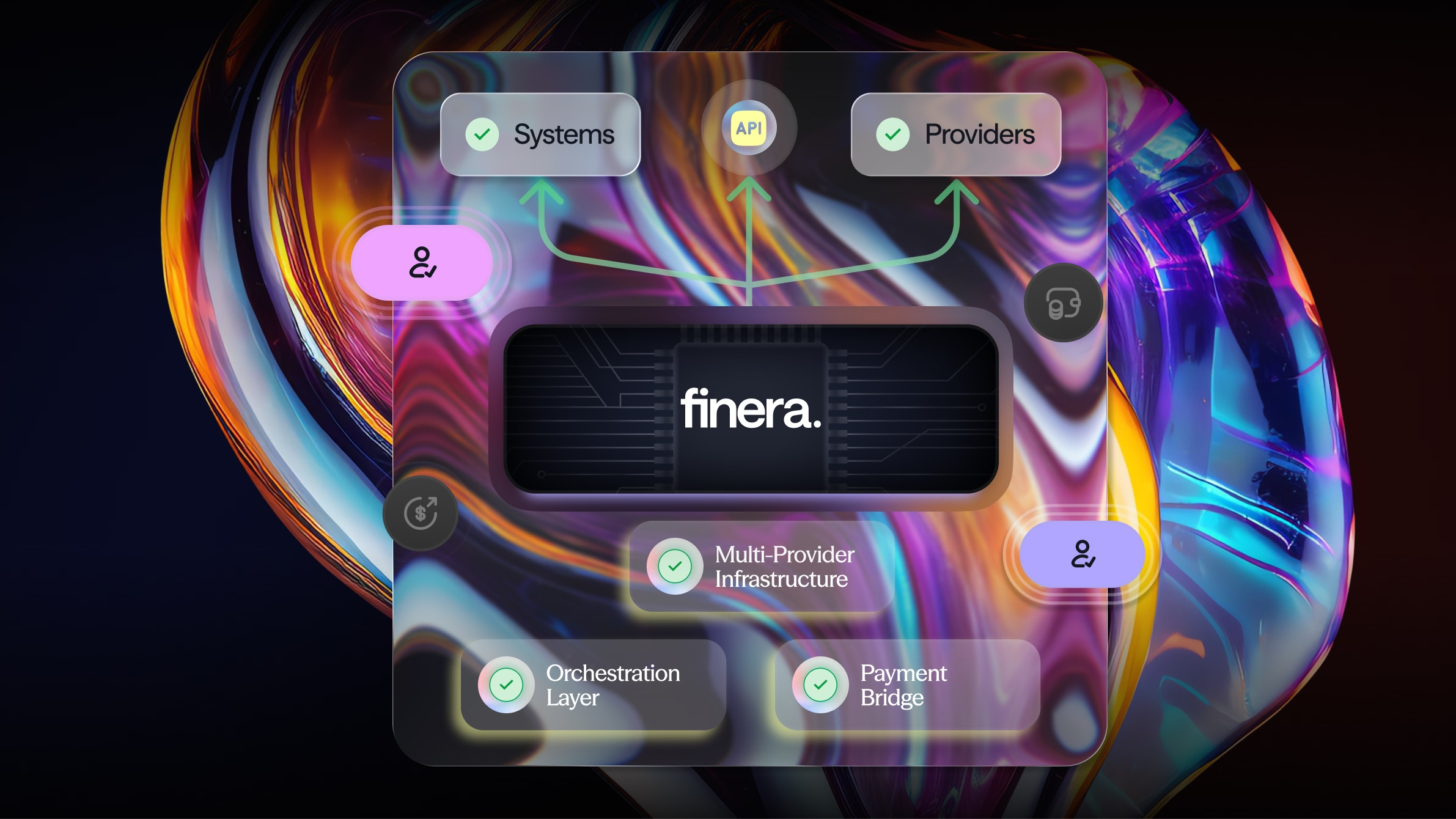
An orchestration layer provides this execution capability. It enables routing decisions to be applied dynamically, allowing transactions to follow the most viable path based on current issuer behaviour.
In iGaming, where issuer sensitivity changes rapidly, the orchestration layer is what allows intelligent routing to move from theory to practice.
Payment Orchestration as a Structural Requirement in iGaming
Payment orchestration coordinates transaction flows across multiple providers, centralising logic while distributing execution. In iGaming, this coordination is not optional.
Payment orchestration enables systems to evaluate issuer response patterns continuously and adjust routing accordingly. When issuer pressure increases on one route, alternatives are shortly available.
Rather than relying on manual intervention, payment orchestration allows intelligent routing to function as a real-time response mechanism under regulatory constraints.
Orchestrated Payment Flows Under Issuer Pressure
Orchestrated payment flows allow each transaction to be assessed within the context of live performance data. In iGaming, this means responding to issuer behaviour as it happens, not after declines accumulate.
When approval rates begin to drop for a specific issuer or region, orchestrated payment flows redirect traffic automatically. This reduces repeated failures and minimises player friction.
In regulated markets, orchestrated payment flows can significantly improve stability and reduce reactive troubleshooting.
Switching PSPs and Acquirers When Issuers Tighten Controls
Issuer pressure often affects providers differently.
Without payment orchestration, merchants may have limited flexibility to adjust routes quickly. With an orchestration layer and Payment Bridge, systems can switch PSPs/acquirers as conditions change.
This flexibility allows platforms to reroute transactions dynamically, preserving approval rates even as issuer behaviour shifts.
Adaptive routing mitigates this by testing alternative paths in real time. When a transaction fails, systems can reroute transactions dynamically through providers with stronger issuer alignment.
Payment orchestration enables this approach by maintaining visibility across providers and coordinating execution without introducing latency.
Issuers apply additional scrutiny to cross-border transactions, especially in regulated markets. Orchestrated payment flows help mitigate this by prioritising local acquiring where available and adjusting routing logic based on regional issuer behaviour.
Payment Bridge simplifies access to regional providers, allowing platforms to adapt without extensive reconfiguration.
Why Multi-Provider Infrastructure Is Non-Negotiable
Single-provider setups may have limited capacity to absorb issuer volatility.
Payment orchestration combined with a multi-provider payment infrastructure ensures resilience. When issuer pressure impacts one provider, alternatives are available immediately.
This redundancy is important for operating effectively in regulated markets.
DISCLAIMER
This article on payment methods is for informational and educational purposes only.
- Not Professional Advice: The content provided does not constitute financial, legal, tax, or professional advice. Always consult with a qualified professional before making financial decisions.
- No Liability: The authors, contributors, and the publisher assume no liability for any loss, damage, or consequence whatsoever, whether direct or indirect, resulting from your reliance on or use of the information contained herein.
- Third-Party Risk: The discussion of specific payment services, platforms, or institutions is for illustration only. We do not endorse or guarantee the performance, security, or policies of any third-party service mentioned. Use all third-party services at your own risk.
- No Warranty: We make no warranty regarding the accuracy, completeness, or suitability of the information, which may become outdated over time.

Frequently Asked Questions

Still Have Questions?
Let’s Find the Right Solution for You
Stay Connected with Us!
Follow us on social media to stay up to date with the latest news, updates, and exclusive insights!