The Evolution of Payment Gateways: From Single PSPs to Orchestration-Driven Infrastructure
How payment infrastructure evolved from single PSPs to orchestration-driven systems.
Payments have come a long way.
Not long ago, most businesses relied on a single payment service provider (PSP) to process transactions. It was simple, relatively quick to set up, and sufficient for companies operating in one market with a limited number of payment methods.
Today, that model is increasingly showing its limitations for many businesses.
As businesses expand across regions, adopt new payment methods, and face growing complexity in regulation and customer expectations, payment infrastructure has had to evolve. What was once a straightforward integration has become a strategic layer within the business.
This shift has led to the rise of payment orchestration technology, transforming how merchants manage payments at scale.
The Early Days: Single PSP Simplicity
In the early stages of digital commerce, the single PSP model worked well.
Merchants would integrate with one provider, which handled card processing and sometimes a handful of alternative payment methods. Transactions followed a fixed path, and reporting was typically provided through the PSP’s dashboard.
For businesses operating in a single region, this approach was efficient.
However, as companies began to grow internationally, limitations started to appear.
A single PSP rarely performs equally well across all markets. Approval rates vary, local payment methods differ, and regulatory requirements change from country to country.
What worked in one market often failed in another.
The Breaking Point: Complexity at Scale
As businesses expanded, payment systems became more fragmented.
To support new markets, companies added more PSPs. To improve conversion, they introduced alternative payment methods. To reduce costs, they experimented with different acquiring partners.
The result was a patchwork of integrations.
Each new provider required additional development work. Each payment method added complexity. Reporting became fragmented across multiple systems. Routing decisions were often static, and failover processes were manual.
At this stage, payments began to shift from a simple integration to an operational challenge.
The Shift to Payment Orchestration
Payment orchestration emerged as a response to this growing complexity.
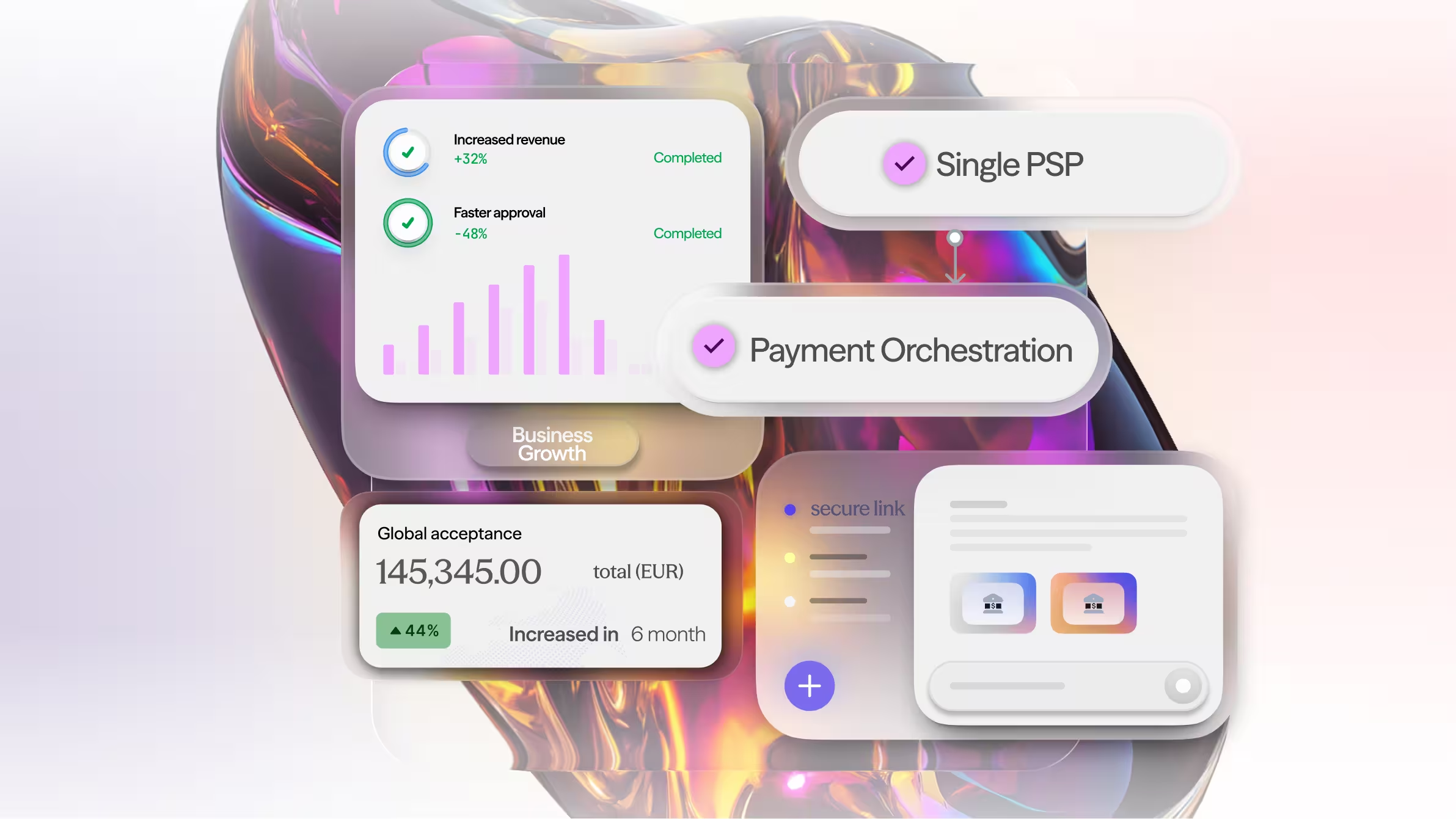
Instead of connecting directly to multiple providers through separate integrations, merchants could use a single orchestration layer to manage all payment flows.
This fundamentally changed how payment infrastructure works.
With payment orchestration technology, businesses can:
- Connect multiple PSPs and payment methods through one integration.
- Route transactions dynamically based on performance, cost, or availability.
- Monitor payment performance in real time across markets.
- Automate failover when a provider experiences issues.
Rather than managing payments as a collection of disconnected systems, orchestration allows companies to treat them as a unified ecosystem.
.jpg)
Single Provider vs Multi-Provider Strategy
One of the most important shifts has been the move from single-provider setups to multi-provider strategies.
A single PSP may perform well in one region but struggle in another. By integrating multiple providers, merchants can optimise for local performance and improve approval rates.
Payment orchestration makes this approach manageable.
Instead of building and maintaining separate integrations, merchants can connect providers through a central layer and control how transactions are routed between them.
This flexibility allows businesses to adapt quickly as markets change.
Static Routing vs Smart Routing
Traditional payment systems rely on static routing.
Transactions are sent through a predefined path, regardless of performance or cost. If that path encounters issues, it can result in failed transactions with limited ability to recover automatically.
Modern payment infrastructure introduces smart routing.
With orchestration, transactions can be routed dynamically based on factors such as:
- Approval rates
- Processing costs
- Geographic location
- Provider availability
This allows merchants to optimise each transaction in real time rather than relying on fixed configurations.
.jpg)
Limited Visibility vs Real-Time Analytics
Another major evolution is visibility.
In single PSP setups, reporting is often limited to that provider’s data. When multiple providers are involved, visibility becomes fragmented.
Payment orchestration solves this by providing unified and real-time analytics.
Merchants can track performance across all providers, payment methods, and regions in one place. This makes it easier to identify trends, detect issues, and make informed decisions.
Visibility transforms payments from a reactive process into a controllable system.
Manual Failover vs Automated Resilience
In traditional setups, failover processes are often manual.
If a PSP experiences downtime or performance issues, teams must intervene to reroute transactions. This can lead to lost revenue and operational delays.
With orchestration, failover can be automated.
If one provider becomes unavailable, transactions can be redirected to an alternative route without disrupting the customer experience.
This level of resilience can be particularly valuable for businesses operating at scale.
Local-Only vs Global Scalability
Perhaps the most significant shift is the move from localised payment setups to globally scalable infrastructure.
Single PSP models are often designed for specific markets. Expanding into new regions requires additional integrations and adjustments.
Payment orchestration enables global scalability.
Merchants can add new payment methods, providers and markets through a central system without rebuilding their infrastructure each time.
This allows businesses to scale faster while maintaining consistency across regions.
The Evolution of Payment Gateways
The evolution of payment gateways is not just a technical story. It is a business story.
Payments influence conversion rates, customer experience, operational efficiency and expansion speed.
Companies that rely on outdated payment infrastructure may struggle to adapt to new market conditions. Those that adopt orchestration-driven systems gain flexibility, visibility and control.
In a competitive environment, these advantages can directly impact growth.
From Integration to Strategy
Payments are no longer just about processing transactions.
They are about building infrastructure that can adapt to change, support global expansion and optimise performance continuously.
At finera., we help businesses transition from fragmented payment setups to orchestration-driven infrastructure. Our platform is designed to support payment orchestration and a range of payment methods, working together to help merchants scale their payment operations more effectively.
If you are looking to modernise your payment infrastructure, explore how finera. can support your payments strategy.
This article on payment methods is for informational and educational purposes only.
- Not Professional Advice: The content provided does not constitute financial, legal, tax, or professional advice. Always consult with a qualified professional before making financial decisions.
- No Liability: The authors, contributors, and the publisher assume no liability for any loss, damage, or consequence whatsoever, whether direct or indirect, resulting from your reliance on or use of the information contained herein.
- Third-Party Risk: The discussion of specific payment services, platforms, or institutions is for illustration only. We do not endorse or guarantee the performance, security, or policies of any third-party service mentioned. Use all third-party services at your own risk.
- No Warranty: We make no warranty regarding the accuracy, completeness, or suitability of the information, which may become outdated over time.
.avif)
Frequently Asked Questions

Still Have Questions?
Let’s Find the Right Solution for You
Stay Connected with Us!
Follow us on social media to stay up to date with the latest news, updates, and exclusive insights!