State of Payment Orchestration 2025: Trends, Benchmarks & Insights
Explore the state of payment orchestration in 2025, including key trends.
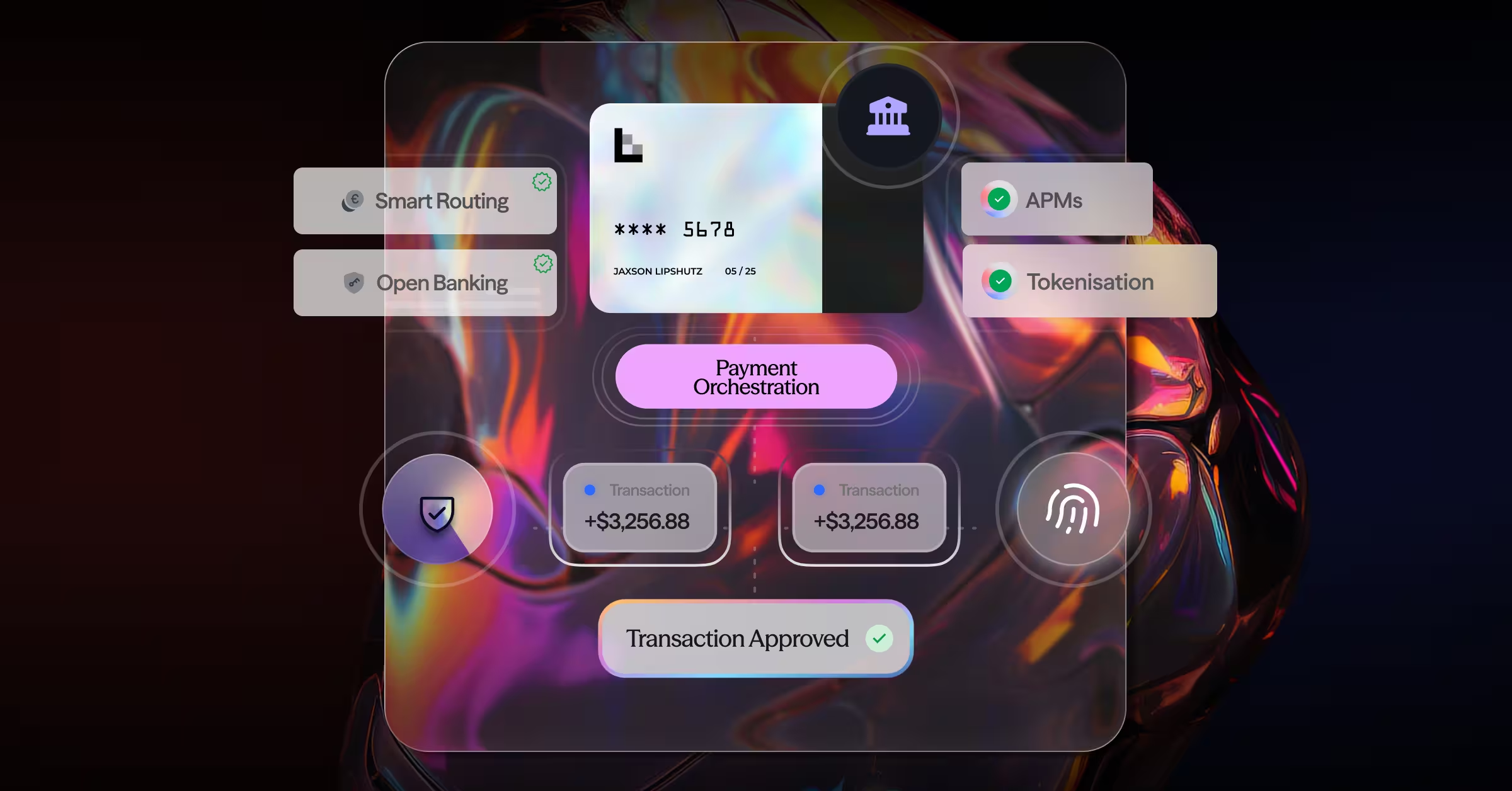
If the last decade taught the payments industry anything, it’s this: complexity never stands still. New rails emerge, consumer habits shift, regulations tighten and expectations rise. In this environment, payment orchestration is increasingly viewed as a commercial priority rather than just a technical consideration .
But what does the state of payment orchestration in 2025 actually look like?
In this deep dive, we explore the forces reshaping payment infrastructure, the trends redefining payment operations and the strategic benchmarks that forward-thinking businesses should be measuring themselves against this year.
Why Is Payment Orchestration Becoming Essential in 2025?
A few years ago, adding an extra PSP integration was considered proactive.
To keep up with consumer expectations, modern businesses need access to multiple acquirers, alternative payment methods (APMs), fraud tools and compliance rules across various geographies.
Payment orchestration simplifies this complexity by unifying routing logic, connectors, fraud controls, reporting and settlement flows into a single intelligent layer. It gives merchants and platforms enhanced visibility and control.
And the timing couldn’t be more critical. Consumer behaviour is shifting at a pace that traditional payment infrastructure can’t keep up with. UK Finance reports that 57% of UK adults used mobile wallets in 2024, a sharp rise from previous years.
Finextra highlights that fewer than half of UK adults now carry a physical wallet at all.
If consumers are moving faster, payments infrastructure needs to adapt accordingly.
Smart Routing and Authorisation Optimisation Are Evolving
One fundamental shift in 2025 has been the rise of smart payment routing. Single-provider dependency is fading, replaced by dynamic, real-time routing based on success rates, cost, geography and risk.
Why? Because a small uplift can enhance results. An improvement in authorisation rates, often seewhen multi-acquirer routing is deployed, could boost revenue for mid-market and enterprise merchants alike.
More importantly, smart routing protects businesses from outages, regional instability and PSP performance dips.
Are Alternative Payment Methods Becoming More Important?
2025 marks a tipping point in how consumers prefer to pay. Alternative Payment Methods such as Digital wallets, instant bank pay, QR-based schemes and region-specific options have moved into the mainstream. It's a behavioural shift and not just an innovation trend.
Consumers expect choice and they expect that choice to work seamlessly across markets, channels and devices. Orchestration allows merchants to expand their APM offering without drowning in integrations.
Instead of integrating iDeal, Apple Pay, PayPal, or Open Banking rails one at a time, orchestration lets them turn on new methods with a single configuration.
Open Banking Matures Into a Core Payment Rail
Open banking has matured into an established payment rail, especially in the UK and Europe. The combination of speed, low cost and near-real-time authentication is proving attractive for high-value, recurring, or time-sensitive transactions.
Businesses are increasingly turning to Account-to-Account (A2A) payments for subscriptions, bill payments, digital services and even iGaming payments. The challenge is knowing when open banking is the right choice and when cards or wallets might be more suitable.
This is where payment orchestration can make the difference, with intelligent backends that can automatically route traffic to the most suitable rail in real time.
Real-Time Payments Change Merchant Expectations
Real-time payment networks are growing faster than ever. According to FinTech Magazine, global real-time payments passed USD $60 trillion in 2025, signalling an important shift.
Payment orchestration platforms can unify these networks and potentially manage speed, compliance checks, FX handling and settlement logic.
Can Orchestration Help Manage Fraud, Risk and Compliance Better?
Rising fraud sophistication and tightening regulations mean businesses can no longer rely on basic rules engines or PSP-provided defaults.
Payment orchestration can give businesses a unified layer for:
- Strong Customer Authentication (SCA).
- 3DS optimisation.
- Velocity checks.
- Identity and affordability verification.
- Geo-based logic.
Crucially, it helps prevent “false declines,” which cost businesses worldwide in lost revenue every year.
Payment performance is increasingly about more than just approval, it's about approving the right transactions safely.
Tokenisation Plays a Bigger Role in 2025
Tokenisation is expected to play a growing role in payments in 2026. Juniper Research estimates that global tokenised payment transactions could surpass $1 trillion next year, reflecting broader industry movement toward safer and more reliable payment methods.
Several factors contribute to this growth. Tokenisation helps reduce the impact of data breaches by replacing sensitive card or account details with secure tokens. Regulatory requirements such as PSD2 and PCI-DSS continue to encourage the use of stronger protections, while mobile and digital wallets rely on tokenisation as part of their standard security model.
Rising e-commerce volumes and higher fraud exposure also make tokenisation an attractive option for online transactions. Payment networks including Visa and Mastercard are increasingly promoting tokenised payments, which is further influencing adoption.
For merchants, tokenisation may help simplify parts of compliance, reduce the likelihood of declines linked to outdated card details and support a smoother customer experience. Taken together, these factors suggest tokenisation will remain an important component of modern payment infrastructure in 2026.
Does Your Business Need Payment Orchestration?
Payment orchestration is increasingly important across industries where high transaction volumes, cross-border payments, and rising customer expectations make traditional setups harder to manage.
In travel, businesses often navigate fluctuating authorisation rates linked to high-risk MCCs, complex international bookings and multi-currency settlement. Travellers also tend to expect quick confirmations, smoother refund journeys and familiar payment options wherever they book.
In retail and eCommerce, merchants continue to balance expanding APM preferences, growing fraud risks, and high cart-abandonment rates. Operating across different regions, currencies and peak seasons can add operational strain, especially without clear visibility or flexible routing across providers.
iGaming introduces its own considerations, including strict regulatory oversight, heightened fraud exposure and customer expectations for rapid deposits and fast withdrawals. PSP performance can vary by region, so operators often look for ways to build resilience into their payment flows.
Payment orchestration can support these industries by providing:
- the ability to route transactions across multiple acquirers.
- access to local APMs in relevant markets.
- faster and more reliable bank pay-ins and payouts.
- improved fraud and risk-management tools.
- configurable failover logic.
- clearer reporting and more streamlined reconciliation.
Across travel, retail, eCommerce and iGaming, orchestration offers a way to simplify payments and support better performance, helping businesses adapt to customer expectations, reduce operational friction and manage payments more effectively at scale.
Payment Orchestration and the Future of Payments
In 2025, payment orchestration is becoming an essential integration layer for global payments. It brings coherence to a fragmented ecosystem, intelligence to formerly manual workflows and performance gains that directly impact revenue.
Whether you’re a merchant, a fintech, a marketplace, or an iGaming operator, orchestration can be essential. It is the infrastructure layer that can help businesses scale globally, meet rising customer expectations, improve authorisation performance and maintain compliance in a changing regulatory landscape.
finera. is built for this new era. Our payment orchestration technology is designed to optimise your complete payment infrastructure, encompassing everything from alternative payment methods (APMs) and global card acquiring to intelligent routing and Open Banking rails.
Optimise your payment infrastructure with finera. Talk to our team today.

This article on payment methods is for informational and educational purposes only.
- Not Professional Advice: The content provided does not constitute financial, legal, tax, or professional advice. Always consult with a qualified professional before making financial decisions.
- No Liability: The authors, contributors and the publisher assume no liability for any loss, damage, or consequence whatsoever, whether direct or indirect, resulting from your reliance on or use of the information contained herein.
- Third-Party Risk: The discussion of specific payment services, platforms, or institutions is for illustration only. We do not endorse or guarantee the performance, security, or policies of any third-party service mentioned. Use all third-party services at your own risk.
- No Warranty: We make no warranty regarding the accuracy, completeness, or suitability of the information, which may become outdated over time.

Frequently Asked Questions

Still Have Questions?
Let’s Find the Right Solution for You
Stay Connected with Us!
Follow us on social media to stay up to date with the latest news, updates, and exclusive insights!