Payment Analytics: The Business Intelligence Behind Smarter Market Expansion
Learn how payment analytics can reveal market opportunities.
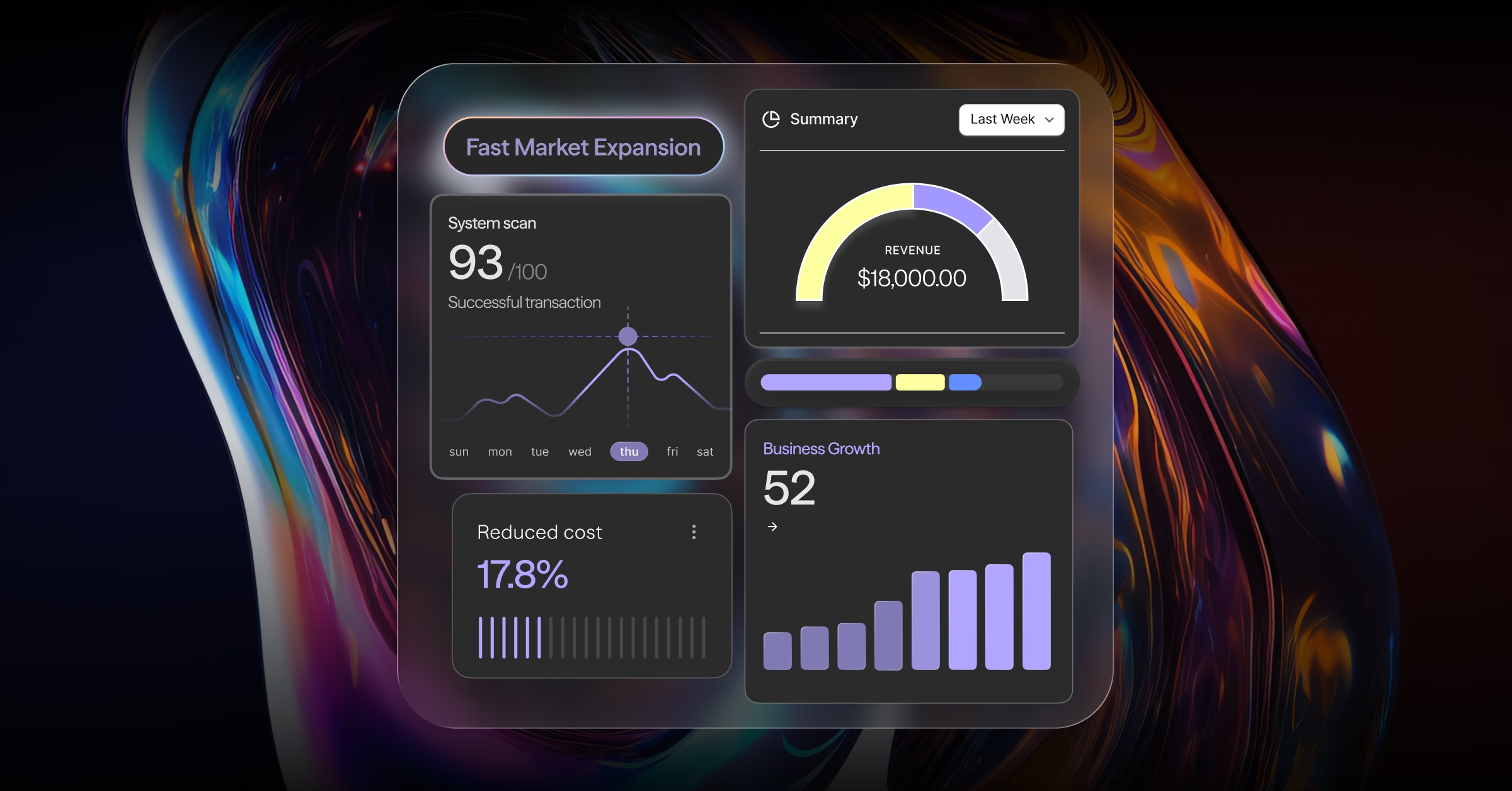
Payment analytics can serve as a form of business intelligence to support growth. Before a merchant commits a budget to a new market, the data already sitting in their payment stack, approval rates, method preferences, issuer behaviour and transaction trends, can help surface useful insights including approval rates, payment method usage and transaction patterns. Read correctly, payment analytics turns expansion into a plan.
For merchants considering international growth, that intelligence can help answer three critical questions: where to expand, how to build the right local payment strategy and what to change once transactions begin.
Why Payment Data Matters Before You Enter a New Market
A market can look ready on every metric a growth team usually tracks, and still fail at the checkout. The reason is that how people pay is local, and it changes fast. A checkout that opens on card in a market that has moved to wallets or bank transfers is not entering that market, it is showing up with the second choice.
The infrastructure underneath is shifting too. J.P. Morgan's 2025 cross-border outlook notes that more than 70 countries now run real-time payment systems, reshaping what customers expect a payment to feel like. Payment data is how a merchant sees this before it costs them a launch. It answers the one question market-sizing cannot: not "is there demand here", but "will that demand actually pay us".

Read the Market Through Four Signals
The most useful way to use payment data before expansion is to treat it as a map. Four signals, read together, tell you where to go and how to arrive. Call it the four-signal read.
Signal 1: Approval Rates by Country
Approval rate is a revenue metric wearing a technical disguise. Every declined transaction is a customer who was ready to pay and could not. Cross-border transactions make this worse: a card routed to a distant acquirer is structurally more likely to be declined than the same card processed locally, and legitimate customers get caught in the gap. The Merchant Risk Council's 2024 Global E-commerce Payments and Fraud Report found that merchants reject around 6% of all e-commerce orders, and between 2% and 10% of those rejections are good customers who would have paid.
Reading approval rates by country before you scale tells you whether a market is reachable on your current setup or needs local acquiring to perform. The fix is preventive, not remedial: smart routing that sends each transaction down the path most likely to be approved, and a global acquirer network that lets a merchant process locally rather than across a border.
Signal 2: Local Payment-Method Mix
The method mix is the clearest expression of a market's habits. Payment data can show to a merchant which methods a market rewards and which it ignores, so localisation follows evidence instead of guesswork. That is what a stack of alternative payment methods and open banking is for: matching the checkout to how a market prefers to pay.
Signal 3: Issuer Behaviour
Two markets can share a currency and behave nothing alike at the issuer level. Reading decline reasons and issuer response by region can help a merchant understand whether local banks trust their traffic, where authentication may be causing friction, and which routing changes could help improve approvals. This reflects the difference between a dashboard that reports what happened and analytics that can help inform what happens next.
Signal 4: Cost to Serve
Reach means little if the economics do not hold. Interchange, currency conversion and method fees vary widely by market, and payment data can help make the margin by country more visible. Allowing customers to pay and settle in their own currency through multi-currency payments can help support both conversion and margin.
Identifying Market Opportunities Through Payment Analytics
A useful approach is segmenting payment analytics for merchants by country, currency, issuer, payment method and provider. This can create a clearer picture of the conditions behind performance. Grand View Research projects the global payment orchestration platform market to reach 6.52 billion US dollars by 2030, at a compound annual growth rate of 24.7%, and names advanced analytics and reporting as its fastest-growing capability. Orchestration is one place this intelligence can come together, because a single integration across acquirers, methods and markets can help bring the full picture into one view. A payment orchestration platform does not just route payments. It can give a merchant a consolidated view across markets, which can help support an expansion decision needs.
Talk to the finera. payments team about leveraging payment technology to build a data-driven payment infrastructure for global growth.

This article on payment methods is for informational and educational purposes only.
- Not Professional Advice: The content provided does not constitute financial, legal, tax, or professional advice. Always consult with a qualified professional before making financial decisions.
- No Liability: The authors, contributors, and the publisher assume no liability for any loss, damage, or consequence whatsoever, whether direct or indirect, resulting from your reliance on or use of the information contained herein.
- Third-Party Risk: The discussion of specific payment services, platforms, or institutions is for illustration only. We do not endorse or guarantee the performance, security, or policies of any third-party service mentioned. Use all third-party services at your own risk.
- No Warranty: We make no warranty regarding the accuracy, completeness, or suitability of the information, which may become outdated over time.
.avif)
Frequently Asked Questions
Payment analytics is the analysis of transaction-level data, approval rates, decline reasons, payment-method adoption, issuer behaviour and cost, to inform commercial decisions. Used well, it functions as business intelligence rather than an operational report.
Approval rates vary with local acquiring relationships, issuer trust, authentication rules and how a transaction is routed. Cross-border processing is structurally more likely to be declined than local processing, which is why reading approval rates by country before expanding is essential.
Start with four signals: approval rate by country, the local payment-method mix, issuer behaviour, and the true cost to serve. Together they show whether demand in a market will convert and what your checkout needs to serve it.

Still Have Questions?
Let’s Find the Right Solution for You
Stay Connected with Us!
Follow us on social media to stay up to date with the latest news, updates, and exclusive insights!