iGaming Payment Solutions: The Infrastructure Powering Scalable, Compliant Platforms
How modern iGaming payment solutions enable scalable growth, compliance, routing, and reliable payouts

In iGaming, payments function as more than a supporting system-they are often integral to the product experience. Every deposit attempt, every withdrawal request, and every decline can affect player trust, regulatory exposure, and long-term revenue. As the industry matures and regulation tightens across regions, igaming payment solutions have become an important factor in whether an operator can scale sustainably.
Unlike standard eCommerce, iGaming transactions sit at the intersection of high risk, strict compliance, and real-time performance demands. Players expect instant deposits and fast payouts, regulators expect full transparency, and banks apply constantly shifting rules. Meeting all three expectations simultaneously requires far more than a single PSP integration.
This article examines igaming payment solutions from a technical and operational perspective. It explains how modern platforms are built, why legacy setups fail at scale, and what operators should expect from an advanced igaming payment provider when operating across regulated markets.
Key Takeaways
- iGaming payment solutions are core infrastructure, not just checkout tools
Multi-PSP and multi-acquirer setups are essential for approval rate stability - Smart routing can improve authorisation and reduce revenue leakage
- Payout orchestration is as critical as deposit processing
- Platforms like finera. are designed to help centralise complexity while preserving flexibility

What iGaming Payment Solutions Actually Include
At their core, igaming payment solutions enable the movement of money between players and operators. In practice, they encompass a much broader set of capabilities that must operate in coordination with one another.
A modern solution includes acquiring connectivity, alternative payment method support, real-time routing logic, fraud and risk controls, compliance tooling, payout management, reconciliation and reporting. Each layer must function reliably under peak traffic, across jurisdictions and under constant regulatory scrutiny.
What differentiates iGaming payment solutions from other industries is not only transaction risk, but variability. The same player behaviour may be acceptable in one market and restricted in another. Payment infrastructure must adapt dynamically without requiring product or engineering teams to rebuild flows market by market.
Why Legacy Payment Stacks Fail in iGaming
Many operators still rely on fragmented payment stacks built over time. One PSP for cards, another for local bank transfers, separate providers for payouts, and manual reconciliation across systems. This approach may work at launch but can face challenges under scale.
The primary issue is rigidity. When an acquirer changes rules, approval rates drop and operators have limited ability to respond. When a market requires a new payment method, integration timelines delay entry. When payouts slow down, support tickets spike and player trust erodes.
iGaming payment solutions designed as orchestration layers solve these issues by decoupling the operator from individual providers. This architectural shift represents a significant development in the iGaming payments ecosystem.
Multi-PSP and Multi-Acquirer Architecture
In iGaming, dependency on a single PSP creates both operational and financial risk. Outages, compliance reviews or unilateral account terminations can potentially halt transactions.
Modern iGaming payment solutions connect operators to multiple PSPs and acquirers simultaneously. Transactions are no longer tied to a single route but are evaluated dynamically. This architecture provides redundancy, resilience, and leverage.
From a technical standpoint, this requires normalised APIs, consistent data models and real-time decision engines. From a business standpoint, it enables operators to protect revenue and maintain uptime even during external disruptions.
Smart Routing and Authorisation Optimisation
Authorisation rates are one of the most overlooked growth levers in iGaming. A few percentage points of improvement can translate into significant recovered revenue.
Advanced iGaming payment solutions use smart routing to determine the optimal path for each transaction. Routing decisions may consider player location, card issuer behaviour, payment method, currency, historical performance and even time-of-day effects.
Unlike static routing rules, modern systems continuously learn and adapt. When an acquirer’s performance drops for a specific segment, traffic is shifted automatically. This level of optimisation can be challenging to achieve with direct PSP integrations.
Card Payments: High Value, High Complexity
Despite the growth of alternative payment methods, cards remain central to most iGaming payment solutions. They are familiar to players and widely accepted but they are also subject to higher scrutiny.
Card schemes impose monitoring programmes, issuers apply iGaming-specific risk rules and chargebacks carry outsized consequences. Without intelligent routing, descriptor optimisation, and regional acquiring, approval rates deteriorate quickly.
Effective iGaming payment solutions treat card payments as a system that must be actively managed, not a static integration. This includes monitoring soft declines, retry logic and issuer-specific behaviour across markets.
The Role of Alternative Payment Methods
Alternative payment methods have become increasingly important. In many regions, they outperform cards in both conversion and approval rates.
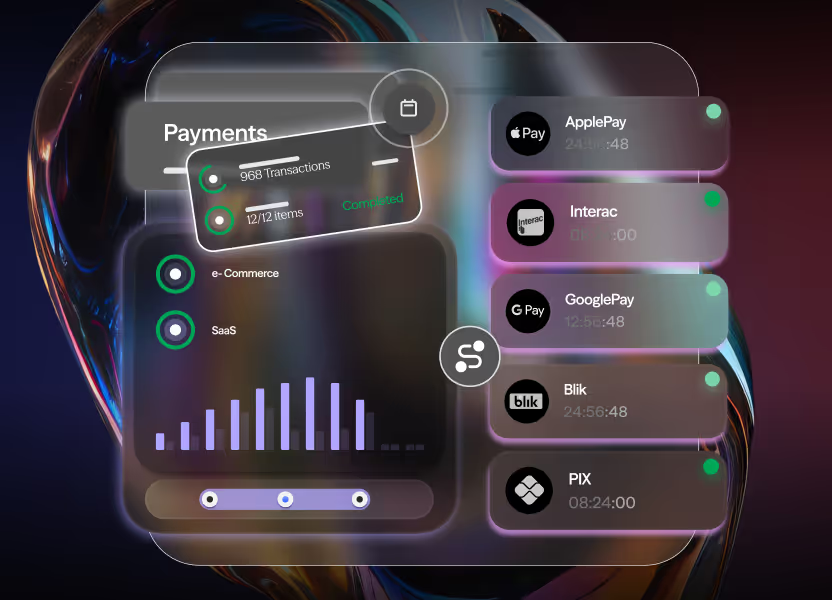
A mature iGaming payment provider supports local bank transfers, instant payment schemes, wallets and mobile-native methods where relevant. More importantly, these methods must be orchestrated intelligently rather than exposed as disconnected options.
True igaming payment solutions unify cards and APMs under the same routing, risk and reporting framework. This allows operators to optimise across methods instead of managing each in isolation.
Payouts and Withdrawal Orchestration
Deposits get players in the door. Payouts are a key factor in whether they stay.
Slow or unreliable withdrawals can significantly erode player trust. From an operational perspective, payouts are also more complex than deposits. They involve different rails, higher compliance sensitivity and often more manual intervention.
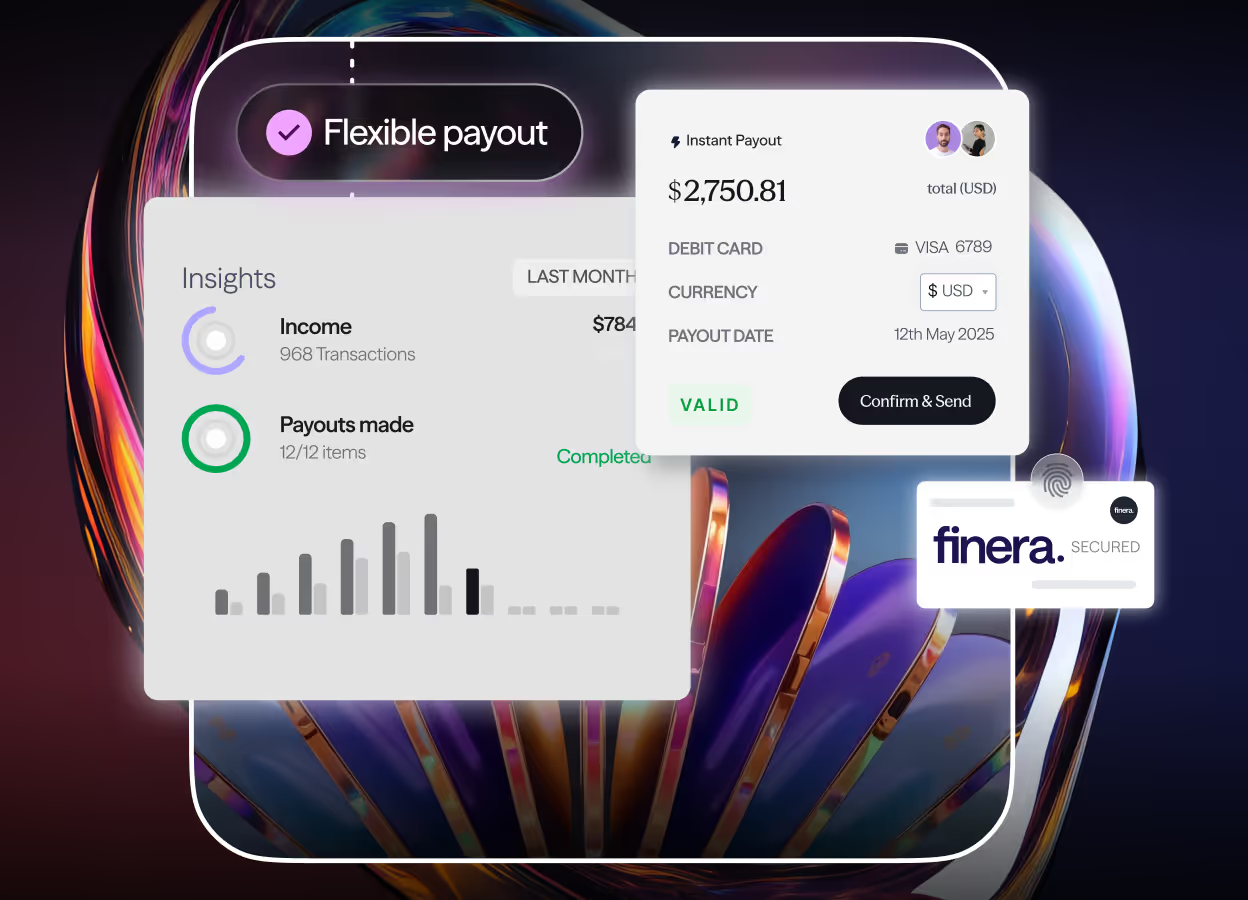
Advanced iGaming payment solutions treat payouts as first-class flows. They enable automated routing, method matching, real-time status updates, and fallback logic when a payout method fails. This reduces operational load while improving the player experience.
Compliance Embedded Into the Payment Layer
Compliance in iGaming should not be bolted on after the fact. AML, KYC, transaction monitoring and jurisdiction-specific rules must be enforced at the payment layer itself.
The best iGaming payment solutions embed compliance logic directly into transaction flows. This includes velocity checks, threshold monitoring, source-of-funds validation and audit-ready reporting.
By centralising compliance within the payment infrastructure, operators can reduce the risk of human error and improve consistency across markets.
Fraud Prevention Without Overblocking
Fraud controls in iGaming are a balancing act. Overly aggressive rules reduce conversion, while weak controls increase chargebacks and regulatory risk.
Modern iGaming payment solutions rely on contextual risk assessment rather than static rules. Device data, behavioural signals, transaction history, and geolocation are evaluated in real time to determine the appropriate level of friction.
This approach allows legitimate players to transact smoothly while high-risk activity is flagged or blocked. The key is adaptability, not rigidity.
Data, Analytics, and Continuous Optimisation
Payments generate some of the most actionable data in an iGaming business. Approval rates, decline reasons, payout success rates and PSP performance all reveal opportunities for improvement.
Advanced iGaming payment solutions expose this data through unified dashboards and detailed reporting. Operators can identify underperforming routes, optimise method mix and negotiate better terms with providers based on real performance metrics.
Without centralised data, optimisation can be more challenging and less data-driven. With it, payments can become a controllable growth lever.
Scaling Across Regulated Markets
Global expansion represents a significant challenge in iGaming. Each new market introduces different regulations, payment preferences and banking relationships.
Well-designed igaming payment solutions allow operators to activate new markets without rebuilding their stack. Local acquirers and methods can be added through configuration rather than code changes. Compliance rules can be adjusted dynamically.
This flexibility can shorten time-to-market and reduce engineering burden.
Choosing an iGaming Payment Provider
Not every payment platform is suitable for iGaming. Operators should look for an iGaming payment provider with proven experience in regulated environments, strong acquiring relationships, advanced routing capabilities, and deep payout support.
Equally important is architectural philosophy. Platforms like finera. are designed to act as orchestration layers, with the goal of giving operators control while abstracting complexity.
Why Modern iGaming Platforms Win or Lose at the Payment Layer
In today’s market, igaming payment solutions significantly influence how efficiently an operator can grow, comply, and compete. They influence approval rates, player trust, operational cost, and regulatory resilience.
Operators that invest in modern, orchestrated payment infrastructure may gain measurable advantage. Those that rely on fragmented, legacy setups may face increasing friction as markets evolve.
By centralising payments, routing, payouts, and compliance through a platform like finera., iGaming businesses may be better positioned to focus on product and growth while maintaining control over their payment systems.
DISCLAIMER
This article on payment methods is for informational and educational purposes only.
- Not Professional Advice: The content provided does not constitute financial, legal, tax, or professional advice. Always consult with a qualified professional before making financial decisions.
- No Liability: The authors, contributors, and the publisher assume no liability for any loss, damage, or consequence whatsoever, whether direct or indirect, resulting from your reliance on or use of the information contained herein.
- Third-Party Risk: The discussion of specific payment services, platforms, or institutions is for illustration only. We do not endorse or guarantee the performance, security, or policies of any third-party service mentioned. Use all third-party services at your own risk.
- No Warranty: We make no warranty regarding the accuracy, completeness, or suitability of the information, which may become outdated over time.

Frequently Asked Questions
They are integrated platforms that manage deposits, payouts, routing, compliance, and risk for online iGaming operators.
They operate in higher-risk environments with stricter regulation, higher decline rates, and more complex payout requirements.
It reduces dependency risk, improves approval rates, and ensures continuity when providers underperform or exit markets.
Yes. Modern solutions orchestrate both flows, often with different logic and routing for each.
finera. offers a unified payment orchestration platform designed to connect multiple PSPs, optimise routing, support global payouts and embed compliance capabilities across transactions.

Still Have Questions?
Let’s Find the Right Solution for You
Stay Connected with Us!
Follow us on social media to stay up to date with the latest news, updates, and exclusive insights!