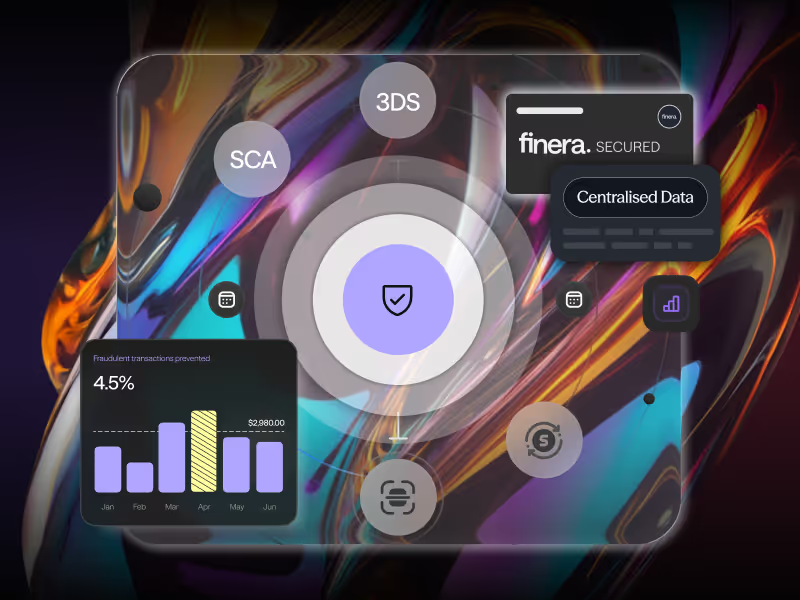
How Intelligent Fraud Management Protects Every Transaction
How intelligent fraud management reduces risk and keeps every digital transaction secure.

Every fraudulent transaction tells a story but often the same one. The system reacted too late.
As digital payments accelerate across every channel like eCommerce, iGaming, retail and travel, fraudsters have learnt to move just as fast.
Traditional prevention tools weren’t designed for this scale. Static rules, manual reviews and isolated data often can’t keep pace with dynamic fraud networks operating in real time. What merchants need is less friction and intelligence built directly into the payment layer.
Intelligent fraud management represents an evolving approach to how global businesses protect revenue. By analysing data, patterns and intent throughout the transaction flow, these systems can help detect and anticipate suspicious behaviour, supporting efforts to address fraud earlier in the process.
Because in modern commerce, every payment is a moment of truth and every transaction deserves trust.

The Challenge: Fraud Moves Faster Than Ever
Fraudsters adapt as quickly as technology does. As payments diversify, from card and wallet to crypto, BNPL and instant transfers, every new channel creates fresh opportunities for exploitation.
According to The Nilson Report, global losses from payment fraud reached $33.33 billion in 2023 and behind that number are millions of failed authorisations, false declines and compromised customer experiences.
For high-volume merchants, the challenge is two-fold. One, it’s blocking fraudulent transactions while ensuring legitimate customers can complete their purchases. Two, false positives can be equally damaging, eroding customer trust and long-term loyalty.
That’s why the shift toward fraud management systems has become a defining trend in payment strategy.
The Shift to Intelligent and Built-In Fraud Prevention
For years, preventing fraud meant following strict, predefined rules.
The logic was simple but the fraudsters got smarter. Static systems can’t keep up with adaptive threats and manual reviews only slow the checkout experience for legitimate customers.
That’s where intelligent fraud management offers a different approach. Instead of reacting to red flags after the fact, it learns in real time, analysing thousands of data points in milliseconds. Device fingerprints, transaction velocity, IP shifts, behavioural cues and historical context all come together to support more informed decisioning around trust or risk.
For merchants, the goal is to intercept fraud with minimal friction for customers. AI-driven decisioning can be embedded directly into the payment flow, supporting fraud detection before authorisation. This represents built-in fraud prevention: protection that’s part of your architecture, not an external layer that adds friction or delay.
In high-volume environments like iGaming or travel, this intelligence can help keep payments seamless, proving that smart systems don’t just stop fraud but also keep business moving.
How Intelligent Fraud Management Works
The power of intelligent fraud management lies in orchestration and insight. Instead of relying on a single gateway or processor, data from multiple sources is unified in real time.
Machine learning algorithms assign dynamic risk scores to each transaction, updating continuously as new behaviours emerge.
For example:
- An eCommerce checkout detects mismatched IP and billing data, triggering instant risk assessment before payment submission.
- A gaming platform identifies unusually high betting frequency from one account, automatically flagging it for secondary review.
- A travel platform spots an irregular booking pattern from a compromised device and blocks the transaction before authorisation.
Each decision enriches the model further, building resilience through experience. This approach supports fraud prevention that learns, not just reacts.
How 3D Secure Supports Smarter Fraud Prevention
Authentication remains a critical part of fraud prevention and 3D Secure (3DS) continues to play an important role in securing card-not-present transactions worldwide. The newer versions of the protocol, including 3DS 2.2, allow issuers to use risk-based authentication to determine whether a transaction can proceed frictionlessly or requires additional verification.
While this improves security, it can also introduce variability in customer experience depending on issuer performance, device compatibility and regional adoption. Intelligent fraud management helps bridge these gaps by adding behavioural signals, device insights and historical transaction patterns to complement 3DS decisioning. Together, these layers enable merchants to strengthen verification while maintaining a smoother, more consistent checkout flow for legitimate customers.
To explore how 3DS requirements differ across eCommerce, travel, retail and iGaming, see our guide on 3DS strategies by vertical.
Tokenisation & Fraud Prevention
Beyond authentication, protecting stored or reused credentials remains critical. Tokenisation is a highly effective way to reduce exposure to card-related fraud. By replacing card numbers with tokens that hold no inherent value if intercepted, tokenisation limits the impact of compromised credentials and reduces the risk surface for merchants.
This is particularly important for merchants that rely on card-on-file transactions or subscription models. Combined with intelligent fraud management, tokenisation enhances accuracy by allowing risk models to focus on behavioural and contextual signals rather than raw credentials. The result is a more resilient, secure environment, especially valuable in high-volume digital commerce.
The Measurable Impact of Intelligent Fraud Systems
The results speak for themselves. According to Business Insider, AI-driven fraud prevention platforms improved fraud detection rates by up to 300% and reduced erroneous declines by intelligently analysing transactions.
That can mean less lost revenue, smoother customer journeys and measurable ROI from fraud prevention investments.
Connecting risk intelligence to orchestration can provide merchants with visibility across acquirers, regions and channels, helping position fraud management as a growth enabler.
Smart Payment Orchestration Protecting Revenue
Fraud prevention can become even more effective when paired with strategic payment orchestration. Orchestration enables merchants to apply risk insights consistently across all providers, markets and payment methods. By aligning fraud scoring with routing logic, merchants can direct transactions to the most suitable acquirers based on risk level, geography and performance.
This not only can help reduce unnecessary declines but also helps protect revenue that might otherwise be lost due to routing inefficiencies or inconsistent data. For global merchants, orchestration can help ensure more stable, predictable performance even when operating across multiple regulatory environments and customer behaviours.
Fraud prevention and smart routing, when connected, can reinforce each other, strengthening security while supporting higher authorisation rates.
Strengthening Payment Security Through Fraud Management
As payment volumes grow and new transaction models emerge, one question becomes unavoidable: How do you maintain security without disrupting the customer experience?
Intelligent fraud management offers a practical answer. By combining contextual data, real-time analytics, and adaptive decisioning, it can help strengthen protection while reducing unnecessary friction. When supported by established standards like 3D Secure and complemented by mechanisms such as tokenisation and payment orchestration, businesses can build a more resilient foundation for secure digital commerce.
In an environment where fraud continues to adapt, intelligent fraud management offers tools and approaches to maintain reliability and trust in every transaction.
This article on payment methods is for informational and educational purposes only.
- Not Professional Advice: The content provided does not constitute financial, legal, tax, or professional advice. Always consult with a qualified professional before making financial decisions.
- No Liability: The authors, contributors, and the publisher assume no liability for any loss, damage, or consequence whatsoever, whether direct or indirect, resulting from your reliance on or use of the information contained herein.
- Third-Party Risk: The discussion of specific payment services, platforms, or institutions is for illustration only. We do not endorse or guarantee the performance, security, or policies of any third-party service mentioned. Use all third-party services at your own risk.
- No Warranty: We make no warranty regarding the accuracy, completeness, or suitability of the information, which may become outdated over time.


Frequently Asked Questions
It is a data-driven approach that evaluates transactions using behavioural, contextual and device insights in real time to help identify potential fraud more accurately.
By analysing broader transaction patterns rather than relying solely on static rules, intelligent systems can distinguish legitimate customers from unusual or suspicious activity.
Yes. 3DS provides issuer-side authentication, while intelligent fraud systems can help enhance accuracy with additional behavioural and contextual data.
Tokenisation reduces exposure to compromised credentials but must be combined with behavioural intelligence and layered controls to address broader fraud risks.
It aligns fraud scoring with routing decisions, helping merchants direct transactions to the most appropriate acquirer or pathway based on performance and risk.

Still Have Questions?
Let’s Find the Right Solution for You
Stay Connected with Us!
Follow us on social media to stay up to date with the latest news, updates, and exclusive insights!