
The Role of Digital Wallets in Retail: Why Wallet Acceptance Is Now a Strategic Priority
Digital wallets are growing. See how orchestration supports retailers.
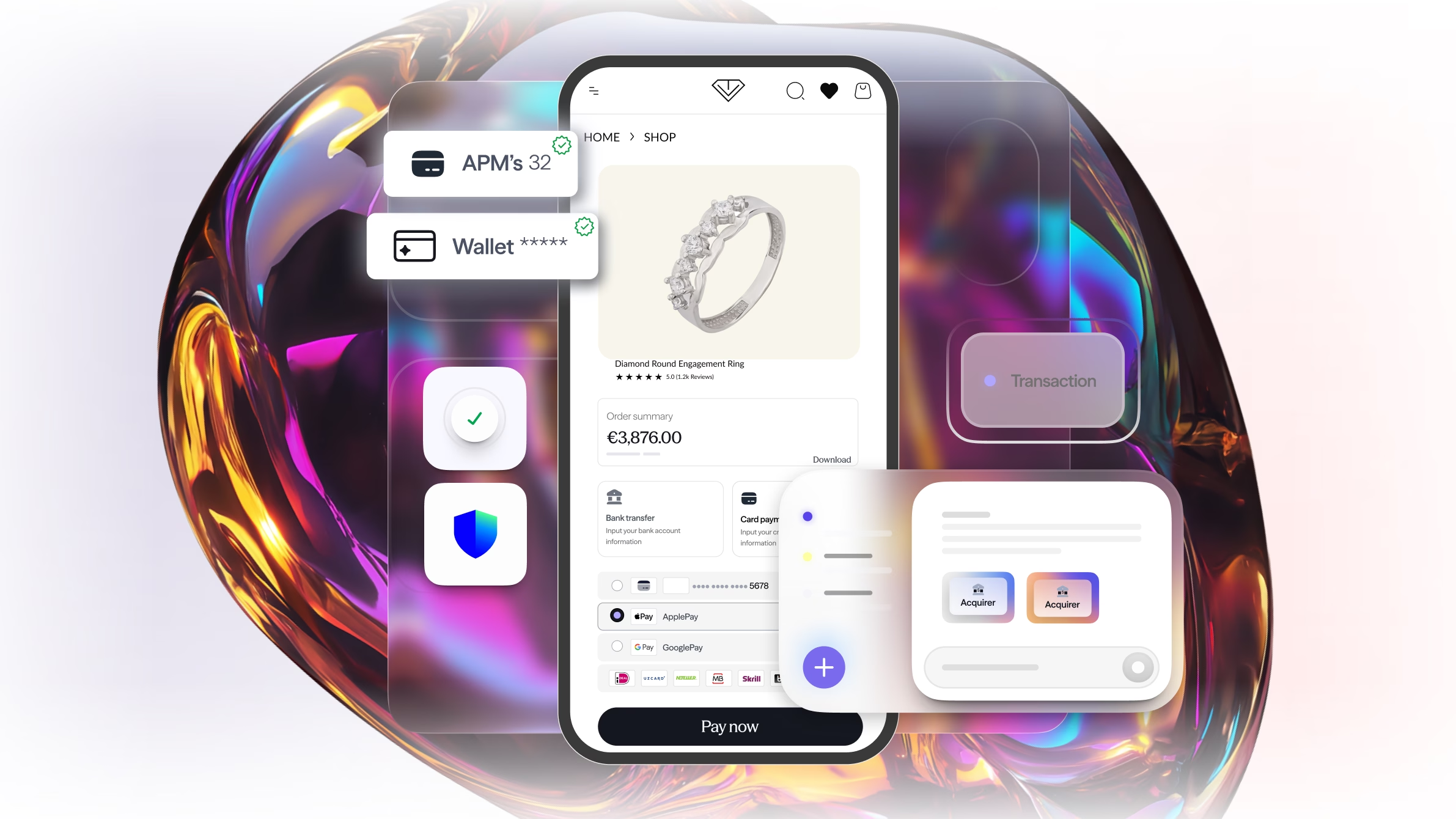
The way people pay in retail has shifted faster than most checkout systems were designed to handle. Digital wallets, once a novelty at the till, now sit at the centre of how consumers expect to buy, both online and in store. According to Worldpay’s Global Payments Report, digital wallets accounted for 56% of global e-commerce value and 33% of point-of-sale value in 2025, together representing more than $13.8 trillion in spending. For retailers, the question is no longer whether to support digital wallets, but how to do so at scale, across markets, and without adding complexity to their payment infrastructure.
Why Digital Wallets Are Changing Retail Payments
A digital wallet stores a customer’s payment credentials; cards, bank accounts or a stored balance, inside a secure app or device, allowing them to pay with a fingerprint, a face scan or a single tap. That small 7change in mechanics has a large effect on behaviour. Checkout friction is one of the biggest causes of abandoned baskets, and wallets remove much of it: no card numbers to type, no billing address to re-enter, no fumbling at the terminal.
The shift also reflects how payment data is moving. Much of the recent growth in digital wallets is card spending migrating into apps, but wallets can add genuine value on top, tokenisation that helps protect card details, faster authentication, and built-in options such as instalments. For retailers, wallets have increasingly moved from a secondary alternative to a primary way many customers choose to transact. Supporting them can be an important part of meeting evolving expectations for retail payments.

The Growth of Mobile-First Shopping
Digital wallets and mobile commerce have grown together. Mobile devices now account for roughly 59% of global e-commerce sales, an estimated $2.5 trillion in 2025 and for many consumers the smartphone is the primary storefront rather than a secondary screen. Shopping increasingly begins and ends on a phone: discovery through a social feed, research in an app, and purchase in a few taps.
In that environment, a wallet is often the most natural way to pay. A customer who has already saved their credentials to their device may expect to reuse them everywhere, and a checkout that asks them to type a 16-digit card number on a small screen can feel cumbersome by comparison. For a large share of shoppers, mobile payments are increasingly a preferred path to conversion, which puts checkout optimisation directly on the revenue line.
Benefits of Digital Wallets for Retailers and Consumers
For consumers, the appeal is speed and reassurance. Wallets cut the number of steps needed to complete a purchase, remember preferences across sessions, and use biometric authentication that feels both quicker and safer than manual entry.
For retailers, the benefits are commercial:
- Higher conversion: fewer checkout steps can mean fewer abandoned baskets, particularly on mobile.
- Stronger security: tokenised credentials can reduce exposure to raw card data and help lower fraud risk.
- Broader reach: accepting the wallets a market prefers can help remove a barrier for customers who may not use traditional cards.
- Better authentication: biometric and device-based verification can help lift approval rates while supporting regulatory requirements.
Taken together, these effects can make digital wallets in retail a potential lever for growth, not merely a payment convenience. The retailers seeing the most benefit tend to treat wallet acceptance as part of a wider customer-experience strategy rather than a standalone project.
Common Digital Wallets Used Globally
There is no single global wallet, and that is precisely why coverage matters. The landscape varies sharply by region. In much of Europe and North America, device-based wallets such as Apple Pay and Google Pay, alongside PayPal, lead online and contactless payments. Asia-Pacific is the most wallet-led region in the world, wallets make up around 77% of online spend there and super-apps such as Alipay and WeChat Pay are the default, often funded by bank accounts rather than cards. India’s ecosystem is built around account-to-account rails, while many other markets lean on local schemes and QR-based payments.
For a retailer selling across borders, this fragmentation is the central challenge. The wallet that converts a customer in Singapore is not the one that converts a customer in the United Kingdom, where cards still lead at the point of sale. Offering the right payment methods for retailers in each market is difficult to achieve one integration at a time.
.avif)
The Importance of Payment Orchestration for Wallet Acceptance
This is where payment orchestration becomes essential. Integrating each wallet directly, with its own API, settlement process, compliance requirements and maintenance overhead, quickly becomes unmanageable as the list grows. Every new wallet is another connection to build, monitor and update.
Payment orchestration resolves this by sitting between the retailer and the wider payments ecosystem. Instead of building and maintaining dozens of individual connections, a retailer integrates once with an orchestration layer that connects to wallets, card networks, acquirers and alternative payment methods on their behalf. New methods can be switched on through configuration rather than development work. Just as importantly, orchestration gives retailers control over how transactions are routed, so they can use intelligent routing to improve approval rates, manage cost and stay resilient if a provider has an outage. It turns a sprawling set of integrations into a single, manageable piece of payment infrastructure.
Building a Payment Strategy That Supports Evolving Consumer Preferences
Consumer payment preferences will keep changing, and the pace is not slowing, digital payments are forecast to reach close to 79% of global e-commerce value by 2030. A payment strategy built only around today’s most popular methods will look dated within a few years. The more durable approach is to build for flexibility: the ability to add, test and retire payment methods as demand shifts, without re-engineering the checkout each time.
That means treating payments as a capability rather than a fixed setup. Retailers who can respond quickly to digital payment trends, a new local wallet, a rising account-to-account scheme, a change in customer behaviour, protect both conversion and margin. If you are weighing up how different rails compare, our guide to account-to-account vs card vs wallet is a useful place to start. The goal is a checkout that adapts to customers, rather than one that asks customers to adapt to it.
How finera. Helps Retailers Expand Payment Coverage
finera. is a payment orchestration platform that lets retailers offer digital wallets alongside cards, account-to-account payments and other methods through a single integration. Rather than managing a growing web of direct connections, retailers connect once to finera. and gain access to a broad range of retail payment solutions, with the flexibility to add new ones as markets evolve.
Ready to expand your payment coverage? See how finera.’s payment orchestration platform helps retailers accept digital wallets and more through a single integration. Get in touch with our team.
This article on payment methods is for informational and educational purposes only.
- Not Professional Advice: The content provided does not constitute financial, legal, tax, or professional advice. Always consult with a qualified professional before making financial decisions.
- No Liability: The authors, contributors, and the publisher assume no liability for any loss, damage, or consequence whatsoever, whether direct or indirect, resulting from your reliance on or use of the information contained herein.
- Third-Party Risk: The discussion of specific payment services, platforms, or institutions is for illustration only. We do not endorse or guarantee the performance, security, or policies of any third-party service mentioned. Use all third-party services at your own risk.
- No Warranty: We make no warranty regarding the accuracy, completeness, or suitability of the information, which may become outdated over time.

Frequently Asked Questions

Still Have Questions?
Let’s Find the Right Solution for You
Stay Connected with Us!
Follow us on social media to stay up to date with the latest news, updates, and exclusive insights!


