Choosing the Right Infrastructure for Multi-Market Expansion
A practical guide to building scalable payments infrastructure for multi-market growth.

Expanding into new markets is one of the fastest ways to grow a digital business. It is also one of the easiest ways to expose weak foundations in your payment setup. What works well in one country often breaks down the moment you cross borders. Different regulations, customer preferences, currencies, fraud patterns and technical requirements quickly turn payments into a bottleneck rather than a growth engine.
That is why choosing the right infrastructure for multi-market expansion is not just a technical decision. It is a strategic one. Your payment stack determines how quickly you can launch in new regions, how well you convert local customers, how much you pay in processing costs and how resilient your operations are under pressure.
So how do you make the right choice?
Key Takeaways
- Multi-market expansion exposes weaknesses in payment setups that often stay hidden in single-market operations.
- The right infrastructure directly impacts speed to launch, conversion rates, costs and operational resilience.
- Scalable payments require more than volume handling. They need flexibility to add markets, methods and providers without rework.
- Compliance and local payment preferences must be built into your architecture, not patched on later.
- Orchestration efficiency is what turns a complex, multi-provider environment into a system you can control and optimise over time.

Why Multi-Market Expansion Puts Pressure on Payments
At a small scale, almost any payment setup can seem “good enough”. A single gateway, one or two acquirers and a handful of payment methods may cover your initial needs. But as soon as you expand internationally, complexity increases fast.
Each market comes with its own rules. Europe brings PSD2 and strong customer authentication. Latin America and parts of Asia require local payment methods to compete. Some regions expect bank transfers or QR payments. Others still rely heavily on cards or wallets. On top of that, cross-border processing can increase decline rates and fees, while local compliance requirements can slow down launches by months.
The result is often a fragmented payments stack. Different providers in different countries. Separate integrations. Limited visibility. Rising costs. Slower time to market. This is exactly the point where infrastructure choices start to define whether expansion becomes a growth story or an operational headache.
The Three Pillars of Scalable Payments Infrastructure
When evaluating infrastructure for multi-market expansion, three principles matter more than anything else. These are scalability, compliance and payment orchestration efficiency.
Scalability is about more than handling higher volumes. It is about being able to add new markets, new payment methods and new providers without rebuilding your stack every time. If every expansion requires months of development work, your growth will always be constrained by engineering capacity rather than market opportunity.
Compliance is non-negotiable. Regulations differ by region and change over time. Your infrastructure needs to support requirements such as PCI DSS, local data protection laws and region-specific rules like PSD2 or local banking regulations. The right setup reduces compliance scope where possible and makes it easier to adapt when rules change.
Payment orchestration efficiency is what ties everything together. Instead of managing each provider separately, orchestration allows you to control routing, retries, failover and optimisation logic centrally. This is what turns a complex, multi-provider setup into a coherent system that can scale across regions.
Multi-Market Payments Infrastructure
In practice, scalable payments infrastructure is not about one feature or one provider. It is about how well the whole system works together as your business grows across regions. A strong setup usually shares a few common traits:
- One core integration that can support multiple acquirers, gateways and payment methods without constant rework.
- Local payment method support so customers can pay the way they expect in each market.
- Smart routing and failover to protect approval rates and revenue during outages or performance drops.
- Centralised reporting and monitoring to track performance, costs and issues across all markets.
- Built-in compliance and security controls to reduce risk as regulations change.
- Flexibility to add or switch providers without rebuilding your checkout or backend systems.
If your current setup struggles with even a few of these, expansion will almost certainly slow down or become more expensive than it needs to be.
Step 1: Understand Your Market Requirements Before You Build
One of the biggest mistakes companies make is designing payment infrastructure based only on their current market. Before you choose tools or providers, map out where you plan to expand over the next two to three years.
Ask practical questions. Which regions are priorities? Which payment methods dominate those markets? Are customers card-first, wallet-first, or bank-transfer-first? What regulatory frameworks apply? What currencies will you need to support?
This exercise quickly reveals whether your current setup can stretch to meet future needs or whether it will become a limiting factor. It also helps you avoid over-engineering for edge cases that do not support your actual growth strategy.
Step 2: Avoid Provider Lock-In
One of the biggest risks in multi-market expansion is locking your business into a single provider or a tightly coupled integration. While this may seem simpler at first, it creates long-term problems.
Different acquirers perform better in different regions. Some have stronger local acceptance. Others offer better pricing or better support for specific payment methods. If your infrastructure makes switching or adding providers difficult, you lose the ability to optimise for performance, cost, or resilience.
A flexible infrastructure should allow you to add, remove or rebalance providers without rewriting your checkout or backend logic. This is where payment orchestration becomes critical. It decouples your business logic from individual providers and gives you freedom to adapt as markets change.
Step 3: Design for Local Acceptance, Not Just Global Reach
Global reach does not automatically mean local success. In many markets, customers simply will not complete a purchase if their preferred payment method is missing. Cards may dominate in some regions, but in others, wallets, bank transfers, or real-time payment schemes are essential for conversion.
The right infrastructure makes it easy to add and manage local payment methods without complex, market-by-market integrations. It also allows you to present the right options to the right customers, rather than showing the same checkout everywhere and hoping for the best.
This is not just about conversion. It is also about trust. A checkout that feels familiar to local customers signals credibility and reduces friction at the most critical point in the customer journey.
Step 4: Build Cost Control Into Your Architecture
Cross-border payments are expensive. Interchange fees, scheme fees, FX costs and provider margins all add up. Without visibility and control, costs tend to creep up quietly as you expand.
A modern payments infrastructure should allow you to optimise routing based on cost as well as performance. In some cases, routing a transaction through a local acquirer can reduce fees and improve approval rates at the same time. In others, retry logic or alternative routes can recover revenue that would otherwise be lost to declines.
This is another area where orchestration efficiency matters. Cost optimisation is not a one-off project. It is an ongoing process that depends on data, monitoring and the ability to adjust routing logic without redeploying your entire stack.
Step 5: Prioritise Visibility and Control
As your payment setup becomes more complex, visibility becomes more important, not less. You need to know what is happening across providers, markets and payment methods in near real time.
Which regions have higher decline rates? Which providers are underperforming? Where are costs increasing? Where are customers dropping out of the checkout flow?
Without unified reporting and monitoring, these questions are hard to answer and even harder to act on. The right infrastructure brings data together in one place and makes it actionable. This turns payments from a black box into a controllable growth lever.
Step 6: Plan for Resilience, Not Just Growth
Expansion increases not only opportunity but also risk. Outages, provider incidents and regional disruptions become more likely as your footprint grows. If your infrastructure relies on a single point of failure, the impact of these events is magnified.
A resilient payment infrastructure includes automatic failover, smart retries and the ability to shift volume between providers when performance drops. This protects revenue during peak periods and ensures that growth does not come at the cost of stability.
In practical terms, resilience is what separates a payments stack that merely supports expansion from one that actively enables it.
How Payment Orchestration Efficiency Brings It All Together
Scalability, compliance, cost control, local acceptance, visibility and resilience are not separate challenges. They are deeply connected. Payment orchestration efficiency is what allows businesses to address all of them through a single, coherent layer of control.
By centralising routing logic, provider management, performance optimisation and monitoring, orchestration turns a fragmented setup into a flexible, scalable system. It reduces the need for constant re-engineering, speeds up market entry and gives teams the tools they need to improve performance over time rather than react to problems after the fact.
Choosing the Right Infrastructure for Multi-Market Expansion with finera.
The right payment infrastructure is not the one that solves today’s problems in the simplest way. It is the one that still works when you double your volume, enter three new regions, add new payment methods and face new regulatory requirements.
Multi-market expansion rewards businesses that plan for complexity instead of being surprised by it. By focusing on scalability, compliance readiness and orchestration efficiency, you create a foundation that supports growth rather than holding it back.
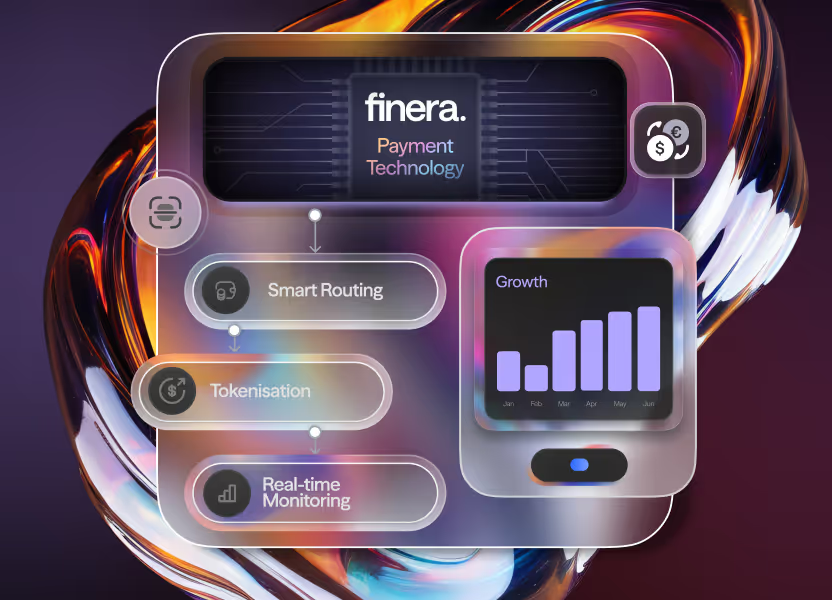
At finera., we help businesses do exactly that. Our full suite of solutions covers payment orchestration technology, card processing, alternative payment methods, crypto processing, smart routing and real-time performance monitoring, all designed to work together as one scalable ecosystem.
If you are ready to future-proof your payments infrastructure and turn expansion into a competitive advantage, contact us and discover how finera. can support your next stage of growth.
This article on payment methods is for informational and educational purposes only.
- Not Professional Advice: The content provided does not constitute financial, legal, tax, or professional advice. Always consult with a qualified professional before making financial decisions.
- No Liability: The authors, contributors, and the publisher assume no liability for any loss, damage, or consequence whatsoever, whether direct or indirect, resulting from your reliance on or use of the information contained herein.
- Third-Party Risk: The discussion of specific payment services, platforms, or institutions is for illustration only. We do not endorse or guarantee the performance, security, or policies of any third-party service mentioned. Use all third-party services at your own risk.
- No Warranty: We make no warranty regarding the accuracy, completeness, or suitability of the information, which may become outdated over time.

Frequently Asked Questions

Still Have Questions?
Let’s Find the Right Solution for You
Stay Connected with Us!
Follow us on social media to stay up to date with the latest news, updates, and exclusive insights!